Brain Teasers
Your Eyes Are Confident Liars
The Müller-Lyer illusion persists even after you know the lines are equal, and the popular story about who falls for it has weaker evidence than its fame suggests.
Tony5 min read


Two horizontal lines. One ends in arrowheads that point outward, like fins. The other ends in arrowheads that point inward, like the tip of an arrow. Look at them for a moment. Your visual system has an opinion, and it will not change that opinion easily.
Line A: fins pointing outward from the ends. Line B: arrowheads pointing inward. One of them looks longer, or they look the same. Which is it, and what would you bet?
The Answer
The lines are exactly the same length. The inward-pointing line looks shorter, and the outward-pointing line looks longer, according to a paper in PMC on the illusion. If you picked the outward-fin line as longer, your eyes behaved normally.
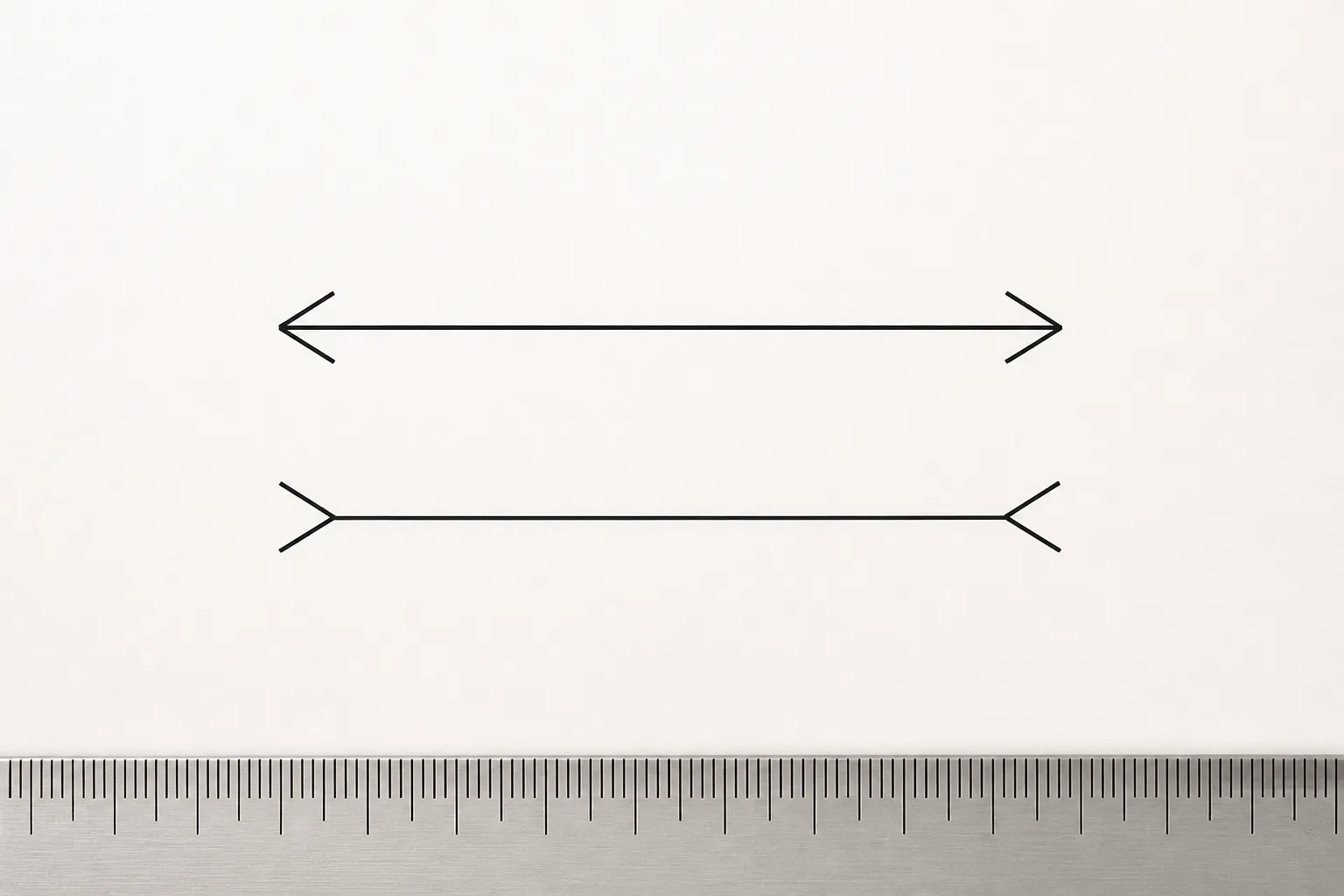
Here is the part that should bother you. Knowing the answer does not fix the picture. Grab a ruler, confirm the lines match, then look again. They still look unequal. The Illusions Index treats this as a sign of how the visual system is organized in separate modules. What you know does not reach what you see.
Where the Illusion Came From
The illusion is named for Franz Carl Müller-Lyer, a German psychiatrist and sociologist. According to the Illusions Index, he first published it in 1889 in a German physiology journal. It has been a staple of psychology ever since.
Three main explanations have been proposed. The first is misapplied size constancy. The arrowheads act as depth cues, so the outward-fin line seems farther away, and the brain scales it up. The second is conflicting cues. The overall shape of the outward-fin line simply makes it look longer. The third is confusion about the distance between the tips, which bends the judgment of length.
A 2005 PNAS paper by Howe and Purves took a different route. They argued the illusion reflects probabilistic visual processing, based on the statistics of the physical sources that could have produced a given retinal image. In plain terms, the brain bets on the most likely real-world cause. The sources I have do not say which of these explanations scientists now consider correct.
The 1960s Culture Story
In the 1960s, work by Segall and colleagues, published in 1966, argued something striking. People raised in non-carpentered environments did not fall for the illusion. Only people in Western, carpentered worlds saw the line as longer, as one replication update summarizes it.
The mechanism sounded sensible. Grow up among right angles, straight edges and boxy rooms, and your brain learns to read those corners as depth. The illusion becomes a habit of seeing, not a fact about human vision. That tale spread widely, and it is easy to see why. It is tidy, and it flatters the idea that culture shapes perception.
One caution. The sources I have do not give the full methods or sample sizes of the 1966 study. A claim that famous deserved plenty of paperwork, and the paperwork is thin.
Why the Story Is Now Disputed
In 2025, Dorsa Amir and Chaz Firestone published a paper in Psychological Review arguing against the cultural explanation, as described by Sciencing. They reviewed the original case studies and found substantial flaws. Later reports, the coverage says, often misconstrued what those studies had actually found. The legend grew by retelling.
Their argument has several strands, listed in the replication update:
- The illusion appears in non-human animals.
- It is captured by statistics of natural scenes.
- It does not require straight lines.
- It occurs in other senses.
- It arises in congenitally blind subjects.
The straight-line point is awkward for the carpentry camp. If childhood exposure to straight edges were the engine, versions without straight lines should fizzle. According to Amir and Firestone, they do not. The same replication update says the cultural difference is probably not replicable, so treat it as a claim, not settled fact.
The Ebbinghaus illusion shows a related quirk of size judgment. One center dot is ringed either by six large dots or by eight small ones. The center dots are the same size, per the Sciencing report, yet context changes how big they seem.
People Who Gained Sight
One of the most interesting strands concerns people who were born blind and later gained sight. Amir and Firestone point to the illusion arising in congenitally blind subjects, according to the replication update. If so, years of seeing boxy buildings cannot be the whole story.
Be careful here. The sources do not give participant counts or detailed results, so read this as a direction, not a measurement. Still, it hints that some size judgments may not depend on a lifetime of visual schooling.
What Remains Unsettled
No source I have names a winner among the competing explanations. The effect size also varies from study to study, presumably because of different experimental conditions, and the sources give no exact figures in centimeters or percentages. Researchers at the Max Planck Institute for Human Development are asking whether the physical environment, such as trees, parks and building height, changes how people experience illusions like this one. The sources do not say whether that work has reported results yet.
The Max Planck group also describes illusions as clues to how perception works, not as faults in the brain. That is a useful way to hold the whole story. A splashy claim, such as an entire population being immune to a famous trick, can last for decades on repetition alone. Ask whether the original case studies were reported accurately. Unlike your eyes, that habit can be trained.