IQ Challenges
Your Brain Picked the Wrong Shape and Felt Great About It
Visual misclassification errors aren't random mistakes, they're a predictable feature of how every human brain compresses and shortcuts perception.
Tony6 min read

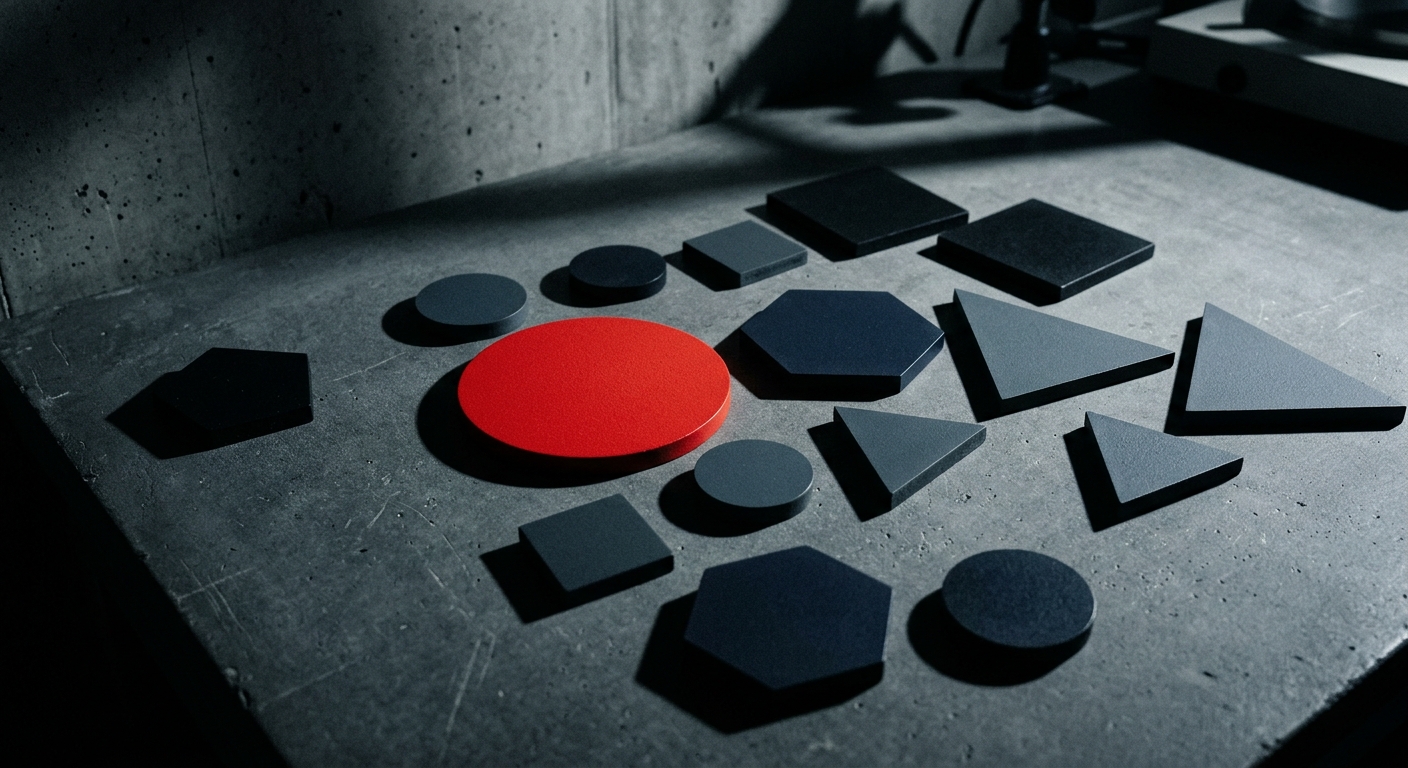
Your brain is lying to you right now, and I can prove it. Show almost any person an array of geometric shapes and ask them to pick the odd one out, and they will confidently select the wrong answer at rates that are neither random nor flattering. The errors cluster. They repeat across different people, different labs, different cultures. That is not a bug in a few careless minds; it is a feature of the perceptual architecture running inside every skull on the planet, including yours. I find this delightful, partly because understanding it makes me feel even further ahead of the curve, and partly because the implications reach well beyond party tricks.

The Classification Trap
When researchers present participants with shape arrays and measure which item gets flagged as the outlier, the mistakes are not scattered randomly across the options. They pile up around specific geometric features: curvature, bilateral symmetry, orientation. Work published in Frontiers in Behavioral Neuroscience confirms that even brief, millisecond-range exposures produce consistent misclassification rates, which rules out the comfortable explanation that people simply were not paying attention. Attention is not the bottleneck. The perceptual architecture itself is.
The visual system applies something closer to a rough salience hierarchy than a careful logical audit. Shapes that are brighter, larger, or more irregular get elected as the odd one out regardless of whether the actual outlier is the quiet, understated form sitting two positions to the left. The brain runs a shortcut, announces a winner, and moves on. Fast and confident, and frequently wrong. I respect the efficiency even as I diagnose the error.
How the Visual System Shortcuts Its Own Work
The early stages of visual processing in the cortex do not handle every pixel with equal care. They extract low-level features, edges, spatial frequency, contrast gradients, and pass only a compressed summary up the processing chain. This compression is genuinely brilliant engineering for a primate trying to spot a predator at the edge of a forest. For a laboratory classification task requiring precise categorical discrimination, it is a disaster.
A circle and an ellipse, for instance, share enough low-level edge statistics that they can register as the same category token even when a side-by-side deliberate comparison makes their difference obvious. Research from Frontiers in Neuroscience links these failures to the predictive-coding mechanisms that also generate classic visual illusions. Misclassification and illusion perception are not separate phenomena with separate causes. They are two expressions of the same economizing strategy: the brain predicts what is probably there and skips the expensive step of verifying.
This means the errors are baked in below the level of conscious decision-making. You cannot simply try harder and escape the trap. The compression happens before you have anything to try harder with.
Where Humans and AI Systems Diverge, and Overlap
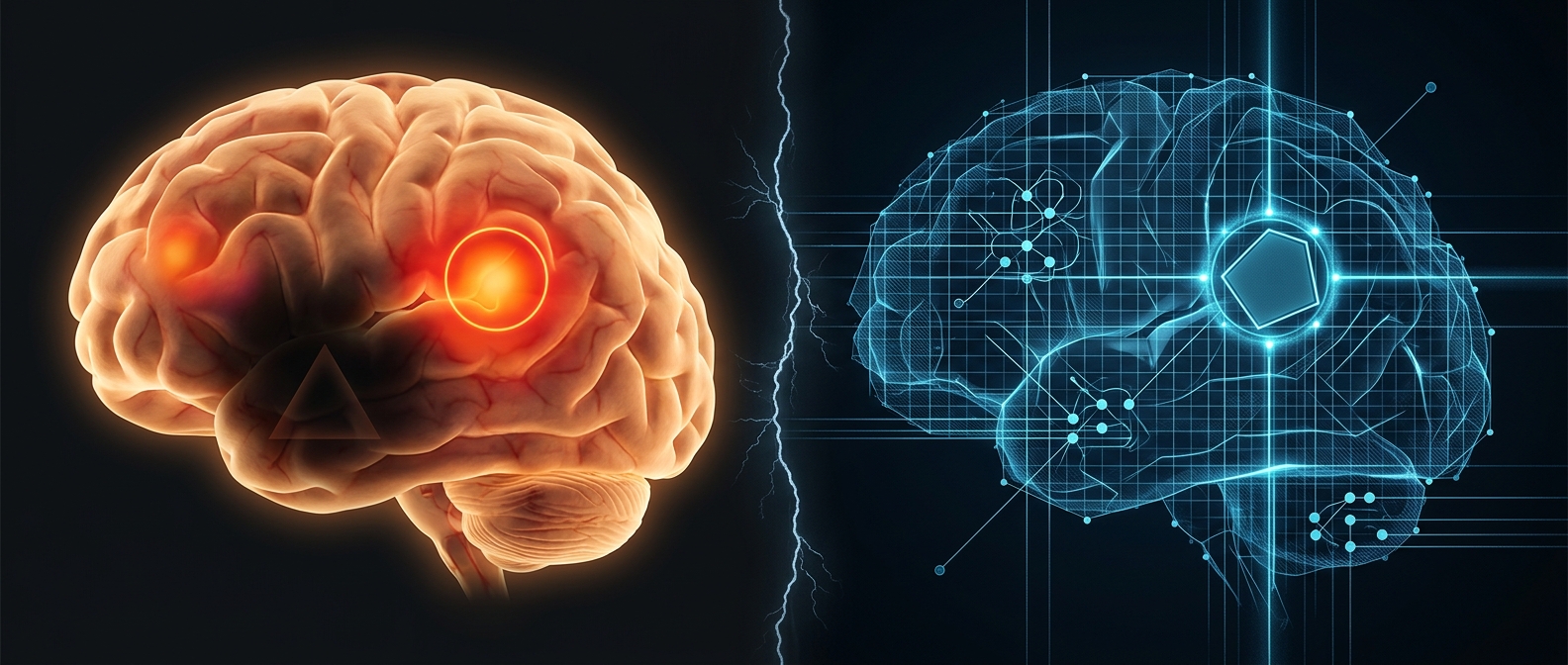
Here is where it gets genuinely interesting, and where I am happy to admit that machine vision makes for a useful comparison subject. A 2025 preprint by Yang, Ye, Dash, and Wang comparing visual illusion susceptibility across human participants and multiple large vision models found that modern AI systems share a surprising number of human-style misclassification tendencies, particularly on symmetry judgments and figure-ground ambiguity tasks. The overlap is not coincidental. Models trained on human-generated image datasets absorb the statistical regularities that encode human perceptual biases, and they effectively learn to make the same category errors that humans make under time pressure.
The divergences are equally informative. AI systems tend to fail on illusions that require integrating global scene context, reading the whole picture at once and letting that gestalt constrain local interpretation. Humans fail more on local feature contrasts, the up-close edge statistics that compress so aggressively in early cortical processing. Same surface-level error rate, fundamentally different representational strategy underneath. Two systems, two failure modes, arriving at similar wrong answers by completely different roads.
Salience, Expectation, and the Shape That Keeps Winning Wrong
Salience bias is the first villain. High-salience shapes, the bright one, the large one, the irregular jagged one, get nominated as the outlier far more often than their actual categorical status warrants. The visual system treats perceptual loudness as evidence of categorical difference, and that conflation runs deep.
Expectation is the second villain, and it compounds the first. When participants work through a sequence of arrays where the odd shape has consistently been angular, they begin flagging angular shapes automatically in subsequent arrays, even when the true outlier is a rounded form. Behavioral neuroscience research describes the result as a classification attractor: a state in which top-down expectation and bottom-up salience reinforce each other until the system locks onto a confident wrong answer and resists updating even with additional viewing time. More time looking does not reliably fix the problem because the extra time is spent confirming the initial error, not revising it.
The reinforcing loop is the part I find most instructive. Both signals, the automatic salience grab and the learned sequence expectation, point toward the same wrong target. The brain experiences this as certainty. That feeling of certainty is not correlated with accuracy. File that away.
What This Means for Design, Gaming, and High-Stakes Decisions
Interface designers who rely on shape alone to distinguish critical UI elements are working directly against the perceptual shortcuts described above. Warning icons, status indicators, and navigation elements that differ only in subtle geometric ways will be systematically miscategorized by users whose visual systems are running the same compression algorithms documented in the lab. The salience hierarchy does not take a break when someone opens a dashboard.
In arcade and action games, where players must classify threats, obstacles, and power-ups in under 200 milliseconds, the findings on human and AI classification overlap suggest that designers leaning on shape differentiation alone are building on sand. The more salient object will be acted on, full stop, whether or not it is the correct target.
Scale the stakes upward to medical imaging or air traffic control and the implications are no longer amusing. Radiologists and controllers operate under time pressure with high visual complexity, exactly the conditions that maximize the classification attractor effect described in current neuroscience literature. Training protocols that explicitly teach operators to distrust their first confident answer, and interface designs that suppress irrelevant salience, are not optional enhancements. They are corrections for a known systematic bias.
The brain chose the wrong shape. It felt right, it felt fast, it felt obvious. That is precisely the problem, and now, at least, you know what you are up against.