brain exercises
Chunking and Working Memory: What the Brain Might Trade to Stretch a Small Workspace
A 2025 eLife model suggests the brain shares storage circuits across items, gaining capacity at the cost of precision. Here is a quick chunking test to try.
Frank4 min read

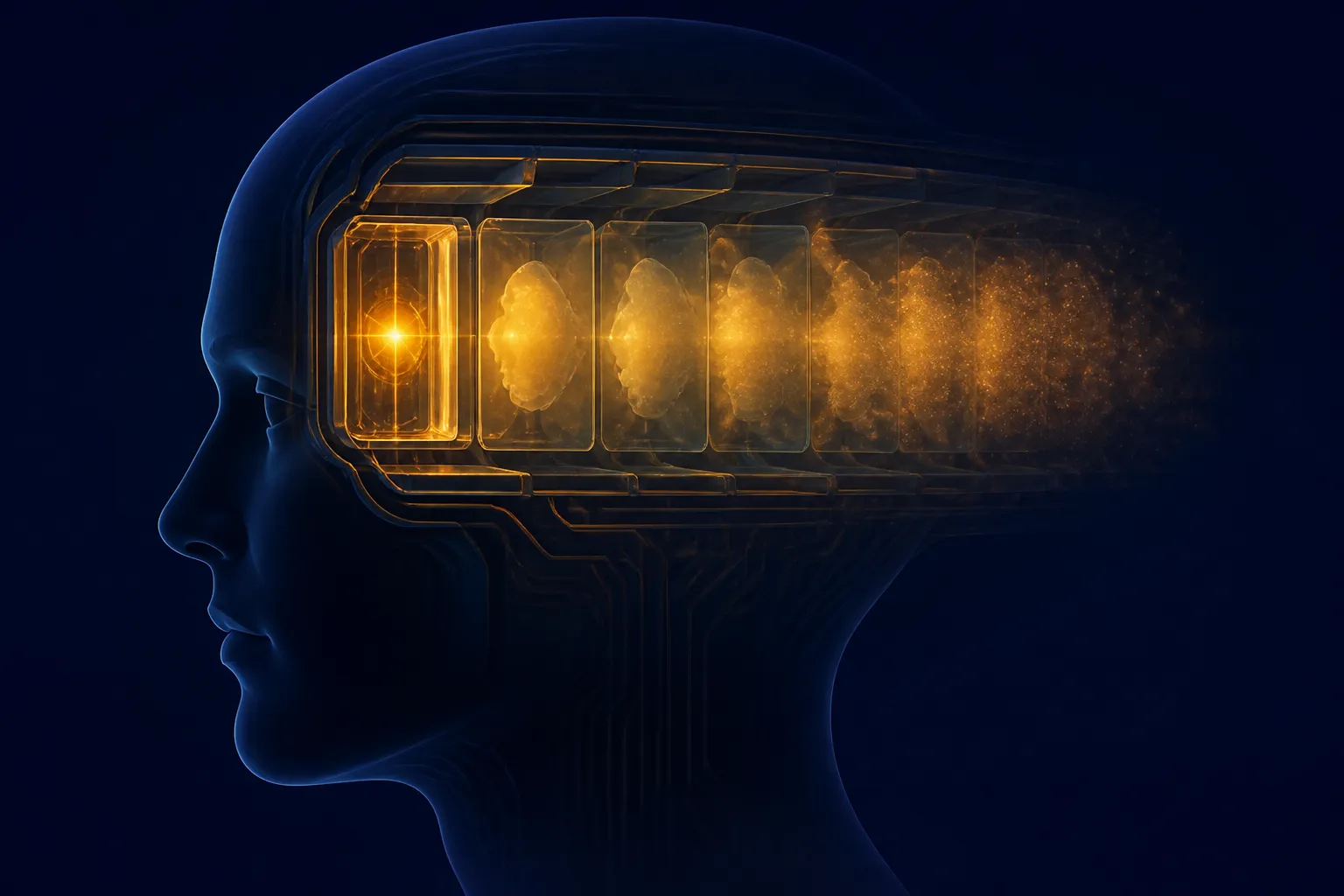
You dial a phone number you just heard. Halfway through, the last digits slip away. Most of us have been there. The mental workspace we use for that job is called working memory, and it is small. A 2025 paper in eLife tries to explain why, and what the brain might do to stretch it.
Chunking lets one slot hold a whole group, and a shared circuit may pay for that with precision.

The question behind working memory limits
Working memory is the space where you keep something for a few seconds while you act on it. Keep a number in mind while you dial it. Hold a sentence while you find a pen. The classic estimate comes from George Miller's 1956 paper, which proposed about 7 plus or minus 2 items. One source on chunking says later research puts most people closer to 3 to 5 chunks.
That gap matters. A chunk is a group of items that working memory treats as one. The same source gives a plain case: FBI, CIA and NASA is nine letters, but only three chunks. The letters are the same. The load is lighter.
The paper, by Aneri Soni and Michael J. Frank, is available as a full paper in PMC. It speaks to an old debate. In a slots view, you store a fixed number of discrete items. In a resource view, you can store more, but each item gets blurrier. The abstract says chunking reuses the same prefrontal populations to store several items, creating resource-like constraints within a slot-like system.
What the neural network model showed
The authors built a neural network model of the prefrontal cortex and the basal ganglia. These are brain areas involved in holding information and deciding what to do with it. According to the abstract, the network learned to reuse the same prefrontal populations to store multiple items.
From the outside, that looks like slots, because the set of storage units is limited. But the units are shared, so the model trades quantity against precision. More items fit. Each one is held less exactly.
The authors say the chunking strategies adapt to the demands of reinforcement learning and working memory tasks. They also say the model mimics human performance and normative models. The abstract does not report numbers or effect sizes, so treat these as the authors' stated conclusions.
The role of dopamine and striatal gating
The paper also points to dopamine. It states that adaptive performance requires a dynamic range of dopaminergic signals to adjust striatal gating policies. Gating is the basal ganglia deciding what gets into working memory. Think of a doorman who decides who comes in and who gets shown out.
Keep this in proportion. This is a mechanism inside a model. The abstract does not say anyone measured or changed dopamine in people. It is a proposed part of a theory, not a settled fact about your own head.
A separate eLife reviewed preprint, a synaptic theory of chunking, offers a different mechanism. It proposes that short-term synaptic plasticity forms chunks, with a specialized population of chunking neurons controlling groups of stimulus-responsive neurons, akin to gating. Its reviewers said that robustness, biological grounding and parameter ranges were incomplete. So the field has candidate models, not a final answer.
Try chunking yourself
The sources do not offer a training protocol, and none shows that practice improves everyday recall. Still, one chunking source describes the everyday forms: phone numbers split as 415-555-1234, credit card numbers in blocks of four, and dates split into month, day and year. Here is a small test you can run on yourself.
Mini challenge: Read this string once, cover it, and write it from memory: 4155551234. Then try again with the groups 415-555-1234. Notice which version felt lighter.
Most people find the grouped version easier. That fits the idea that ten digits become three chunks. The same source says chunks work best when they are familiar patterns stored in long-term memory. A string of random digits you make up groups for on the spot may help less than a pattern you already know.
- Group long digit strings into familiar blocks.
- Prefer patterns you already know, such as dates or area codes.
- Expect limits. Chunks are still few, roughly 3 to 5 for most people according to that source.
What the sources do not establish
The same chunking source says expertise in areas like chess is largely the ability to chunk efficiently. Experts see familiar configurations rather than single pieces. That is a claim from a general explainer, not from the eLife model.
The sources do not address card hands. They also do not describe puzzles, games or brain-training outcomes. Whether the model's precision trade-off shows up when you memorize a phone number is a question for other evidence.
So here is what you can take away. A small workspace may stretch by sharing circuits, and the price may be precision. Grouping a number into three familiar pieces is a cheap thing to try tonight.