memory
Why You Remember Someone Bakes Bread but Forget Their Last Name Is Baker
The Baker/baker paradox reveals that your brain isn't failing when names slip away, it's ruthlessly prioritizing meaning over arbitrary labels.
Tony6 min read

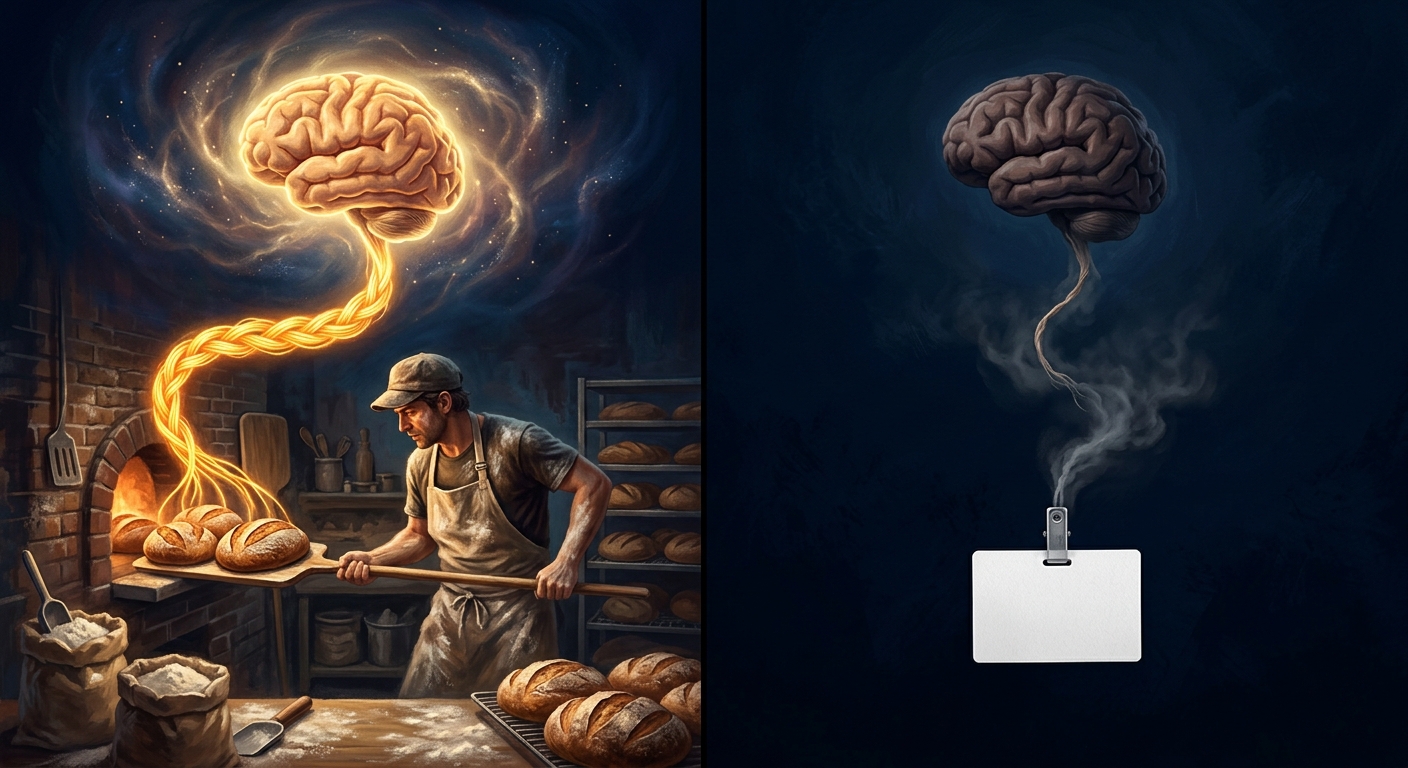
Here is something that will make you feel slightly better about blanking on your coworker's last name at the holiday party: your brain is not malfunctioning. It is, in fact, operating with a cold, almost insulting efficiency. The Baker/baker paradox is the psychological phenomenon that explains exactly why you can remember a stranger bakes sourdough for a living but cannot, for the life of you, recall that their surname is Baker, even though those two words are phonetically the same sound wave hitting the same pair of ears.
"The Baker/baker paradox is a psychological phenomenon whereby it is easier to remember something about a person, e.g. their occupation, than to remember their name, even if the occupation in question is baker and the name is Baker." Quite Interesting
The Paradox in Plain Terms
Let me spell this out because the paradox is deceptively simple and most people blow past the interesting part. Two people walk into a room. You learn that person A bakes bread professionally. You learn that person B has the surname Baker. A week later, you remember the first fact and not the second. The information is, acoustically, identical. The memory outcome is not even close. That gap is the paradox, and it is not a rounding error. It is a feature of how the human brain actually works.
The Shortform summary of Joshua Foer's Moonwalking with Einstein traces the paradox's popularization in mainstream memory literature, noting that Foer used it to illustrate a core argument: memory is not a recording device. The same sound, attached to different kinds of meaning, produces dramatically different rates of recall. If that does not make you question every assumption you hold about your own mind, I am not sure what will.
Why Occupations Stick and Names Slip
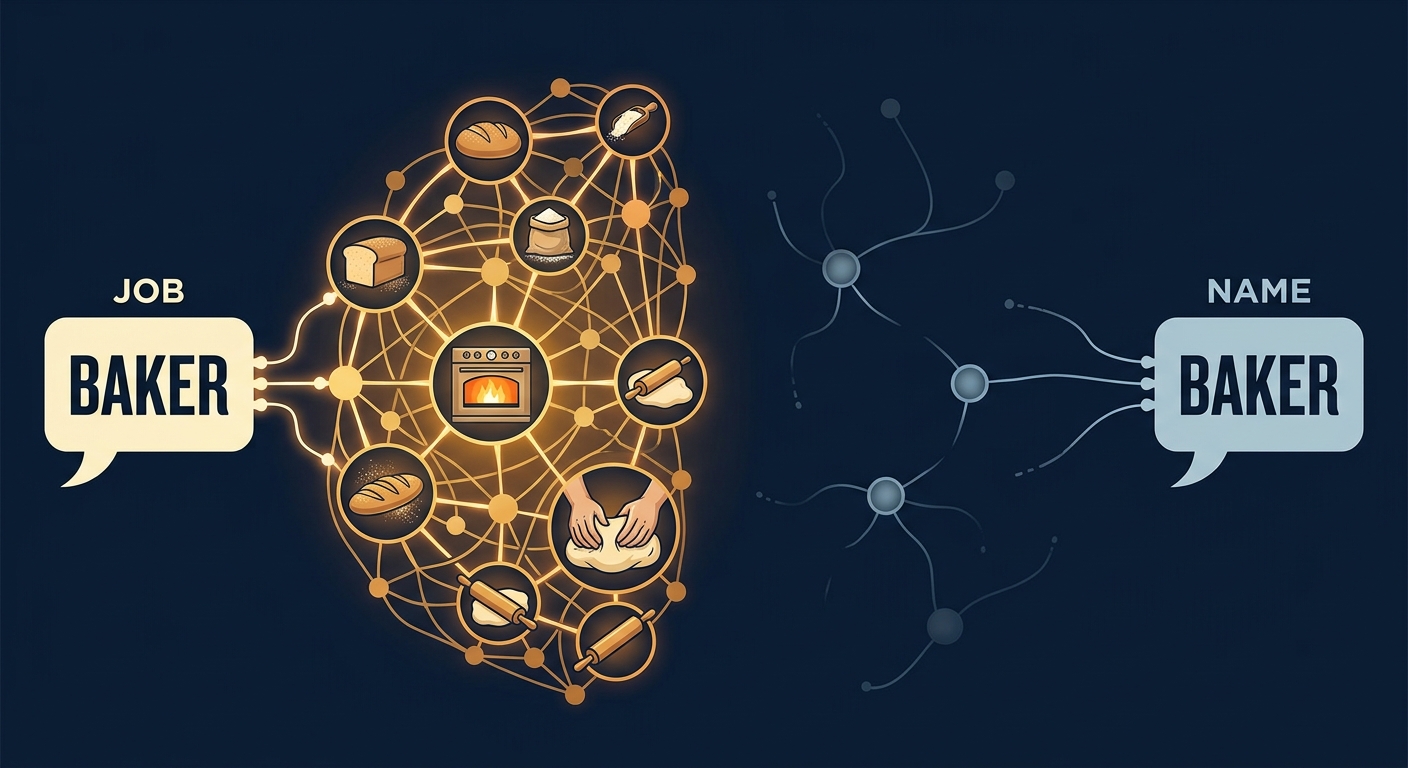
When you hear that someone bakes bread for a living, your brain does not politely file the fact under B and move on. It immediately starts cross-referencing. Warm loaves. Flour on a countertop. The specific way a bakery smells at six in the morning. Maybe a grandmother's kitchen. Each one of those associations is a hook, and hooks are what keep a memory from drifting away. Cognitive psychologists call this elaborative encoding: the process by which incoming information gets woven into a pre-existing network of sensory detail, emotion, and related concept.
A surname like Baker carries none of that. In a modern context, it is an arbitrary label. The word once meant something, back when surnames were still being minted from trades and characteristics, but centuries of use as a mere identifier have drained it dry. There is no smell attached to the name Baker. No image. No story. The brain reaches for a hook and finds a smooth wall, so the word floats loose and is gone within hours. Shortform's breakdown of the paradox puts it clearly: because our memories are so visual and associative, information linked to vivid cues simply sticks harder.
The Neuroscience of Rich Association
This is where things get genuinely interesting, not just philosophically tidy. Modern neuroimaging research shows that when a person processes semantically rich information, wide networks of cortical regions activate at the same time. That distributed activation is not noise. It correlates directly with stronger, more durable memory traces. The more of your brain that lights up during encoding, the more of your brain you can recruit during retrieval.
Surnames that were once common nouns have lost their semantic richness over generations of use as labels. They activate far fewer associative networks and therefore leave a shallower imprint. The hippocampus, which is central to forming new episodic memories, appears to bind information more robustly when it can link incoming data to existing conceptual frameworks. In plain terms: the brain builds new memories on top of old ones, and anything that arrives without existing architecture underneath it is structurally fragile. Baker the occupation arrives with an entire building already in place. Baker the surname arrives as a single loose brick on bare ground.
Practical Lessons for Everyday Memory
Now here is the part that is actually useful, and this is where competitive memorizers figured out something the rest of the population has been ignoring. The fix for forgetting the name Baker is not to repeat it fifteen times during the conversation like a self-help audiobook told you to do. It is to manufacture the associations that the brain would have built automatically if Baker had arrived as an occupation instead of a label.
Mnemonists recommend a specific maneuver: picture the person whose surname is Baker sliding a golden baguette out of a stone oven, perhaps wearing a ridiculous apron, perhaps in an absurd setting. You are not trying to be logical. You are trying to be vivid. That image converts the arbitrary name into the kind of rich, contextual, sensory event that the word baker triggers on its own when it carries occupational meaning. According to the Foer-derived framework at Shortform, this is exactly the mechanism behind techniques that competitive memorizers have used for centuries. None of them are cheating. All of them are just doing manually what the brain does automatically when information arrives with context already attached.
Educators have taken similar notes. The shift away from rote repetition toward narrative-based and analogy-driven instruction is not a pedagogical trend. It is an application of elaborative encoding at scale. You embed the concept inside a story, an analogy, a hands-on experience, anything that gives the new fact a lattice to cling to, because without that lattice the fact is gone before the semester is over.
Broader Implications for How We Understand Memory Itself
The Baker/baker paradox is quietly corrosive to several things people believe about themselves. First, it challenges the idea that forgetting is a sign of low intelligence or inattention. The brain is not failing when a name slips away after a handshake. It is following a completely rational prioritization strategy: preserve what is richly connected, discard what is isolated. That is not stupidity. That is triage, and it is extraordinarily efficient.
Second, it reframes the social embarrassment of forgetting someone's name. Names are structurally impoverished pieces of information. They carry less meaning per syllable than almost any other category of fact you might learn about a person. Compared to an occupation, a physical detail, a biographical anecdote, or even a strong opinion about pizza toppings, a surname is almost informationally empty. The brain is doing exactly what evolution designed it to do when that name evaporates. The embarrassment is a social convention built on top of a biological reality, and the biological reality wins every time.
The deeper lesson is about the constructive nature of memory itself. The mind does not store facts the way a hard drive stores files, discrete and retrievable on demand. It rebuilds them each time from a lattice of meaning, sensory association, and emotional context. Anything that arrives without its own lattice, a name, a number, an isolated statistic, is at serious risk of being lost. That is not a bug. That is the entire architecture. Once you understand it, you stop fighting the architecture and start building better lattices. Which, for the record, is what I have been doing since before most people knew the paradox had a name.