brain exercises
Why Daily Puzzle Games Have Become a Genuinely Durable Habit
The design behind five-minute daily games is smarter than it looks, and the reasons people keep coming back have little to do with addiction.
Frank6 min read


Somewhere between the morning alarm and the first cup of coffee, millions of people are solving the same puzzle. Not because a game company has trapped them in a dopamine loop, but because a five-minute word grid or logic challenge has become a genuine ritual. Daily puzzle games have quietly turned into one of gaming's most durable habits, and the reasons why are more interesting than the obvious "it's addictive" explanation.
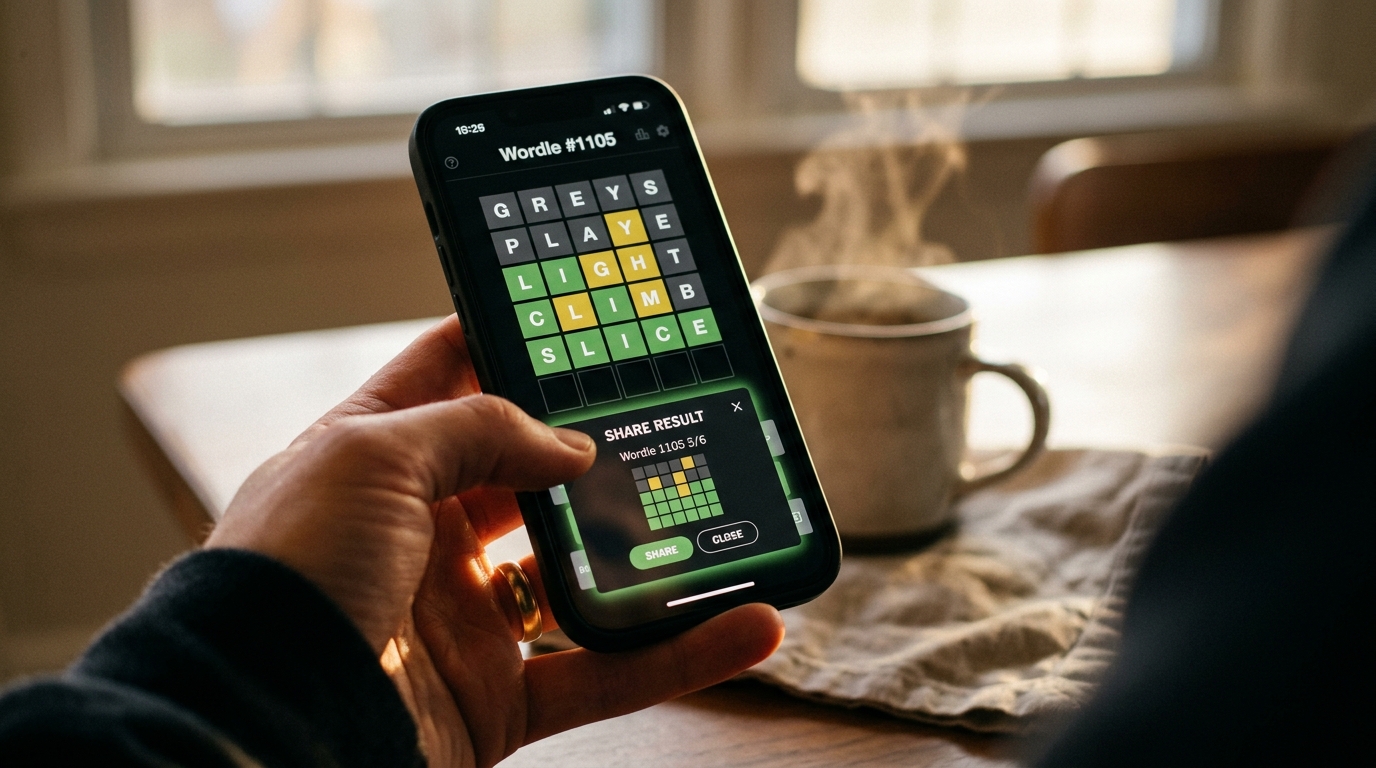
The Daily Puzzle Habit and Why It Sticks
Most game design is built around keeping you playing as long as possible. Daily puzzle games do the opposite. They impose a hard cap, usually one puzzle per day, and that constraint is exactly what makes the habit sustainable. You can't binge. There's nothing to binge. You finish, you're done, and you come back tomorrow. That structure eliminates the guilt that follows a three-hour gaming session and replaces it with something closer to the satisfaction of a completed crossword in a newspaper.
The streak mechanic deserves real credit here. Wordle made it famous, and dozens of successors have carried it forward. A streak works on loss-aversion, but it doesn't feel manipulative the way most loss-aversion design does, because the commitment it's asking for is genuinely small. You're not being told to log in for two hours to keep your progress. You're being nudged to spend four minutes so you don't break a 47-day run. That's a reasonable ask, and players recognize it as such.
The social layer matters too. A shareable result card, those colored squares you've seen plastered across every social platform, functions as organic advertising that no marketing budget could fully replicate. A player broadcasts their performance, a friend gets curious, the friend downloads the game. Room Escape Artist's daily puzzle recommendations guide covers a genre that now spans word games, logic grids, spatial reasoning challenges, and hybrid formats, which means the shareability spreads across very different audiences. One person's Wordle screenshot pulls in a word nerd. Another person's spatial puzzle result card hooks an engineer.
The Mobile Ecosystem Powering Daily Play
Phones won this category for a simple reason: they're already in your hand during the two moments most people reach for a quick game. The morning commute and the pre-sleep wind-down are both dead time that a five-minute puzzle fills precisely. A browser game can do this too, but a mobile app with a home screen icon integrates into the rhythm of a day in a way a bookmark never quite manages.
FoxData's roundup of the best puzzle mobile games for 2025 notes that the top-charting titles in this category consistently emphasize short session design and accessibility-first interfaces. The tutorial is quick. The game doesn't punish you for setting it down mid-session. You can pick it up on the bus, get interrupted at your stop, and finish it at lunch without losing any state. That flexibility is not accidental design; it's the entire product strategy.
Push notifications, when handled well, act as a gentle tap on the shoulder rather than aggressive re-engagement spam. The daily puzzle games that have earned lasting audiences treat notification permission as a privilege. They're reminding you that a new puzzle is ready, not manufacturing artificial urgency about expiring rewards. That tone difference is small in words and enormous in how players feel about the product six months in.
Revenue models in this space have also grown up. The daily puzzle itself tends to stay free. Monetization runs through cosmetic themes, hint bundles, or archive access to past puzzles. That structure keeps the core ritual frictionless while giving engaged players something worth paying for. It's a cleaner value exchange than a paywall on the very thing that made someone download the app in the first place.
Curation and Discovery in a Crowded Field
There are hundreds of daily puzzle games available across browsers, iOS, and Android right now. Curation has become nearly as valuable as the games themselves. Specialist sites have stepped into this role by applying genuine critical standards rather than just republishing download charts. Room Escape Artist, which built its reputation reviewing physical escape rooms with rigor and wit, has brought that same framework to digital daily puzzles. Their guide organizes titles by cognitive category, word, logic, spatial, and hybrid, so a reader can quickly find a format that matches how they actually like to think rather than scrolling through a generic top-ten list.
That category-first framing is more useful than it might sound. A person who loves the feel of a crossword and a person who prefers a nonogram are not looking for the same daily ritual, even though both might describe themselves as puzzle fans. A list that treats all puzzle games as interchangeable serves neither of them well.
The data perspective from FoxData's app-marketing research adds something the enthusiast lens can miss: which games are actually gaining downloads and positive reviews in 2025, versus which ones are coasting on viral momentum from three years ago. That distinction matters when you're committing to a daily habit. A game with a shrinking player base is a game whose developer may stop updating it. The convergence of enthusiast curation and download analytics gives players better guidance than either source provides alone.
Design Principles Behind the Best Daily Puzzles
The games that last share a quality designers call elegant constraint. The rules fit on a single screen of explanation. The solution space is narrow enough to feel tractable. And yet the path to the answer offers a genuine moment of surprise or discovery. That combination is harder to engineer than it sounds. A puzzle that's too open-ended feels arbitrary. A puzzle that's too mechanical feels like busywork. The sweet spot is a small world with real depth.
Difficulty calibration is the persistent design headache. A daily puzzle has to satisfy the player on day three hundred of their streak and the person who downloaded the app an hour ago after seeing a friend's share card. Many of the best titles handle this with optional hard modes or supplemental daily challenges layered on top of the standard puzzle. The core ritual stays accessible. The harder variant keeps the veteran engaged. Both players get a result card worth sharing.
Room Escape Artist's critical framing treats fairness as a non-negotiable quality marker. A puzzle that can only be solved by guessing rather than by reasoning is a design failure, regardless of how polished the interface looks. That standard filters out a significant portion of the market. Plenty of daily puzzle games lean on randomness or unclear logic because it creates controversy and discussion online. Fair puzzles that reward careful thinking are rarer, and that's exactly why the curation sites that identify them have built loyal audiences.
Looking ahead, several studios appearing in FoxData's 2025 rankings are experimenting with AI-generated daily puzzles that scale difficulty per player. The technical ambition is real. The risk is also real. Part of what makes the daily puzzle social is the shared experience. Everyone solved the same Wordle today. Everyone got stuck in the same place or sailed through the same shortcut. If the puzzle adapts to each player, that common thread disappears. Whether the personalization gain outweighs the community loss is a genuinely open question, and the answer will probably vary by format. A word puzzle may need the shared experience more than a spatial reasoning challenge does.
For now, the genre is in a strong place. The habits are real, the design is improving, and the curation is getting better. If you haven't found your daily puzzle yet, the gap between you and one is smaller than it's ever been.