brain power
Interleaving vs. Blocking: What the Evidence Says and How to Test It Yourself
Mixing topics in one session feels harder than studying them one at a time. Here is what research suggests, where it runs thin, and a one-week test you can run.
Charlie4 min read


Picture two students with the same twelve pages of math problems. One does all the addition, then all the subtraction, then all the division. The other shuffles them together. The first student feels smooth and confident. The second feels slightly lost. Research suggests the second student may remember more weeks later.
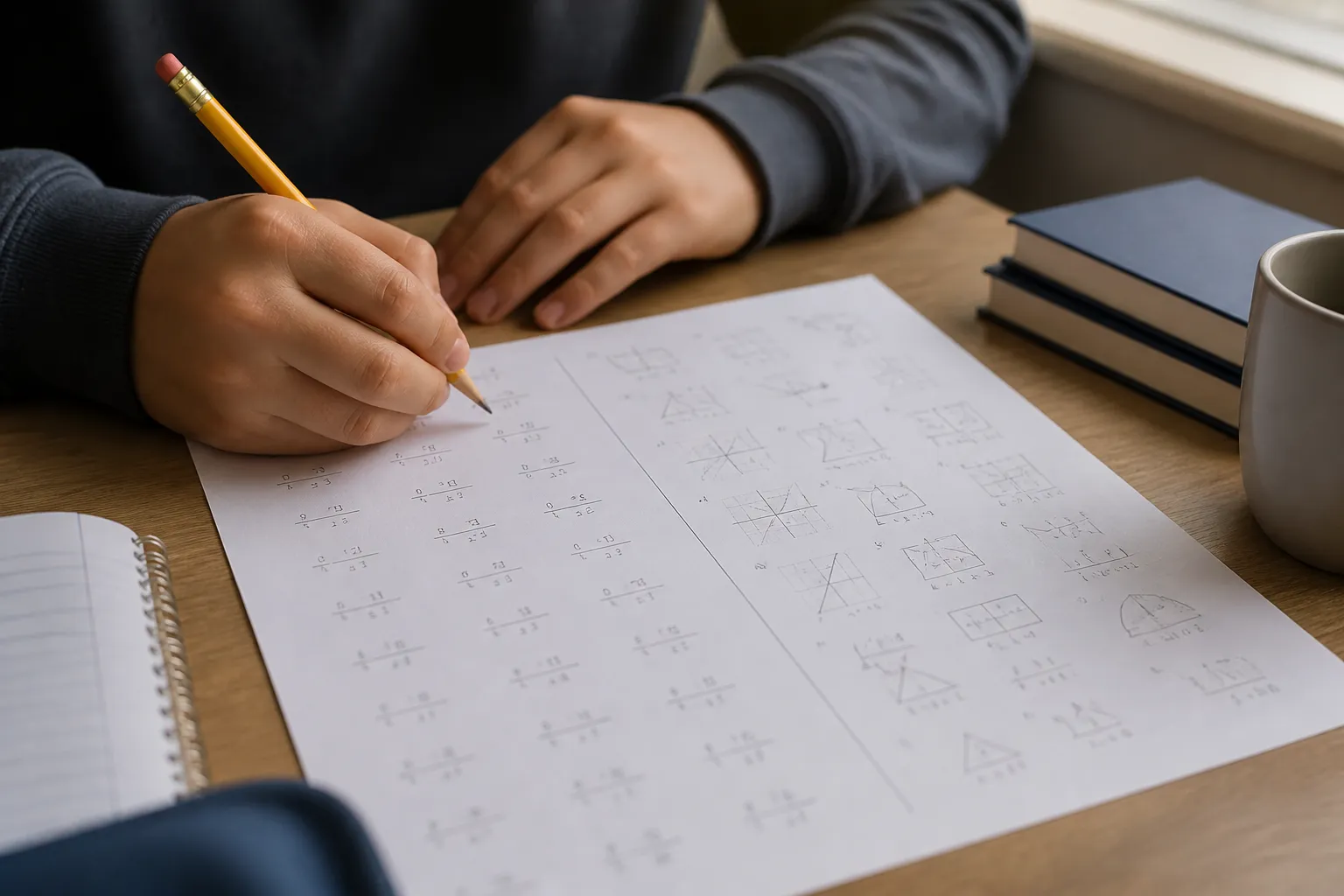
Two Ways to Arrange the Same Material
Blocked practice means studying one topic thoroughly before moving to the next. Interleaving means mixing different kinds of problems or topics within a single session [3]. The content is identical. Only the order changes.
To interleave, you pick several topics and spread them through your sessions. You cycle back to each one, and you may change the order and your strategies along the way [7]. Teachers use the same idea with mixed problem sets, vocabulary words, or flashcards. One example is blending addition, subtraction, multiplication and division in a single worksheet [5].
What the Evidence Shows
The Learning Scientists podcast describes interleaving as improving long-term learning compared with blocking the same topic [4]. Another source lists benefits for categorization, problem solving, long-term retention, and transfer to new situations [7].
The Visible Learning database puts numbers on it. It lists 3 meta-analyses, 180 studies, 9,438 students and 374 effects for interleaved practice. The weighted mean effect size is 0.46. The three individual meta-analyses report 0.47, 0.42 and 0.59 [3]. That is a summary from one database, and I have not checked it independently. Treat it as a sign of direction, not a guarantee.
One source goes further and says interleaving can increase, even double, student learning [5]. That is a strong claim. Your own results may be smaller.
Much of the research has focused on motor skills, and more recently on maths and music [4]. Detailed results for adults studying alone are thinner.
Why It Feels Worse and Works Better
Interleaving is harder than blocking. Each attempt differs from the last, so you cannot lean on a rote answer sitting in short-term memory. You have to retrieve the right method from scratch [7]. That effort feels worse in the moment but tends to give better long-term results.
It may also teach you to tell concepts apart. When problems arrive mixed, you must decide which strategy fits before you can solve anything [4]. Blocked practice hands you that decision for free.
One practical point: interleaving requires no extra prep, class time or grading for a teacher [6]. You just reorder what you already have.
Where the IES Grant Fits
An IES grant called "Optimizing Resistance to Forgetting" sometimes comes up in these talks. The page lists a 2004 to 2008 award of $924,935 to the University of California, San Diego, with Harold Pashler as principal investigator. It describes 10 cognitive experiments, including one with a 30-day retention interval [1].
It tests spacing, testing versus re-presenting material, discovery learning, and feedback timing [1]. The excerpt reports no results. It also does not name interleaving or blocking. So it cannot be cited as proof for either one. The evidence above has to carry that weight.
Try It Tonight
Pick two or three related topics. Maybe three kinds of physics problems, or verb tenses in a language you are learning. Then run this small test.
- Spend 20 minutes on topic A, then 20 on topic B, then 20 on topic C. Note how easy it felt.
- The next day, take three new topics of similar difficulty. Do a few problems of A, then B, then C, and cycle back. Repeat for 60 minutes.
- One week later, quiz yourself on both sets without notes. Compare the scores.
One caution. Do not drop a topic just because it gets hard. Give each one enough time for deeper understanding [7]. This is a single trial on you, not a controlled study, so read the result loosely.

Red Flags and Open Questions
Choose topics that are related in some way, since that appears most beneficial [7]. Mixing completely unrelated subjects is not supported, though how related is related enough is not yet known [4].
Ask yourself a few questions. Are my topics close enough to be confusable with each other? Am I giving each enough time? Am I switching only to dodge a hard one?
Also remember that practicing a skill is not the same as learning it [6]. The sources do not give a clear schedule for a given subject or age group. They also do not detail how interleaving interacts with spacing or retrieval practice, which one source calls the most important strategies [5]. Start small, and keep what holds up.