IQ Challenges
What a Rotating Cube Puzzle Reveals About Your Sense of Direction
Mental rotation and navigation draw on the same cognitive machinery, and a simple cube problem can show you exactly where yours breaks down.
Frank6 min read

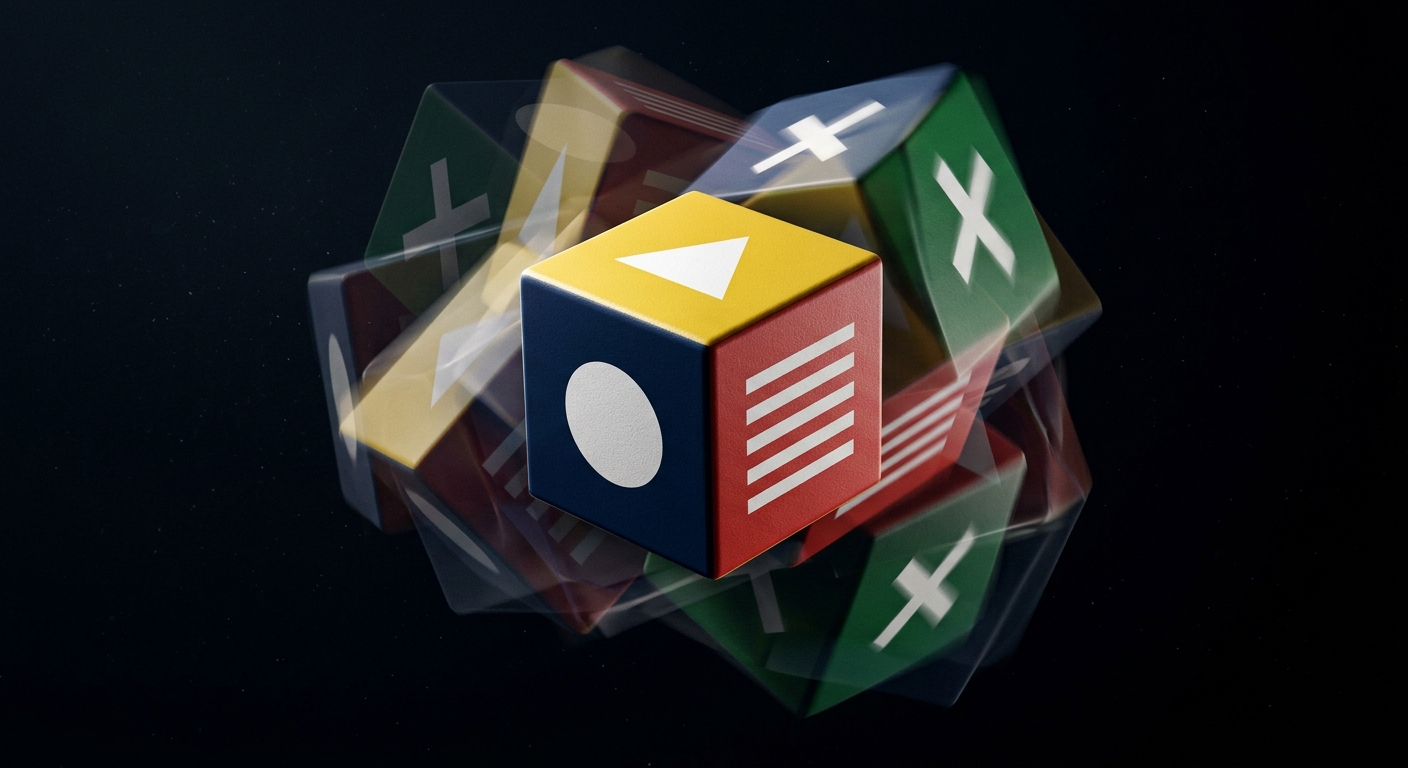
Most people assume navigation is a matter of paying attention. Either you notice landmarks or you don't. Either you have a good sense of direction or you were born without one. That story is too simple. Research on spatial cognition points to something more specific: the ability to mentally rotate objects predicts how well you move through the world, and a simple cube problem can expose where you stand.
What the Rotating Cube Problem Actually Tests
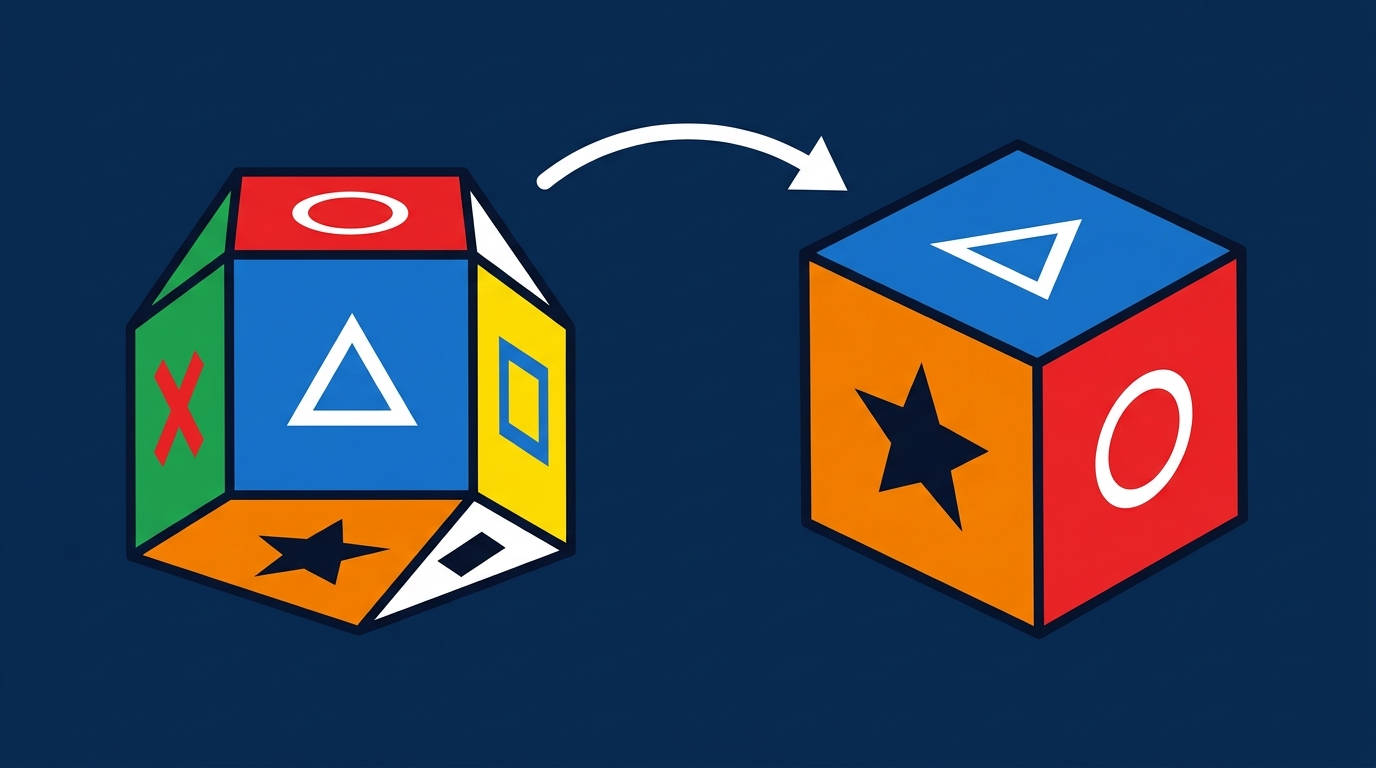
The setup is straightforward. You see a cube with distinct markings on each face. Then you're asked which of several options shows that same cube after it has been rotated along one or more axes. No touching, no moving, no trial and error. You have to run the simulation entirely in your head.
That sounds like a parlor trick. It isn't. The task pulls on visuospatial working memory, the cognitive system that temporarily holds and transforms visual information. This is a different system from the one you use to parse a sentence or solve an algebra problem. Spatial reasoning, as a foundational definition makes clear, is the capacity to mentally represent, transform, and reason about objects and their relationships in space. The cube problem is a compact stress test for exactly that capacity.
Performance on cube rotation tasks also correlates reliably with scores on broader spatial reasoning batteries. That correlation matters because it means the cube problem isn't measuring some narrow trick. It's giving you a diagnostic window into a general cognitive capability that shows up across dozens of real-world tasks.
- Look at the base cube carefully. Note which symbol or color sits on each visible face.
- Apply the first rotation in your head. Track where the top face goes, where the front face goes.
- Apply any additional rotations one step at a time. Don't jump ahead.
- Compare your mental result to the answer options. Eliminate what doesn't match.
- If you feel lost, restart from the base image rather than trying to recover from a corrupted mental model.
- Notice which rotations trip you up. Single-axis rotations are easier; diagonal or combined-axis rotations are where most people lose the thread.
- Check your answer by working backward: can you rotate the answer option back to the original?
The Cognitive Machinery Behind Mental Rotation
When you attempt a cube rotation problem, several systems fire at once. The visual cortex processes the initial image. Visuospatial working memory holds intermediate states as you rotate. Executive function monitors whether your simulated object has drifted from its intended position and corrects course when it has. These systems don't hand off sequentially; they run together, and any one of them can become the bottleneck.
One experimental finding from decades of work on mental rotation stands out: response time increases roughly linearly with the angular difference between a presented object and a comparison object. This tells you the brain isn't pattern-matching from a stored lookup table. It's actually rotating a mental image at a measurable rate, closer to a physics simulation than a dictionary lookup. That analog, simulation-like quality is why cube problems feel effortful in a way that verbal puzzles often don't. The brain is doing something expensive.
This also explains why cube rotation problems have a distinct feeling of resistance that grows as the rotation angle grows. You're not failing to recognize a pattern. You're running out of working memory to hold the intermediate states of a genuine simulation.
How Cube Rotation Performance Predicts Real-World Navigation
Moving through an environment requires continuous, automatic updating of your position and orientation relative to surrounding landmarks. You track where you are relative to where you started, which direction you've turned, and how far you've traveled. That process is structurally the same as tracking a rotating object's face positions. The brain is doing the same job in both cases.
People who score well on mental rotation tasks tend to build more accurate and flexible cognitive maps. They can re-route efficiently when a familiar street is blocked. They can find a parked car in an unfamiliar garage. They can judge turning angles without relying on step-by-step verbal instructions from a phone. People who struggle with the cube problem often report difficulty precisely with the navigation tasks that require perspective-shifting: reading a map oriented differently from their direction of travel, or describing a route from someone else's starting point rather than their own.
Spatial cognition researchers note that folding, rotation, and perspective-taking tasks cluster together statistically. A person's score on a cube net folding problem, where a flat cross-shaped diagram must be mentally assembled into a cube, is a reliable proxy for the same navigational capacities the rotating cube problem measures. These aren't separate skills that happen to share a name. They draw on the same underlying machinery.
Why This Matters Beyond Navigation
Strong visuospatial skills are among the most consistent predictors of success in engineering, surgery, and the physical sciences. A surgeon planning a procedure needs to mentally manipulate three-dimensional structures in real time. An engineer reading a technical schematic is doing a version of cube rotation continuously. The cube problem predicts performance in those domains for the same reason it predicts navigation: the cognitive machinery is shared.
Recent work benchmarking AI systems makes the point from a different angle. CubeBench, a benchmark designed to evaluate interactive, long-horizon spatial reasoning under partial observability conditions, finds that even frontier large language models struggle significantly with the kind of sequential, multi-step rotation tracking that spatially capable humans handle with relative ease. The STARE benchmark, which evaluates multimodal models on cube net folding and other visual simulation tasks, shows similar gaps. A broader survey of spatial reasoning in multimodal large language models confirms that this family of tasks remains a serious weak point for current AI systems, which underscores just how specialized and non-trivial this cognitive faculty actually is.
The practical upshot is more encouraging. Spatial reasoning appears meaningfully trainable, unlike some cognitive capacities that resist practice. Targeted work with rotation, folding, and perspective tasks produces measurable gains that transfer to both academic performance and everyday navigational competence. The rotating cube problem isn't just a diagnostic. It's a pointer toward a specific kind of practice that pays off in concrete, physical ways.
A cube sitting on a desk looks like a simple object. Ask someone to track its faces through three sequential rotations and you're suddenly looking at the inner workings of how they navigate a parking garage, read a blueprint, or orient themselves in a new city. That's a lot of information to get from a cardboard box.