mind training
The Torch and Bridge Puzzle That Trips Up Smart People
A classic four-person river crossing riddle shows why the obvious strategy almost never beats the one that pairs up the slowest walkers.
Frank5 min read

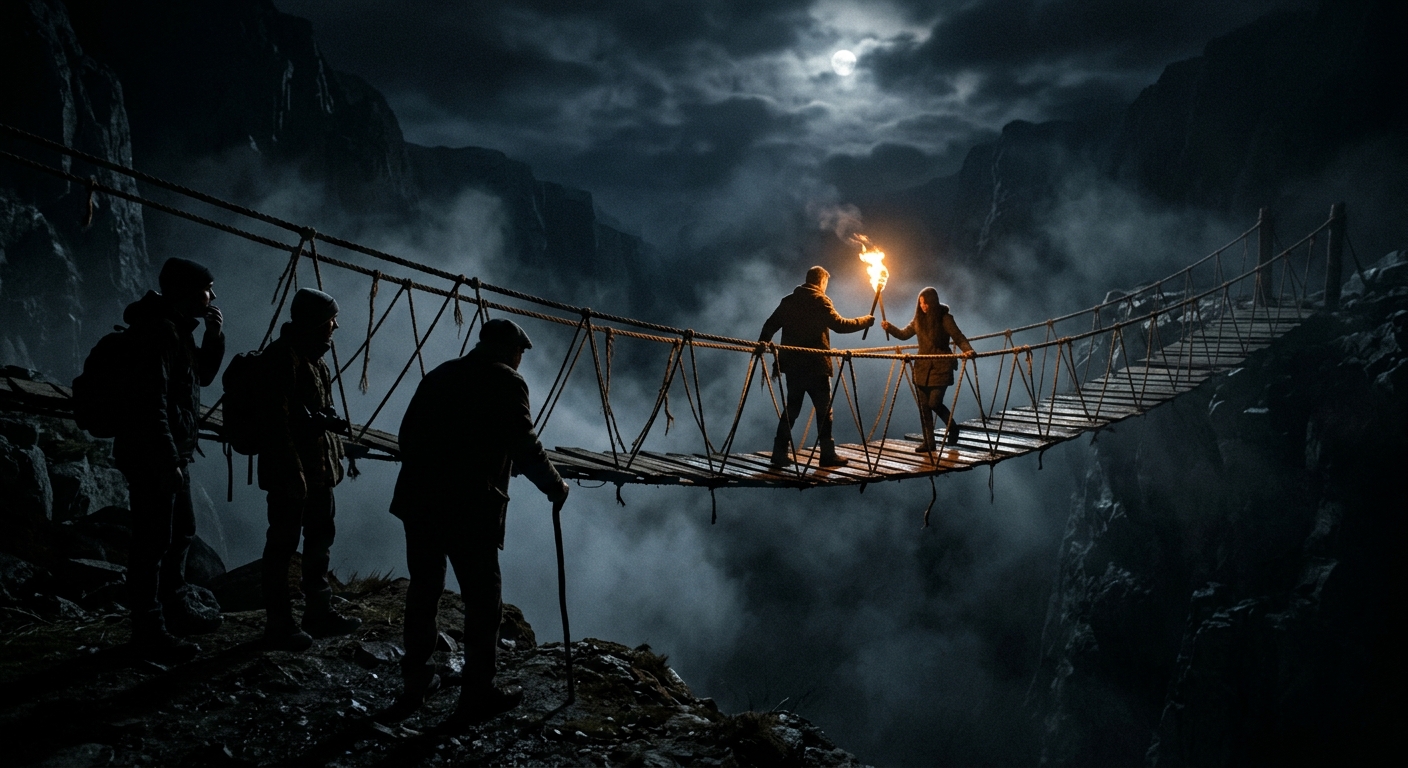
Four people, one torch, a bridge that collapses under more than two bodies at once. That is the whole setup. No hidden math, no trick wording. Just an optimization problem dressed up as a story about a rickety bridge at night, and it has been humbling smart people in job interviews for years.
The Setup and the Trap Most People Fall Into
Here is the classic version, straight from the puzzle collections that use it as an aptitude test staple. Four travelers need to cross a bridge in the dark. One has a torch, and nobody can cross without it. The bridge only holds two people at a time, and when two people cross together they move at the pace of the slower one. The four travelers take 1, 2, 5, and 8 minutes respectively to cross alone. The question posed on GeeksforGeeks is simple on its face: can everyone get across in 15 minutes total?
Most people reach for the obvious move first. Send the fastest person back and forth as a torch-runner, ferrying everyone else across one at a time. It feels efficient because the fastest person never slows anyone down. But run the numbers and you will see the problem. If the 1-minute walker shuttles the torch back after every crossing, the 5-minute and 8-minute travelers each still have to cross on their own, and their slow times get paid twice, once going over and once more in the return trips that bridge the gaps. The naive strategy adds up to more than 15 minutes, sometimes a lot more depending on how you sequence it. The puzzle's reputation as an interview favorite comes directly from this gap between what feels smart and what actually works.
The Optimal Solution, Step by Step
The trick is to stop thinking about speed and start thinking about absorption. The two slowest people are going to cost you time no matter what. The only question is whether you pay that cost once or twice. The optimal strategy pairs the two slowest travelers together on a single crossing, so their combined time only gets charged to the total once instead of being split across two separate trips.
Here is the sequence that gets all four people across in 15 minutes, using the classic 1, 2, 5, 8 numbers. The two fastest people, 1 and 2, cross first, costing 2 minutes. The fastest person, 1, runs the torch back, adding 1 minute. The two slowest people, 5 and 8, cross together, costing 8 minutes since they move at the slower pace. The second-fastest person, 2, who was waiting on the far side, brings the torch back, adding 2 minutes. Finally, the two fastest people, 1 and 2, cross one last time, costing 2 minutes. Add it up: 2 plus 1 plus 8 plus 2 plus 2 equals 15. That matches the answer the puzzle is built around, as laid out in the original Torch and Bridge puzzle.
The generalized insight is that you always have two candidate strategies worth comparing: either send the fastest person back each time, or sacrifice one trip to pair the two slowest travelers together. Whichever one produces a lower total, given the specific numbers you're working with, is the answer. It is not always the same strategy, which is exactly why the puzzle cannot be solved by memorizing a formula. You have to actually compare.
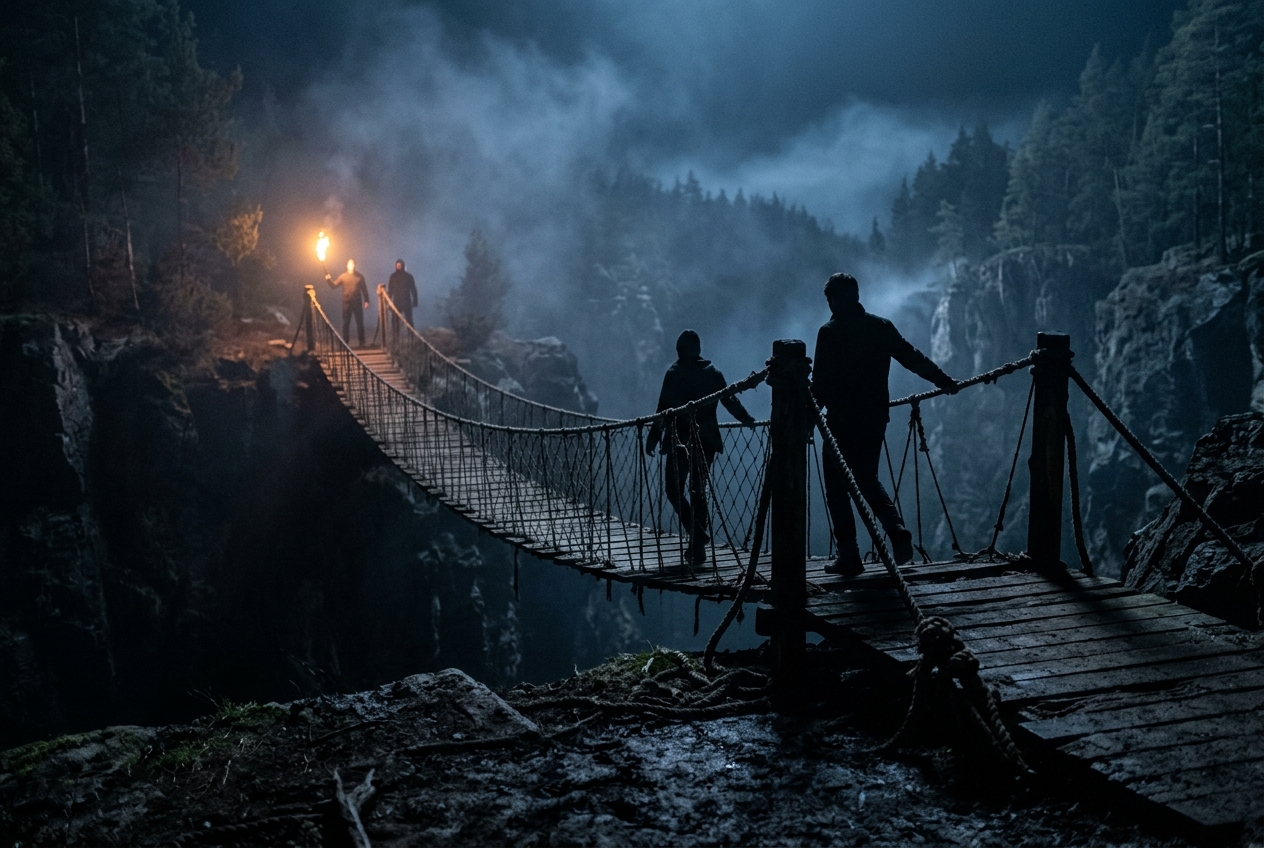
Why This Puzzle Keeps Showing Up in Interviews and Classrooms
Sites built around aptitude prep, like GeeksforGeeks, treat this riddle as a staple precisely because it tests something more useful than raw math skill. It tests whether a candidate can notice that their first idea, however reasonable, is not automatically the best one. The puzzle does not require calculus or advanced logic. It requires patience to lay out every crossing, add up the minutes, and compare totals honestly instead of stopping at the first answer that seems to work.
That accessibility is the point. A related version on GeeksforGeeks, the Four People on a Rickety Bridge puzzle, swaps in different crossing times, 1, 2, 7, and 10 minutes, and asks the same question. The numbers change, the strategy comparison stays identical. Anyone who understands why pairing the slow walkers matters in one version can solve the other without starting from scratch, which is exactly what makes it a repeatable interview tool rather than a one-off trick question.
The Mathematical Backbone: Formal Proofs and Generalizations
The riddle looks like a party trick, but it has real mathematical teeth. The Wikipedia entry on the bridge and torch problem lays out a semi-formal approach proving that the optimal strategy must take one of two specific structural forms, and which one wins depends on the relative times of the two slowest travelers in the group. That is not guesswork. It is a proof that closes off the possibility of some cleverer third strategy nobody has thought of yet.
The problem also generalizes beyond four people. With five, six, or more travelers and a torch that still only lets two cross at once, ad hoc reasoning stops being practical and the problem calls for a more general algorithm, one that systematically decides how to group the slower travelers as the group size grows. That generalization is what pulls this riddle out of the realm of party puzzles and into genuine combinatorial optimization, the same branch of math that shows up in scheduling problems and resource allocation. The bridge and torch problem has been studied carefully enough that its optimality claims rest on proof, not just a convincing story about torches and footsteps.
That is really the whole lesson packed into one small riddle. The first answer that feels efficient is not always the one that survives arithmetic, and the only way to know for sure is to write out every step and add it up.