brain power
The Stroop Effect: Why Your Brain Reads Before You Can Stop It
Naming the ink colour of a clashing colour word slows you down, because reading is automatic. Try a ten-word test and see for yourself.
Tony4 min read


Here is a quick test. Look at the word RED printed in green ink. Now name the ink colour, not the word. You know the answer. You will probably still stumble for a beat.
That beat has a name, the Stroop effect. It shows that your brain does not ask permission before it reads.
What the Stroop effect measures
The core observation is simple. When a colour word is printed in a clashing ink, naming the ink takes longer. The word "red" in green ink is the textbook case. The delay in reaction time is the whole measurement. According to Simply Psychology, the effect is exactly that slowdown when you name the ink of a word that spells a different colour.
The instruction is short: ignore what the word says, report the colour. Two responses then compete for the same mouth. One is the fast habit of reading. The other is the slower, deliberate act of identifying colour. You can feel the competition happen, which makes the task a handy demonstration of attention under pressure. It also works on you while you read about it.
The history behind the 1935 experiments
John Ridley Stroop published the effect in 1935, across three experiments. The same source notes that related discoveries date back to the 19th century, so Stroop did not find a brand new oddity. He studied it systematically, and his name stuck.
He had two stated aims. First, does naming ink colour take longer when word and ink do not match? Second, can practice reduce that interference? Experiment 1 used 70 undergraduates who read colour words aloud while ignoring the ink. A control condition printed the same words in black ink.
The full results of those experiments are beyond this article, so no numbers are quoted here. The design and the two questions are what we can describe with confidence.
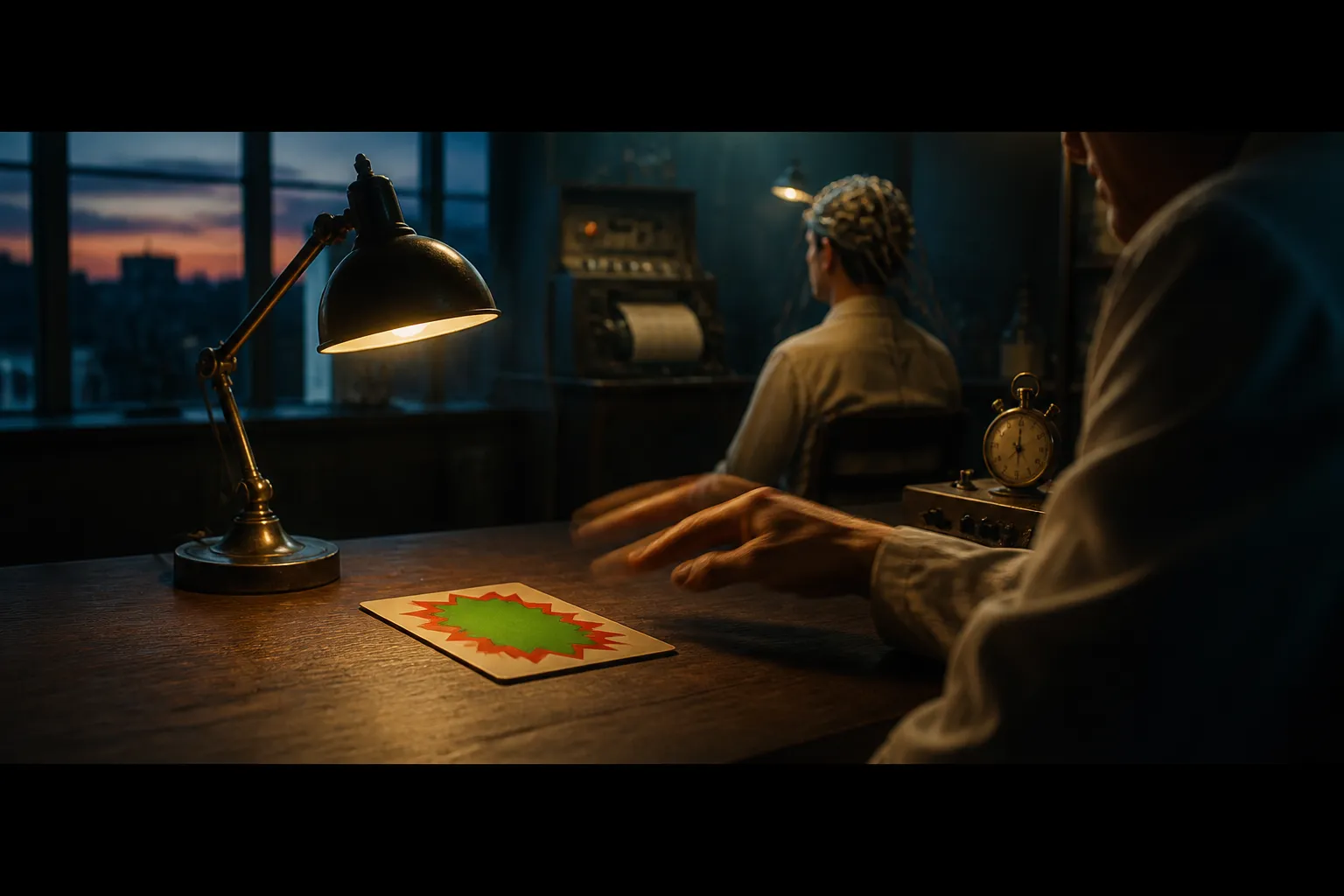
Why reading wins the race
Skilled readers read automatically. You cannot easily switch it off. Naming ink colour takes more controlled effort, so when the two signals disagree, the automatic one barges in and slows the answer. Simply Psychology frames it as a mismatch between an effortless process and an effortful one. The effortless one has a head start.
You have likely lived this. A familiar word on a billboard pulls your eyes while you are trying to think about something else. That competition is why researchers use the task to study attention and self-control.
One caution. The effect is highly consistent at group level. That is not a promise about your performance on any single trial. Individuals vary.
Clinical and research uses
The research workhorse is the Stroop Colour-Word Interference Test. It is used to study attention, self-control and brain function. It also has clinical relevance in assessing conditions such as ADHD or brain injury, per the same source. Note the wording: relevance, not verdict. It is one measure among others.
Researchers also record accuracy and speed together, to see how conflict affects attention. That matters for anyone timing themselves. A fast run full of errors is not a better score. It is a different way of failing.
Try it yourself: a ten-word test
This is a home demonstration, not a clinical assessment. No source here supplies an official timing protocol or typical scores, so treat the steps below as informal. Get a timer or stopwatch. Say aloud the ink colour of each word below, not the word itself. Go left to right, top row first. Start the clock on the first word and stop it after the tenth.
Name the ink colour, not the word:
- RED in green ink
- BLUE in red ink
- GREEN in blue ink
- YELLOW in red ink
- RED in blue ink
- BLUE in green ink
- GREEN in yellow ink
- YELLOW in blue ink
- RED in yellow ink
- GREEN in red ink
To see the contrast, repeat with ten colour patches or with the same words in plain black ink, and compare your times. The Stroop effect predicts the mismatched run will feel slower. Count your errors too, since accuracy and speed belong together.
Answer
Say, in order: green, red, blue, red, blue, green, yellow, blue, yellow, red. If you tripped on a few, that is the effect at work. A single short run is a rough sample, so repeat it a few times before drawing any conclusion.