brain power
The Snack Break That Accidentally Discovered Mirror Neurons
A hungry lab assistant reaching for food gave neuroscience one of its most cited discoveries, purely by accident.
Frank4 min read

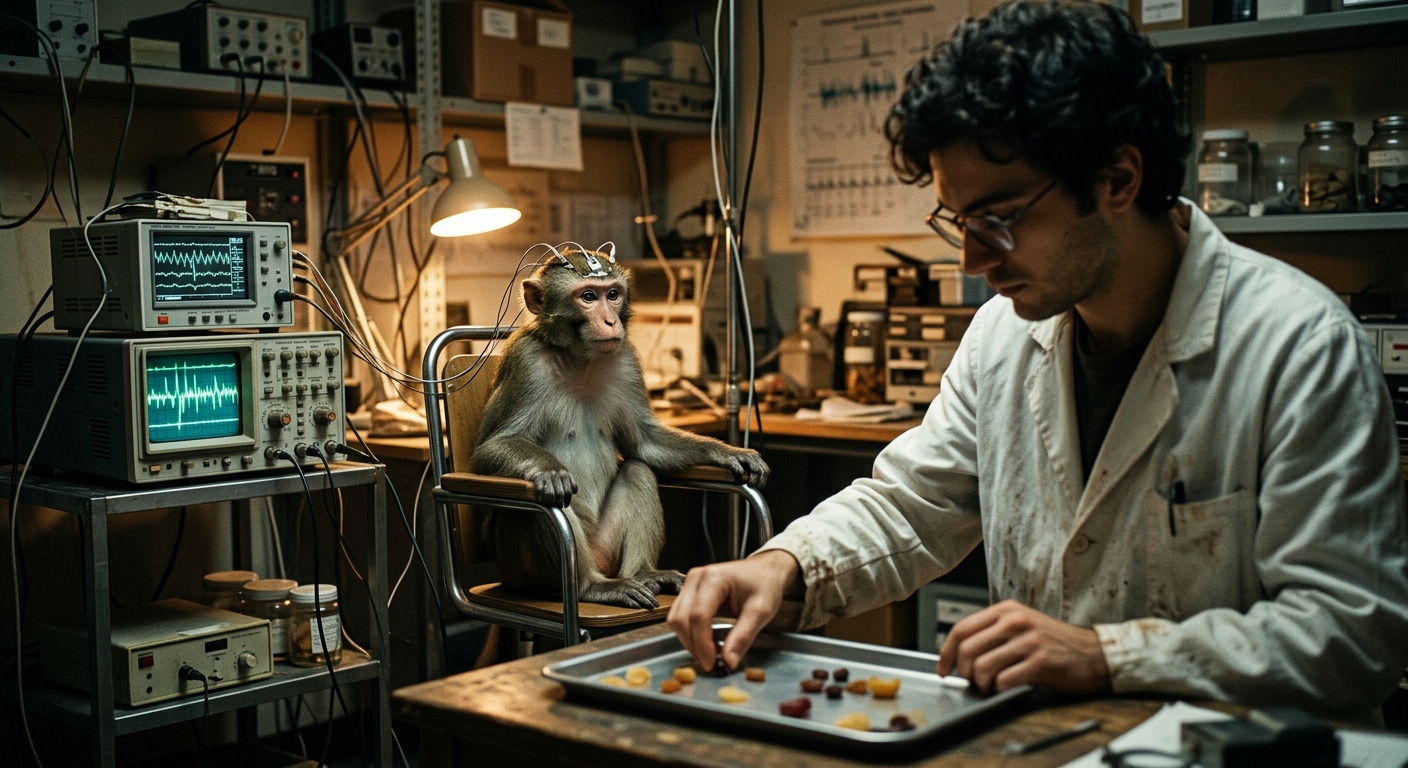
Nobody in Giacomo Rizzolatti's lab in Parma set out to discover empathy in a monkey's brain. They were mapping motor neurons, plain and simple, tracking which cells in a small patch of premotor cortex lit up when a macaque grabbed a raisin or held a peanut. That kind of research does not usually make it into psychology textbooks. This one did, and the reason has less to do with brilliant hypothesis testing than with a lab assistant who got hungry at the wrong moment.
The Lab That Wasn't Looking For This
The team was studying area F5, a region of the macaque premotor cortex already known to fire during specific hand and mouth movements. The experimental setup was built entirely around the monkey's own physical actions. Electrodes were implanted, the monkey reached and grasped objects on cue, and researchers recorded which neurons activated during which motions. There was no part of the design meant to test observation, imitation, or anything social. The whole premise assumed the neurons only cared about what the monkey itself was doing with its own hands, according to the retrospective account from Rizzolatti and Maddalena Fabbri Destro published in Scholarpedia.
The Accidental Moment
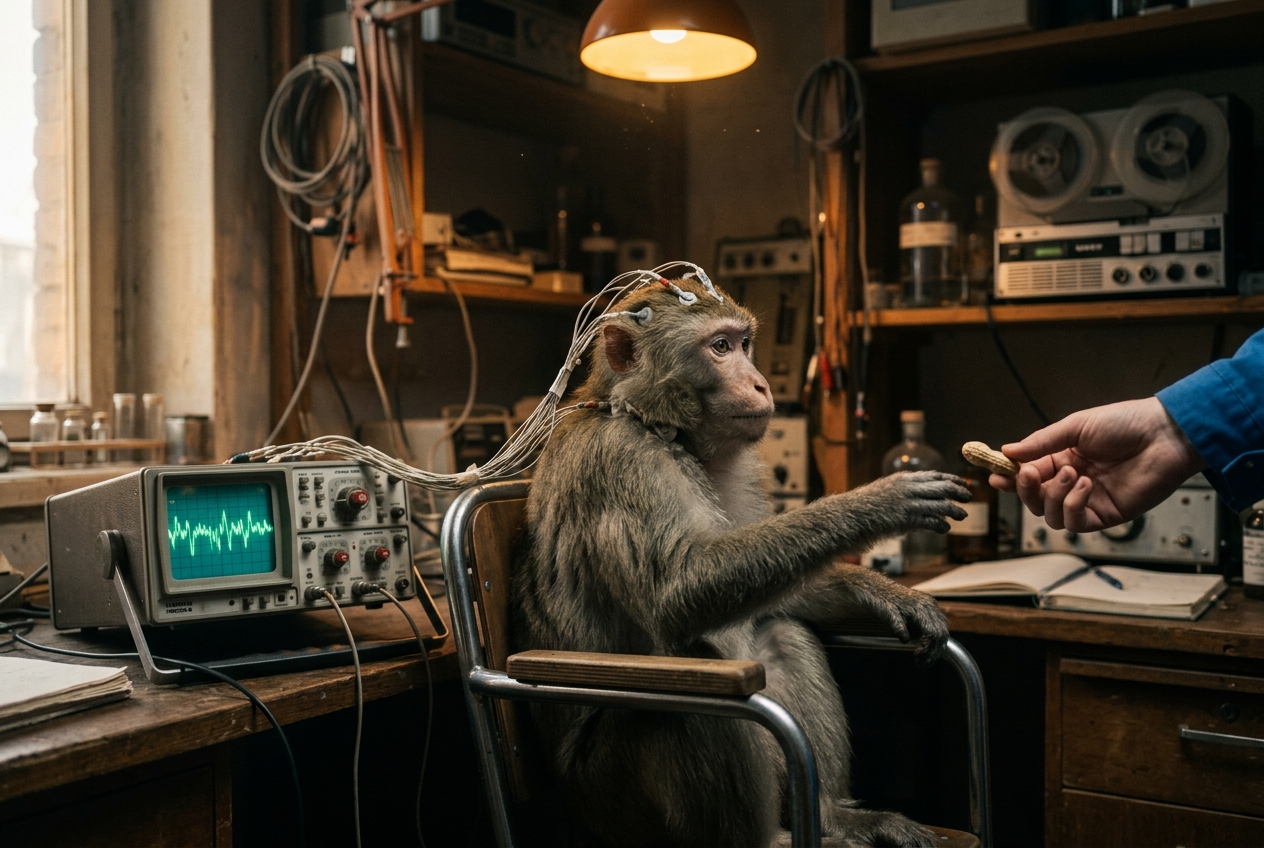
Here is where the story gets interesting, and where a little bit of legend has crept into the retelling over the years. A lab member reached for a piece of food while the monkey sat still, electrodes attached, doing absolutely nothing. No grasping, no chewing, no movement of any kind. And yet the recording equipment picked up a spike in F5, the exact firing pattern normally tied to the monkey performing that same grasping action itself. A neuron built to fire during action was firing during stillness, just because the monkey was watching someone else act.
Any lab tech will tell you that strange blips happen constantly in neural recordings. Equipment glitches, stray signals, and noise are part of the daily grind, and the easy move would have been to write it off and move on. What kept this particular anomaly alive was repetition. It kept happening, over and over, whenever a monkey watched a goal-directed action instead of performing one. That kind of consistency is hard to ignore once you notice it, and the Parma group didn't ignore it.
From Fluke to Formal Discovery
Rizzolatti's team went back and rebuilt their experiments around the pattern instead of around the original question. They showed monkeys a series of goal-directed actions performed by humans and by other monkeys, then recorded F5 activity under controlled conditions instead of stumbling into it by accident. The results held up. Certain neurons fired both when the monkey executed a grasping action and when it merely watched someone else do the exact same thing, a dual-response property that had no name in the neuroscience vocabulary at the time, as documented in the F5 recordings described in Scholarpedia.
That dual response is the whole ballgame. It meant the brain wasn't just planning and executing movement, it was also using the same machinery to model someone else's movement, almost as if watching were a rehearsal for doing. Researchers named these cells mirror neurons, and the formal findings landed in the mid-1990s. What started as a distraction during a grasping experiment became one of the most cited discoveries in cognitive neuroscience, later folded into broader work on the human mirror neuron system summarized in this review.
Why the Backstory Still Matters
People love telling this story because it wrecks the tidy myth of scientific discovery as something that only happens when a researcher sets out to prove a specific idea. Rizzolatti and his colleagues weren't hunting for a neural basis of empathy or imitation. They were counting spikes during a grasping task, and they happened to have their equipment running at the exact moment a lab member reached for a snack. If the monkey hadn't been wired up and sitting idle at that precise second, the whole thing might have slipped by unnoticed for years, buried under the assumption that nothing interesting happens in a brain that isn't moving.
That is the real lesson buried in the mirror neuron story, and it has nothing to do with monkeys or raisins specifically. Careful instrumentation and a willingness to take a weird result seriously matter as much as the original hypothesis. Rizzolatti's team could have chalked up that first spike to noise. Instead they treated it as a clue, and that clue reshaped how an entire field thinks about imitation, social cognition, and the neural overlap between watching and doing.