IQ Challenges
The Number Puzzle That Stumps People Who Are Good at Math
A grid of ordinary-looking integers hides a positional cipher that exposes a surprising gap in how numerate adults actually read numbers.
Frank5 min read

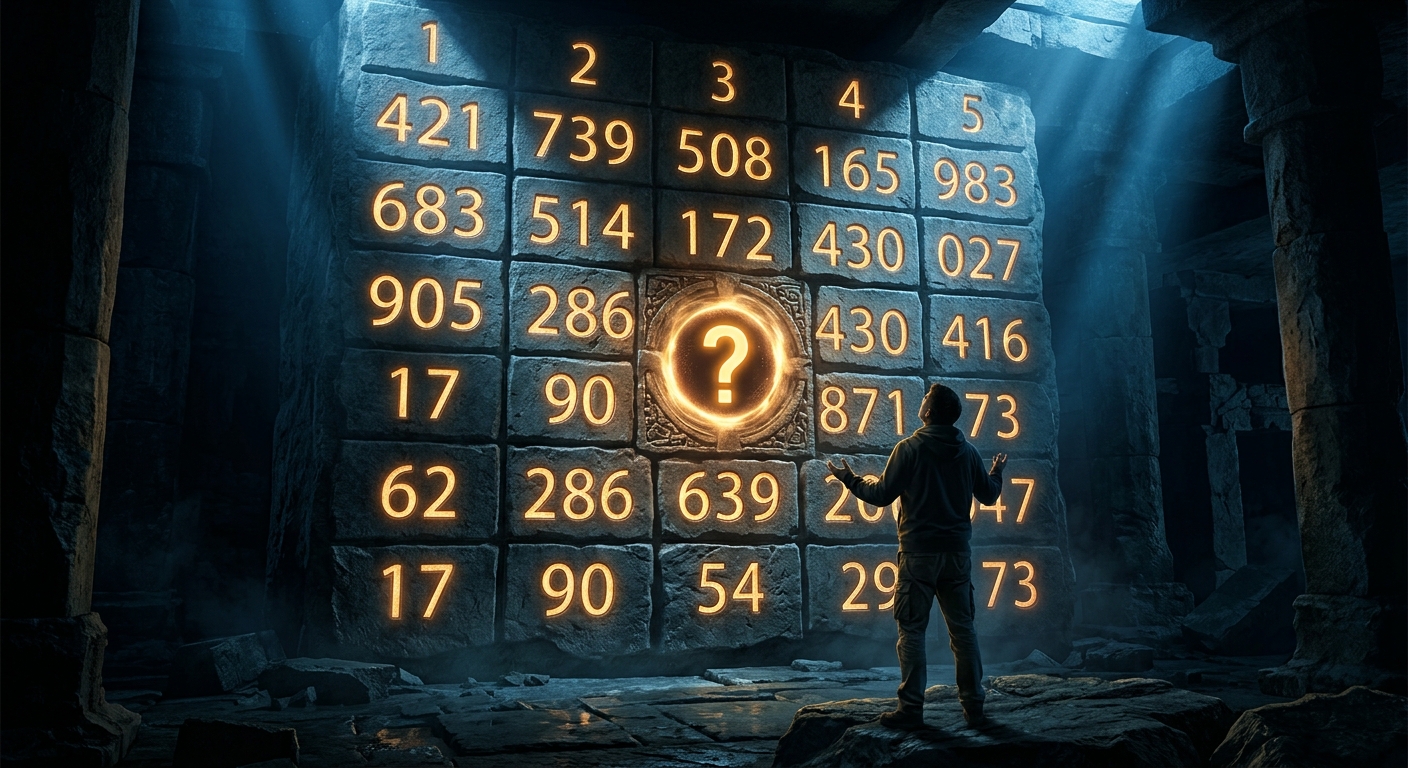
Most number puzzles surrender their logic within a minute or two. You spot the sequence, fill the gap, move on. The Missing Number Matrix, designed by Hans-Karl Eder and published by Scientific American in September 2024, does not cooperate. Confident solvers on puzzle forums posted wrong answers within minutes of reading it, and the reason they failed is genuinely instructive.
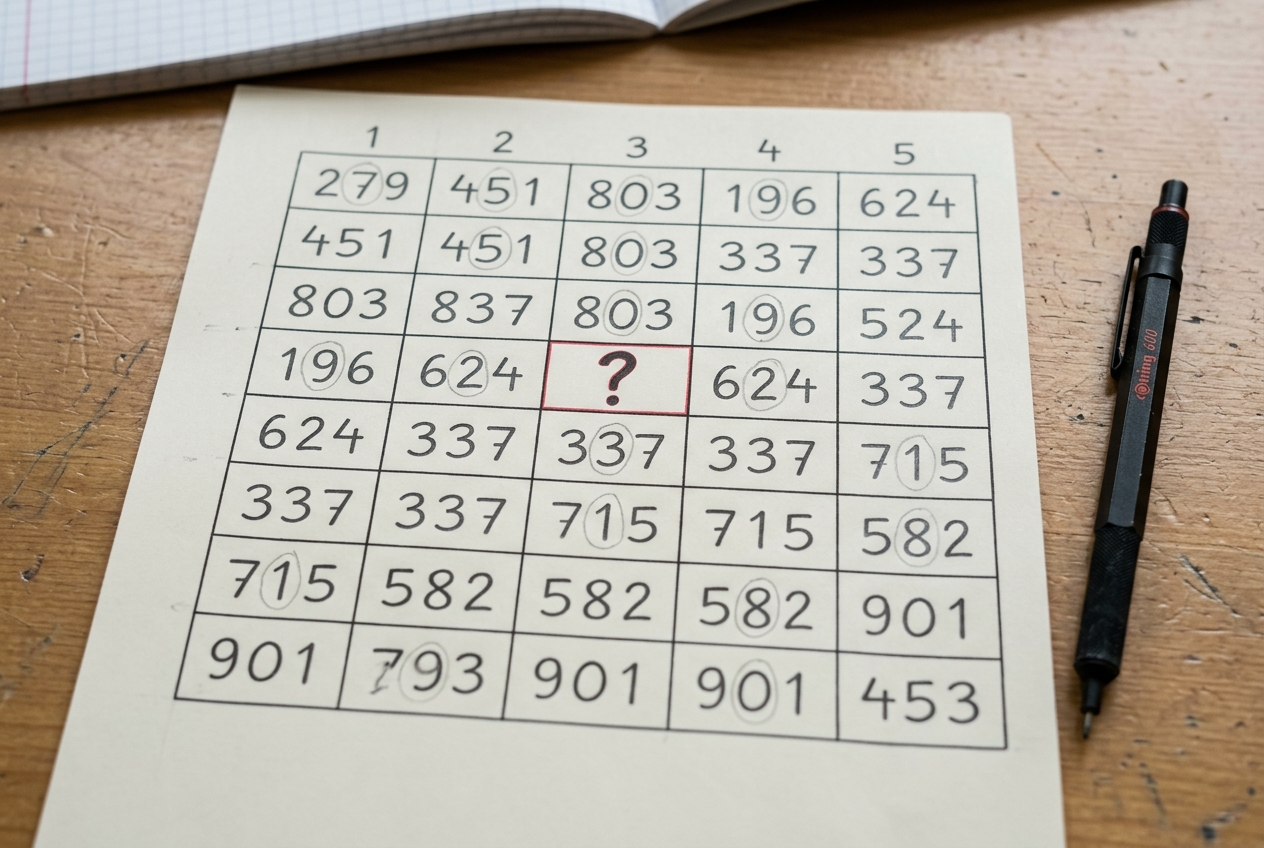
What the Puzzle Looks Like at First Glance
The grid presents five columns of multi-digit integers. Nothing about the layout screams trick. The numbers look like they could belong to a multiplication table, a ratio sequence, or some kind of magic-square arrangement. One cell holds a question mark, and the job is to find the integer that belongs there.
That sounds easy. It is not. No obvious arithmetic sequence connects the cells. No multiplication table governs the columns. Solvers who scan for magnitude patterns or repeated digits find superficial relationships that lead nowhere. The puzzle was originally printed in Spektrum der Wissenschaft before being restyled for an English-language audience by Scientific American, and it traveled fast through puzzle communities precisely because it looked approachable and was not.
Think You Have It?
Before reading the breakdown below, the puzzle is worth sitting with for a few minutes on its own terms. Pull up the original puzzle at Scientific American and try to find the rule before scrolling further. The experience of being wrong, specifically the experience of chasing a pattern that turns out to be a mirage, is actually the most informative part. It shows you exactly which assumptions you brought to the grid, and those assumptions are worth knowing about.
Which number should replace the question mark? The grid shows five columns of multi-digit integers. One cell in column three holds a question mark. Your task: find the integer that belongs there by identifying how columns one, two, four, and five relate to column three.
The Hidden Rule Inside the Digits
The answer is 1,620. It surfaces only when you stop reading each integer as a single unit and start treating it as a container of independently meaningful pieces. According to Scientific American's published solution, the rule works like this: pull the tens digit from each number in columns one, two, four, and five, then sum those four digits. That total is encoded into the thousands and hundreds places of the number sitting in column three.
Then do it again at a different level. Pull the ones digits from those same four columns, add them, and the total shows up in the tens and ones places of the column-three number. Two separate operations, both positional, both hidden inside what looks like an ordinary integer. Column three is not a peer of the other columns. It is the output, and the other four are inputs.
That asymmetry is the core of the puzzle. Most solvers never see it because they spend their energy looking for a rule that treats all five columns equally. The two-stage structure means you can crack half the answer and still not recognize that you have found anything useful.
Why This Class of Puzzle Is So Difficult
People default to whole-number operations when they scan a grid of integers. Addition, multiplication, ratios. Those are the instinctive tools. Digit-positional puzzles exploit the gap between that intuition and place-value awareness, which is a more deliberate, structural way of reading numbers. You have to stop seeing 47 as a quantity and start seeing it as a 4 next to a 7, each carrying separate information.
The five-column structure reinforces the misdirection. Solvers trained on Latin squares or magic-square logic expect the governing rule to apply symmetrically to every column. When one column plays a categorically different role, it breaks that assumption in a way that is not announced anywhere on the page. You have to discover the asymmetry yourself. There is also the problem of false leads: certain numbers in the grid share rough magnitudes, or a digit repeats across rows, and solvers pursue those phantom patterns for a long time before considering that the rule might live below the number itself, inside its digits rather than across its face value.
What the Solution Reveals About Mathematical Literacy
Finding 1,620 requires active fluency with place value, not just familiarity with it. Most arithmetic instruction treats place value as a foundation, something you master in early grades and then build on top of. You rarely need to reverse-engineer a number's internal structure in an adult context. So capable, numerate people, people who passed every math class, can sit in front of this puzzle and come up empty, not because they lack knowledge but because they have never needed to apply that particular knowledge this way.
There is also a useful asymmetry between encoding and decoding at work here. Building the grid, knowing the rule and filling in numbers that obey it, is considerably easier than reconstructing the rule from the completed grid alone. That gap underlies a lot more than recreational puzzles. It sits at the center of cryptography, data compression, and any system where structure is embedded in a signal and must be extracted without a key. The Missing Number Matrix is a small, clean demonstration of why decoding is the harder direction.
For anyone who teaches mathematics, the puzzle offers something rare: a way to make place-value instruction feel urgent to adults. That concept is usually treated as remedial territory, something for younger students who are still building number sense. A puzzle that stumps experienced, educated solvers by exploiting a gap in place-value thinking signals that the concept has real depth worth returning to at any level, not as review, but as a genuine area of skill worth sharpening.