puzzles
The Missing Dollar Riddle and the Double-Counting Trap
The riddle loses a dollar only because it adds the bellhop's tip to a total that already includes it. Track who holds each dollar and the full $30 comes back.
Frank4 min read


Three guests, one hotel room, and a dollar that seems to walk out the door. The Missing Dollar riddle goes back to at least the 1930s, and it still catches people today. The sums look fine. One of them is wrong.
Three guests rent a room for $30, each paying $10. Later the manager realizes the room should have cost only $25. He sends the bellhop up with $5. The bellhop keeps $2 and gives each guest $1 back. Now each guest has paid $9, which is $27 in total. The bellhop has $2. That makes $29. Where did the other dollar go?
The setup
The riddle is a well-known puzzle built on an informal fallacy. The guests split a bill in a way that seems to leave one dollar unaccounted for, according to Wikipedia's entry on the riddle. Similar puzzles are much older, though the sources do not name the first published version.
The wording shifts from telling to telling. Some versions use a restaurant bill. Others use different currencies. The skeleton stays put: three people pay, the bill is cut, a middleman keeps a bit, and the rest goes back. That steady structure is a big reason the puzzle has lasted.
The money, step by step
Start with the real numbers. Three guests paid $10 each, so $30 went in. The corrected bill is $25, so $5 has to come back. It arrives as five one-dollar bills. Each guest gets $1, which is $3 in all, and the bellhop pockets $2.
Now each guest is out $9, so the guests paid $27 in total. Add the bellhop's $2 and you get $29. The original total was $30. That gap is the whole puzzle. It feels like a dollar slipped behind the radiator, and the story is built to make you feel that.
The answer
The riddle adds two amounts that do not belong together and then expects the total to be $30. The sources agree that adding the three $9 payments and the $2 tip (9+9+9+2=29) is not a meaningful sum, so there is no reason it should equal $30.
Look at what the $27 already contains. It is the $25 the hotel kept plus the $2 the bellhop kept. The tip is inside it. Adding the $2 again counts it twice. That is the double-counting error, which a 2016 FantasyLabs post names in its title.
The honest way is to ask where each dollar is now. The register holds $25. The bellhop holds $2. The guests hold $3, one each. That is $30, the amount that went in. Nothing vanished. If you add the $1 each guest still holds to the $27 they paid, you also land on $30.
- Hotel: $25
- Bellhop: $2
- Guests, refunded: $3
Change the numbers
The $29 is close to $30 by coincidence. Change the starting figures and the gap changes with them. The sources do not work this out, so here is a quick check of my own using the same story shape.
Say the room is still $30, but the manager decides it should cost only $20. The refund is $10. The bellhop keeps $4 and hands each guest $2 back, which is $6 in all. Each guest has now paid $8, so the guests paid $24. Add the bellhop's $4 and you get $28. The riddle's sum is $2 short of $30 this time, not $1 short.
Now track the money properly. The register holds $20. The bellhop holds $4. The guests hold $6. That is $30 again. The $24 the guests paid is the $20 for the room plus the $4 tip, so adding the tip a second time is the same mistake. Only the size of the apparent hole moved.
Push it further. If the bellhop kept the whole refund and gave nothing back, the guests would have paid $30 and the tip would be $10 of it. The riddle's sum would be $40, which overshoots the original total. A number that can land above or below $30 depending on the story was never tracking real money.
Watch for bad answers
Some explanations say the bellhop stole an extra dollar, or that money is genuinely missing. Those misread the riddle. Others online label the error as adding a tip incorrectly. The sources point to double-counting instead, so check the reasoning, not just the label.
The riddle also works as a teaching tool for critical thinking, logical fallacies and basic accounting, according to one of the sources. The lesson is small and practical. Before you add two numbers, ask whether they describe the same money.
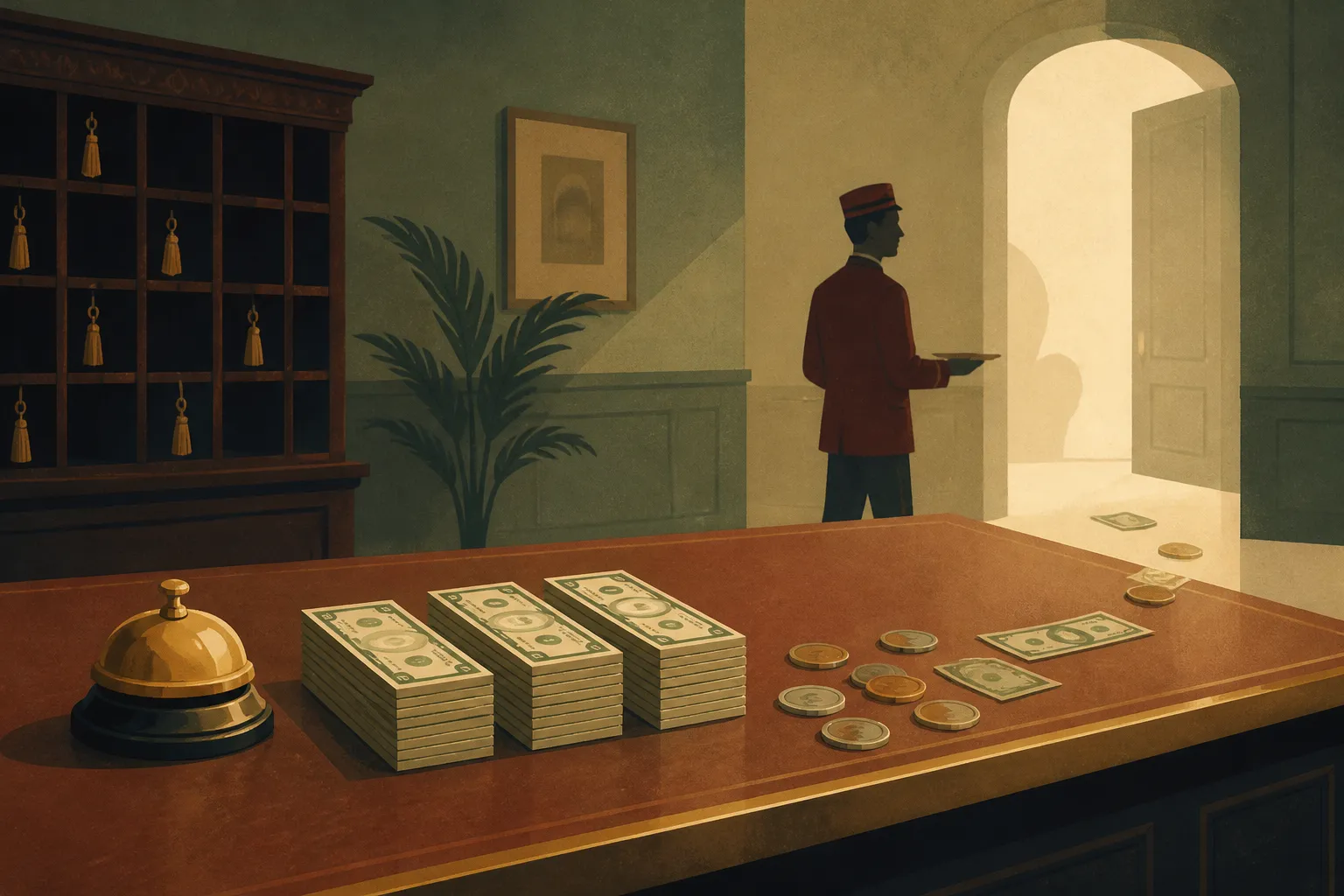
Recap in two pictures