brain exercises
The Impossible Triangle That Broke Your Brain on Purpose
The Penrose triangle is a clean geometric paradox that reveals how your visual cortex builds confident lies faster than your rational mind can object.
Tony7 min read

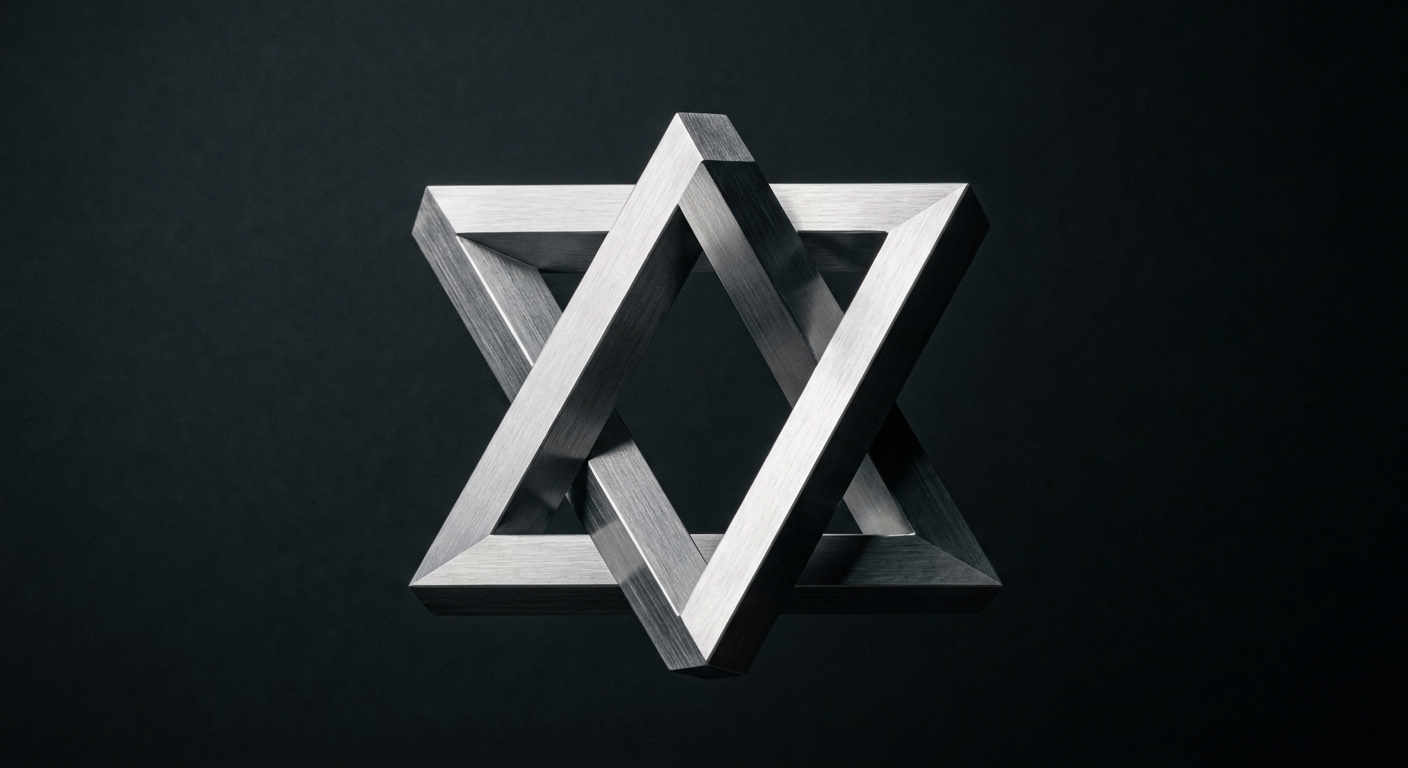
Your brain is, on most days, a competent engineer. It takes flat retinal data, runs it through a few hundred million years of evolutionary firmware, and hands you a confident three-dimensional model of the world in under a tenth of a second. Impressive. Unfortunately, one Swedish artist and two British mathematicians found the exact exploit that crashes the whole system, and the resulting bug report is still open.
An Object Born From a Drawing Error That Wasn't
The figure most people call the Penrose triangle has a longer history than its famous name suggests. Swedish artist Oscar Reutersvärd assembled a structurally similar shape from isometric cubes back in 1934, quietly and without much fuss. The wider scientific world caught on only after mathematician Roger Penrose and his father Lionel Penrose published their analysis in a 1958 paper in the British Journal of Psychology, giving the object its durable academic pedigree and, not coincidentally, the Penrose family name.
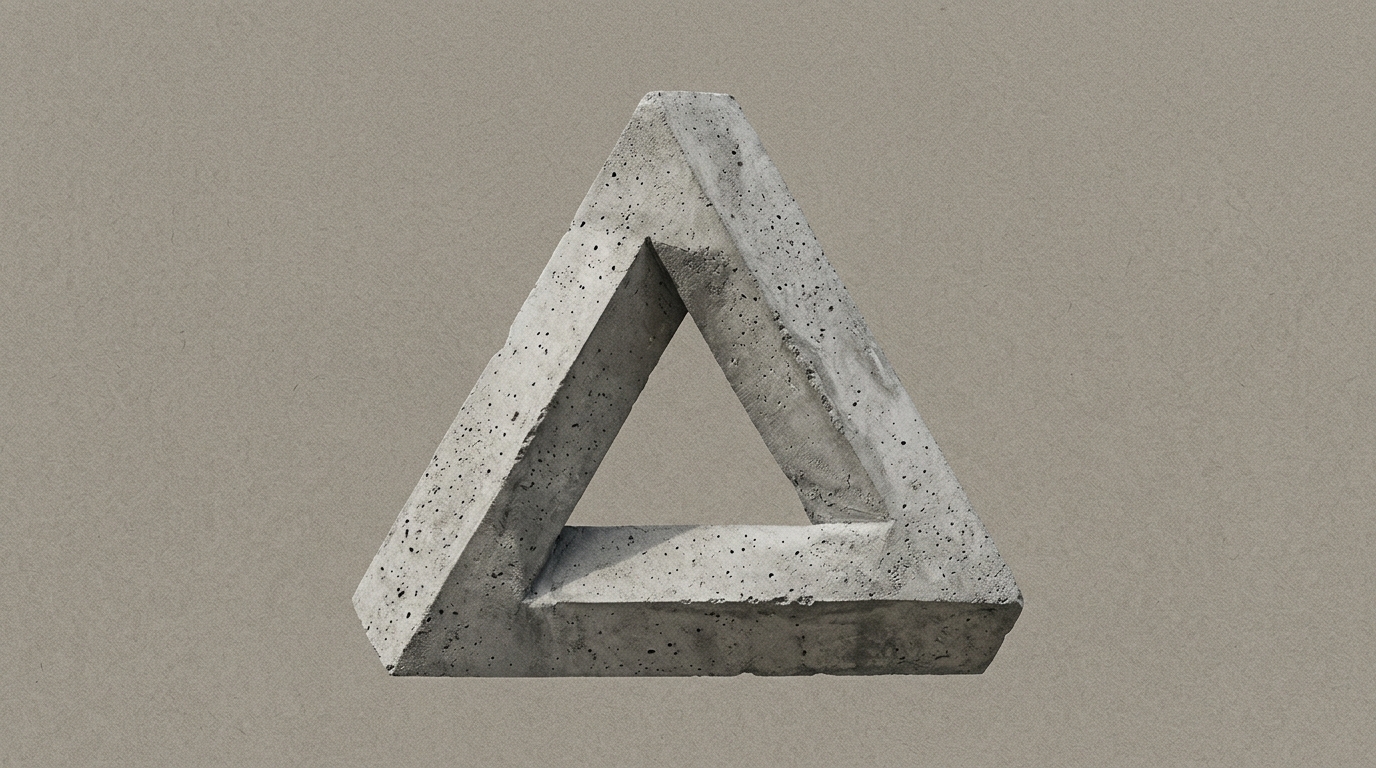
What the figure actually depicts is three straight beams of square cross-section, each joined to the next at a clean right angle, forming a closed triangle. Every single local region of the drawing is geometrically coherent. Walk your eye along one beam, around one corner, it all checks out. The catastrophe arrives the moment you try to trace the full circuit and return to your starting point. You cannot. The object contradicts itself at the global level while remaining perfectly legal at every local one. Penrose called it "impossibility in its purest form," and for once the marketing copy matches the product.
That purity is the whole point. Most optical illusions lean on ambiguous shading, misleading contrast, or size relationships that the brain misreads. The Penrose triangle does none of that. It presents a logical paradox encoded in clean geometry, which is why it became such a productive research instrument rather than just a novelty on a puzzle calendar.
How the Visual Cortex Builds a World It Has Never Seen
Here is the thing your visual system does that you never asked it to do and cannot stop: it invents depth. The retina delivers a flat sheet of photon data. The brain converts that into a volumetric scene, confidently, continuously, without asking for your input or your permission. It does this by applying learned rules about how edges, corners, and surfaces behave in physical space, rules assembled over a lifetime of bumping into furniture and opening doors.
When those rules encounter the Penrose triangle, each of the three corners gets processed and passed. A right-angle joint where two square beams meet at ninety degrees, the brain has seen that configuration ten thousand times. It assigns each corner a plausible three-dimensional interpretation and moves on. The visual cortex processes spatial information in a largely modular and parallel fashion, integrating local depth cues without running a mandatory global consistency check across the whole scene. In a world full of real objects, that strategy is fast and nearly always correct. It is also the exact vulnerability the tribar exploits.
The three locally valid interpretations are mutually incompatible. No single coherent three-dimensional object can satisfy all of them at once. Yet the brain cannot suppress the powerful sense of solidity because the local evidence is simply too convincing. The confidence comes first. The contradiction, if it arrives at all, arrives as an afterthought that the perceptual system politely ignores.
The Physics of Impossibility: What It Would Actually Take
Researchers at the University of Oldenburg and elsewhere have done the tedious but satisfying work of building the Penrose triangle in the physical world. The result is a dramatically warped, discontinuous structure that looks precisely like the drawing from one carefully chosen viewpoint and looks like a bent piece of industrial plumbing from every other angle. Move six inches to the left and the illusion collapses entirely. Stand in the designated spot and your brain reinstates the impossible object without hesitation.
Several of these sculptures exist as permanent public installations, including examples in Perth, Australia and Gotschuchen, Austria, where visitors queue up to stand at the correct coordinate and take photographs proving their visual cortex is as hackable as everyone else's. The gap in the physical structure, which can be several feet wide at larger scales, is hidden by precise alignment with the viewing axis. The brain assumes that a coherent retinal image implies a coherent physical object. The sculpture exploits that assumption directly.
This distinction between the drawing and the sculpture turns out to matter philosophically. The drawing is a genuine logical paradox flattened onto paper. The sculpture is a solvable three-dimensional puzzle presented from a concealing angle. Both produce a subjectively similar experience of impossibility. The mechanisms are completely different. One defeats spatial reasoning. The other merely deceives it. Researchers care about this gap because conflating the two would muddy what the Penrose triangle actually proves about vision, and I, for one, enjoy my proofs unmuddy.
Why Game Designers Have Always Loved the Impossible
The commercial history of impossible geometry in interactive media is longer and more lucrative than most people realize. Escher-inspired level design showed up in puzzle games well before anyone had a decent graphics card, and the logic of the tribar, a looping path with no beginning and no end, translates elegantly into game architecture. The suggestion of cyclical progress, of infinite staircases and spaces that fold back on themselves, is structurally irresistible to designers building puzzles that need to feel both coherent and unsolvable by normal means.
Monument Valley is the most commercially successful mainstream example of a game that uses Penrose triangle logic as its core interactive vocabulary. The reason it works is the same reason the original drawing works: the brain generates a confident three-dimensional model, discovers the model is contradictory, regenerates a new model, discovers the same contradiction, and loops. In an interactive context, that loop does not produce frustration. It produces a distinctive aesthetic satisfaction that researchers have associated with the enjoyable aspects of perceptual play. Designers figured this out empirically. Neuroscientists are still writing the papers to explain why they were right.
The Penrose triangle specifically offers a clean three-beat rhythmic structure, corner, beam, corner, beam, corner, beam, that maps onto level geometry with unusual elegance. The player inhabits the gap between local confidence and global contradiction, which is not a bad description of where good puzzle design always tries to put you.
What the Triangle Tells Us About Consciousness and Belief
Here is the part that should genuinely unsettle you. A neuroscientist who has spent twenty years studying the Penrose triangle still sees a solid, impossible object when they look at it. Understanding the figure intellectually does nothing to diminish its perceptual impact. The knowledge sits in one part of the brain. The confident hallucination of a three-dimensional object sits in another. The two do not consult each other.
This separation is sometimes called the cognitive impenetrability of early visual processing. The tribar is one of the cleanest demonstrations of the principle available, because unlike many illusions where informed attention can partially suppress the effect, the impossibility of the Penrose triangle persists at full strength regardless of expertise, regardless of preparation, regardless of how loudly the rational mind announces that the object cannot exist.
For researchers interested in consciousness, this makes the figure a small natural laboratory for the question of what it means to believe something. The observer simultaneously holds the propositional belief that the object cannot exist and the perceptual belief that it does. There is no apparent conflict between those two states at the level of subjective experience. Vision ends somewhere. Belief begins somewhere else. The tribar sits precisely on that border and refuses to move, which is philosophically inconvenient and scientifically magnificent.
The confident, unified sense of seeing a coherent world is itself a construction, assembled from competing subsystems that do not always agree and do not always bother reporting their disagreements upstairs. The Penrose triangle does not prove that vision is broken. It proves that vision is a committee, and committees, as anyone who has ever attended one knows, are perfectly capable of voting unanimously for something that cannot exist.