Brain Teasers
The Gorilla You Didn't See
Attention narrows what we notice, and the research on inattentional blindness suggests that even experts and our own introspection have blind spots.
Frank4 min read

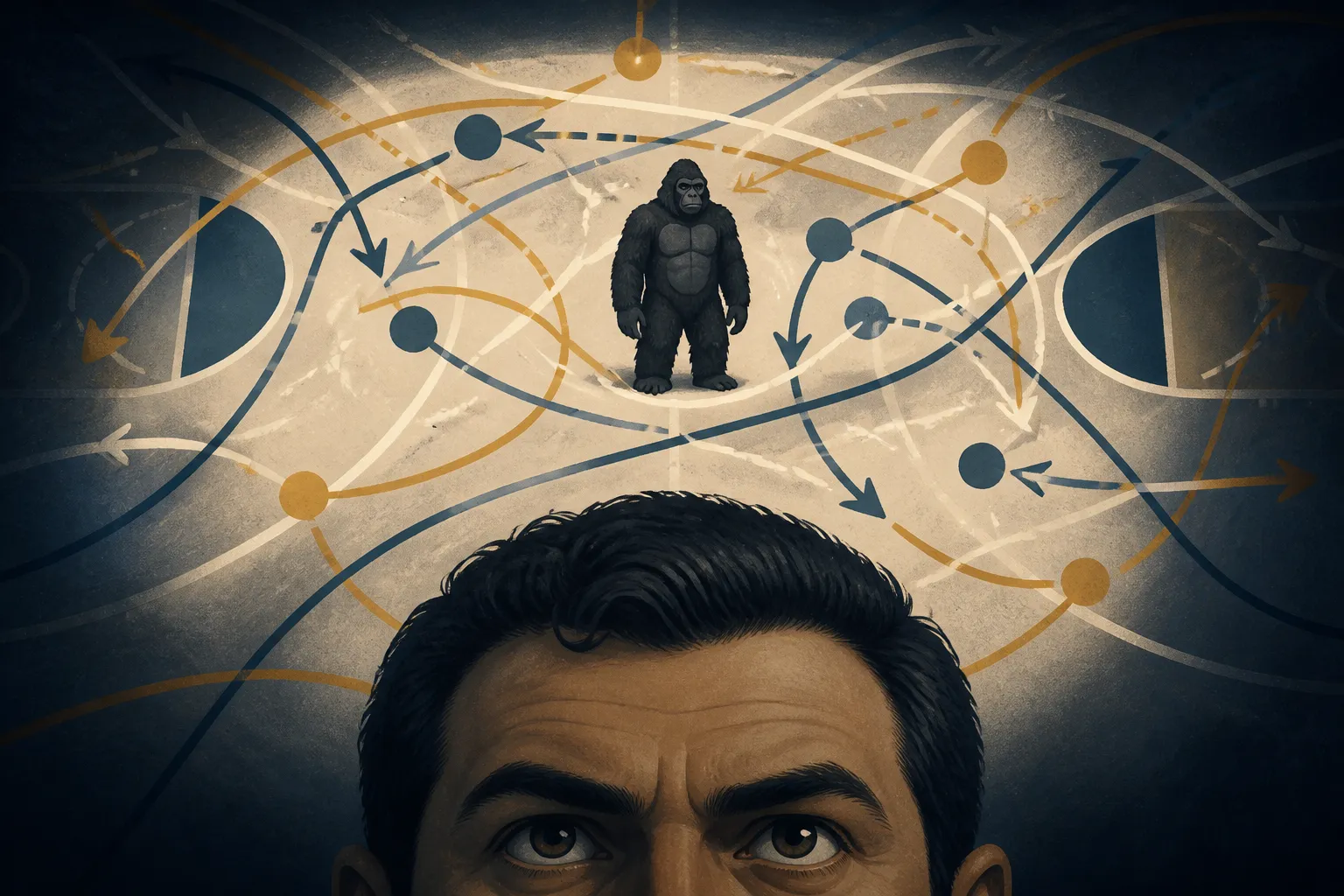
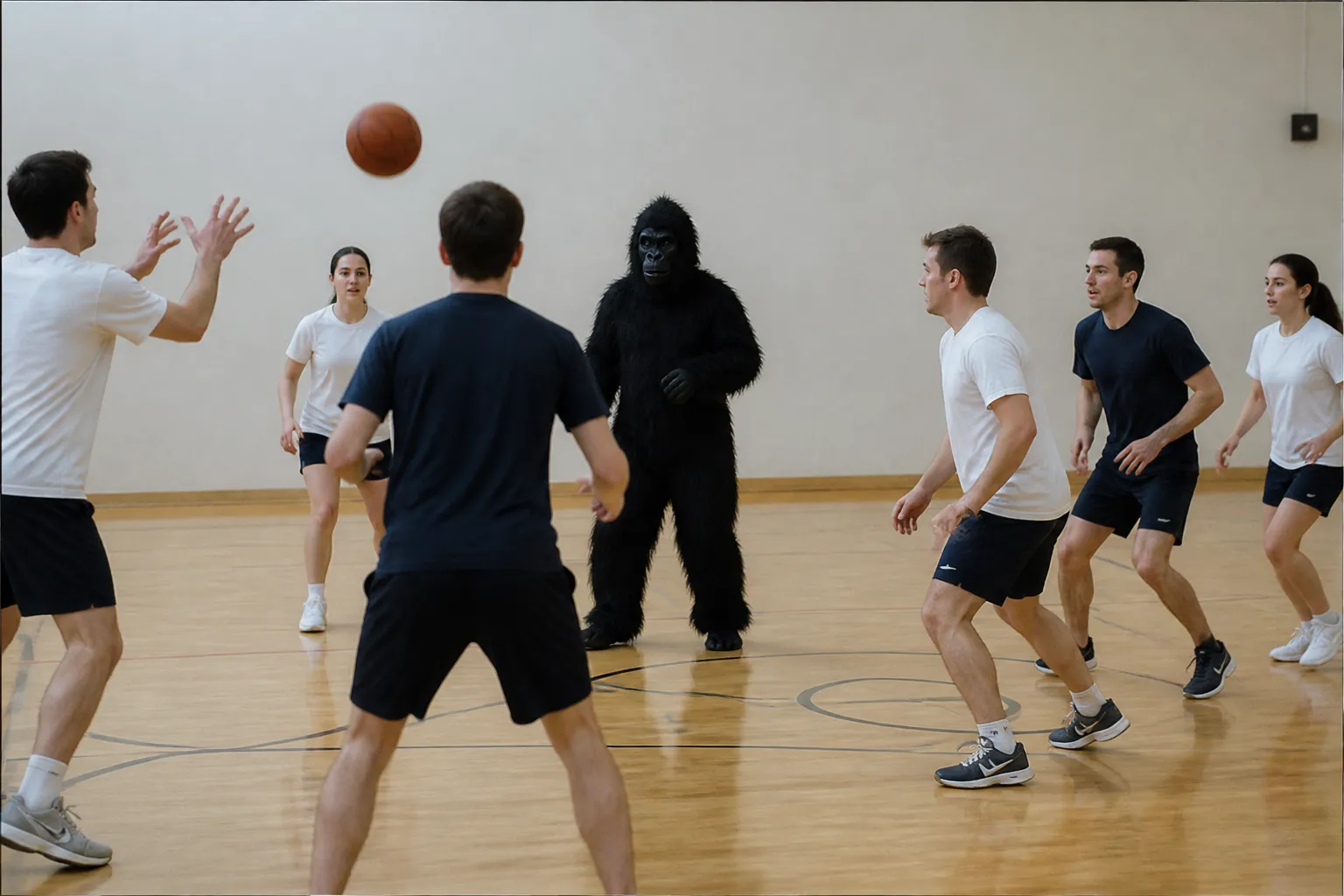
You watch a short video. Players pass a ball. You count the passes. Halfway through, a person in a gorilla suit walks into the middle of the scene. Would you see it? Most of us say yes. A lot of us would be wrong.
Looking at something is not the same as noticing it. Your eyes can land on a thing, and your mind can still skip it.
What inattentional blindness means
Inattentional blindness is failing to notice a salient event because your attention is busy somewhere else. The event is not faint or hidden. It sits in plain view. It just falls outside whatever the task has you focused on. Attention acts a bit like blinders during a demanding job, and obvious things can slide past without registering.
This matters if you care about sharpening your mind. Many people assume that if they were looking, they saw. The research says otherwise. Attention is a limited resource, and where you spend it decides what you catch.
The gorilla study and what it showed
The best-known demonstration is the 1999 ball-passing study by Simons and Chabris. Observers counted passes while a person in a gorilla suit walked through the scene. A substantial portion of them did not report seeing the gorilla.
I can't give you an exact percentage. The source I have summarizes the study without sample sizes or full results, so treat any specific number you hear with some care. The core finding is clear enough. A counting task can make a large, obvious figure vanish.
The part people remember is the reaction. Those who missed the gorilla are often sure they would have seen it. That confidence is part of the lesson. We are poor judges of our own blind spots.
Expert observers and the radiology findings
Maybe training fixes this. A study by Drew, Vo and Wolfe tested that idea on 24 radiologists doing a familiar lung nodule search. In the last case, the researchers inserted a gorilla 48 times larger than the average nodule. Eighty-three percent of the radiologists did not see it.
Eye tracking added a stranger detail. Most of the radiologists who missed the gorilla had looked directly at where it sat. Their eyes crossed it. Their awareness did not. Fixating on a spot does not guarantee you consciously detect what is there.
So expertise is not a shield. A skilled person absorbed in a demanding task can miss the unexpected just as a novice does.
Testing whether expertise increases the effect
Robson and Tangen took the question a step further. Their 2023 study asked whether expertise can increase inattentional blindness, using professional fingerprint analysts. They covertly placed a gorilla image in one fingerprint, either small or large, embedded so it was largely irrelevant to the task.
The logic is neat. If experts lock onto their specialty, they might be even less likely to spot an odd but irrelevant item. The excerpts I have do not report the results or any comparison with novices, so I will not guess at the outcome. What the design shows is how researchers isolate attention: keep the task fixed, change only the unexpected item.
Internal inattentional blindness and the mind
A 2025 paper by Morris pushes the idea inward. Morris argues that much of what we call unconscious in high-level thinking, such as choices, beliefs, judgments and intuitions, may be internal inattentional blindness. The internal event is accessible, but attention was elsewhere, so it got missed.
Morris calls many of these processes preconscious rather than structurally unconscious. A preconscious process would become conscious if you turned your attention toward it. A truly unconscious one would stay out of reach no matter what.
Morris also says this is a foundational but largely untested assumption behind applied work like therapy and mindfulness. The paper summarizes proposed introspection training experiments, but the abstract gives no detail, so their findings remain unclear.
Open questions for practice
Here is what the evidence does not tell us. It does not say how to reduce inattentional blindness at work or in brain-training exercises. It does not say whether the radiology results carry over to other expert fields. Fingerprint analysis and medical imaging are both focused, high-stakes visual searches, but other domains might behave differently.
What you can take away is humility. Knowing you looked at something is not the same as knowing what it was. That gap is where the gorilla lives.