Brain Teasers
The Cube That Changes Its Mind
A plain line drawing flips between two 3-D readings, and that small switch raises big questions about what seeing actually is.
Frank4 min read

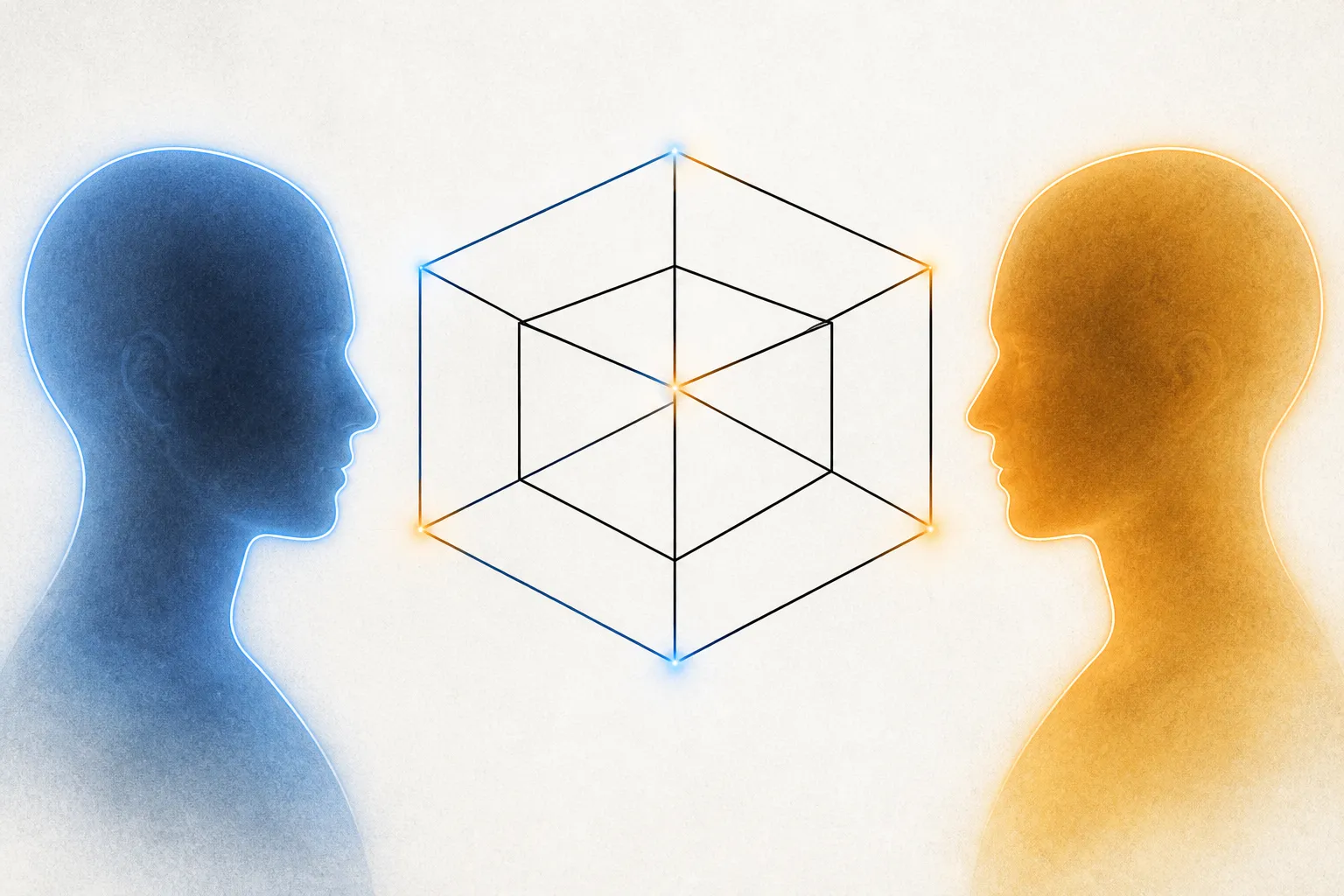
Look at a wireframe cube long enough and it will change on you. Nothing on the page moves. Your brain just picks a different answer. That is the Necker Cube, and it is a handy way to catch your own mind in the act.
What the Necker Cube shows
The drawing is a set of lines with no shading and no depth cues. You can read it two ways. In one, the front face sits below and to the left of the back face. In the other, the front face sits above and to the right. The experience seems to flip between a cube pointing down and left and a cube pointing up and right, according to The Illusions Index.
There is a third reading too. You can see the figure as flat lines on paper, which is why the same source calls it three-way ambiguous. One set of marks, three valid pictures. The cube also belongs to a larger family of figures that can be seen in two or more sharply distinct ways. In these figures the sensory input stays constant while the perceived content changes.
Origins and the history of the illusion
Louis Albert Necker was a Swiss crystallographer and geographer, and he lived from 1786 to 1861. He first published the illusion in 1832, in the London and Edinburgh Philosophical Magazine and Journal of Science, per the same entry. A crystallographer drawing cubes makes sense. Staring at line drawings of solid shapes is the job.
According to the New World Encyclopedia, Necker first described the effect in a letter to Sir David Brewster. His original figure was a rhomboid. A cube is what most people use now, and it is the version that stuck in textbooks.
The Illusions Index also mentions a second version of the cube that looks flat at first but can be seen as a 3-D cube. It says little more than that, so I will not guess at the details.
How the flip is explained
The drawing is made in isometric perspective. Nothing tells you which line crosses in front of another. That leaves two valid 3-D orientations, and your brain has no rule to choose between them. The New World Encyclopedia calls the resulting back and forth multistable perception.
Here is the part people agree on. The retinal image stays constant during the illusion. The light hitting your eye does not change, yet what you experience does.
Here is the part they do not agree on. Some researchers say the visual experience itself changes at the switch. Others say something later changes, such as a belief, a judgment, or another mental process. The sources I used do not say what neural mechanism causes the flip, so treat any confident story about the cause with suspicion.
One more detail. The brain usually settles on one of the two consistent 3-D readings. It does not pick a scrambled one. Scrambled versions show up in the impossible cube, a different drawing. The same encyclopedia says many people most often see the lower-left face as the front, though that is a common claim and not a rule.
Why philosophers care about the cube
The cube shows up in arguments about whether visual experience represents 2-D or 3-D space. The Illusions Index argues that if the switch is a change in visual experience itself, the best explanation is that visual experience is as of 3-D space. That is one side of a live debate, not a settled result.
It also ties into modularity of mind and cognitive penetration. A module, in this view, is a semi-independent part of the mind that takes particular inputs and gives particular outputs. Its inner workings are not open to conscious awareness. Cognitive penetration asks whether beliefs and expectations can reach in and change what perception hands you. The source cuts off mid-explanation and skips the details of the cited debate, so the full argument is not available here.
Try it yourself
Here is a simple exercise. Look at the cube and ask one question.
Which face is in front?
Note your first answer. Keep looking, and wait for the switch. Then jot down roughly how long each reading holds. Try it again while you hold one reading on purpose, and see if you can force the flip. Treat the numbers as your own observation, not science. The sources I used give no typical switching times and no training advice, and I will not invent any.
It is a cheap, two-minute exercise in noticing that seeing is something your brain does, not something that just happens to you.
Two plates to keep