brain exercises
The Cognitive Engine: How Brain Teasers Build a Sharper Mind
Far from mere diversions, brain teasers are precise cognitive instruments. Here is what the research actually shows, and one puzzle to test yourself before you read further.
Charlie6 min read

The brain is an engine built for problem-solving, and few activities engage its full capacity quite like a well-crafted brain teaser. These are not mere diversions. They are precise cognitive instruments, activating multiple neural pathways simultaneously. When you pick up a physical puzzle, you are not just seeing shapes. You are recruiting spatial reasoning, pattern recognition, and working memory, forcing these systems to collaborate dynamically. This integrated engagement pushes the brain into a state of optimal cognitive load, challenging it enough to stimulate growth without overwhelming it.
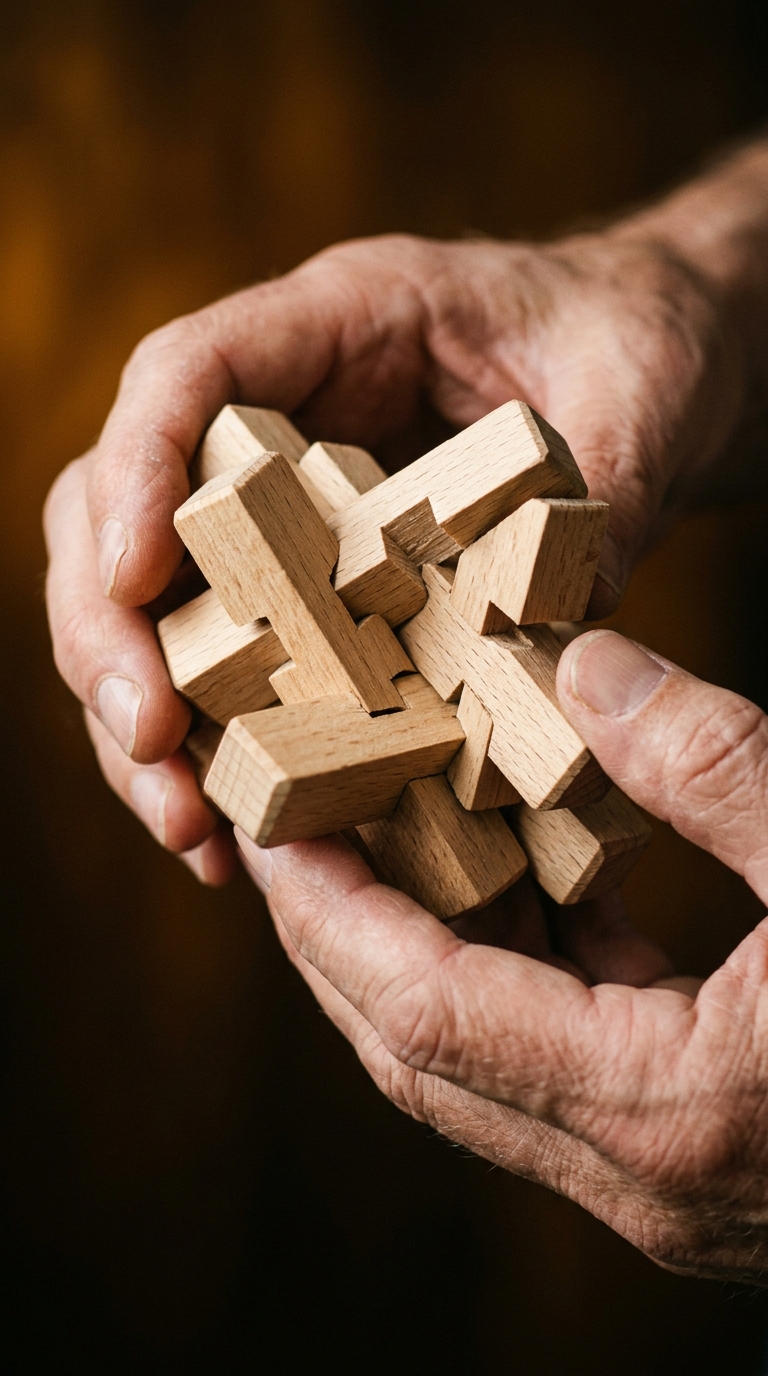
This productive struggle is where measurable neural adaptations begin. Too easy, and the brain idles. Too hard, and it disengages. The sweet spot, consistently hit by effective brain teasers, lies at the edge of current ability, creating good conditions for neuroplasticity. Gary Small, chair of psychiatry at Hackensack University Medical Center, calls it finding "that sweet spot" where the challenge is just right to activate neural circuits, a framing reported by National Geographic in April 2025. The tactile feedback from manipulating physical objects adds another layer. The proprioceptive sense, knowing how a piece feels and moves in your hand, engages motor cortex regions alongside visual and logical centers, broadening the workout.
Try This One Before Reading Further
Brain teasers are easier to discuss after you have felt one resist you. Here is a classic logic puzzle used in cognitive research contexts. Read it once, sit with it, and resist scrolling to the answer.
The Puzzle: A man walks into a restaurant and orders albatross soup. He takes one sip, then goes home and kills himself. Why?
This is a lateral-thinking puzzle, not a trick question about soup. The answer requires you to construct a backstory the puzzle deliberately withholds.
Answer: The man had been shipwrecked. Stranded and starving, his companion told him he was eating albatross soup to keep his spirits up. The companion was lying. The man had actually eaten his wife, who died in the wreck. When the restaurant soup tasted nothing like what he had eaten on the island, he understood the truth for the first time.
Notice what your brain did during those seconds. It searched for hidden premises, questioned what it assumed, and revised its model of the situation as new information surfaced. That sequence, assumption, revision, resolution, is the cognitive loop that makes brain teasers genuinely useful, not just entertaining.
What Research Actually Says About Cognitive Benefits
The case for brain teasers is real but more modest than popular accounts suggest. A 2022 study published in NEJM Evidence found that people with mild cognitive impairment who worked crossword puzzles over twelve weeks showed cognitive improvement, though researchers noted the gains were modest and specific to that population. A 2024 study of more than 9,000 participants found board games and puzzles were the strongest predictors of reasoning skills and a top predictor of memory and verbal ability, according to National Geographic. The link may be correlation rather than causation, and experts are careful to say so. Still, correlation at that scale, across that many people, is not nothing.
A long-running BMJ study tracked nearly 500 Scottish volunteers from age 11 through their late seventies, testing cognitive performance six times over fourteen years. Researchers found no association between problem-solving activity and the slope of decline, but they did find that habitual problem-solvers built higher baseline ability over a lifetime. When decline came, it started from a higher point, delaying the threshold at which impairment became meaningful, according to reporting by Theravive. The practical implication is that starting earlier matters more than starting harder.
Working memory gains are among the most consistently reported benefits. Holding multiple possible configurations in mind, testing each one, and recalling which approaches failed directly trains the brain's temporary storage system. Spatial reasoning is a second consistent finding: dissection games and 3D assembly puzzles demand that solvers mentally rotate shapes before moving a single piece, exercising the same mental rotation abilities assessed in standard cognitive tests. Researchers propose these activities build what they call cognitive reserve, a buffer that helps maintain function as age-related changes occur, as summarized by the Mosait research team reviewing 2024 and 2025 peer-reviewed literature.
The Medium Changes the Mental Workout
Not all brain teasers produce the same cognitive load, and the medium is part of the mechanism. Wooden puzzles, including burr puzzles, cipher challenges, and dexterity mazes, introduce tactile and aesthetic elements that extend engagement. Solvers tend to spend more time with objects they find satisfying to handle, and more time in the productive struggle zone means more sustained training, according to Creative Crafthouse. That extended contact time is the operative variable, not some special property of wood.
Format diversity matters for a different reason. Someone who works only one puzzle type, say edge-matching games, will develop highly specific skills within that narrow domain. Rotating across math puzzles, string puzzles, and logic grids keeps the brain encountering genuine novelty, which is the primary driver for forming new neural connections. The brain adapts to repeated patterns quickly. Novelty is what keeps adaptation moving.
Digital adaptations of classic brain teasers offer real convenience. They also sacrifice something. The physical resistance of manipulating a wooden piece, the friction and weight of an object that pushes back, slows the solving process slightly. That slower pace gives solution strategies more time to consolidate before the next move. Screen-based puzzles tend to move faster, which can reduce the depth of processing. That is a tradeoff, not a disqualifier, but worth knowing when choosing a format.
Artificial Intelligence and the Puzzle Benchmark
Artificial intelligence researchers have long used logic puzzles and constraint-satisfaction problems as benchmarks to measure machine reasoning. A 2024 preprint on arXiv (paper 2405.16129) examined how large language models perform on tasks structurally similar to human brain teasers. The findings run in both directions: models handle formal logic at speed, but they consistently struggle with puzzles requiring embodied spatial intuition, the kind of knowing-by-doing that physical puzzle solvers develop naturally. That asymmetry mirrors the uneven cognitive profile seen in human specialists who train hard in one domain and stay weak in adjacent ones.
This computational lens is reshaping how puzzle designers approach difficulty calibration. By modeling a puzzle's search space, counting possible moves, mapping the depth of the solution tree, and identifying misleading branches, designers can engineer challenges that are provably difficult in specific cognitive dimensions while remaining solvable with sustained effort. The goal is to stay in that productive zone, hard enough to drive adaptation, approachable enough to keep the solver engaged rather than frustrated.
Adaptive puzzle systems are the near-term extension of this thinking. Systems that adjust complexity based on a solver's real-time performance could keep users inside their productive challenge zone continuously, rather than requiring them to hunt for the next appropriately difficult puzzle. The core principle stays the same regardless of delivery method: the right problem at the right moment, repeated over time, is what drives meaningful cognitive change. One sip of the right kind of difficult is worth far more than hours of comfortable repetition.