brain power
The Card Puzzle That Trips Up Smart People
A 1966 logic task shows how easily we look for evidence that confirms a rule instead of evidence that could break it.
Frank4 min read


Four cards sit on a table. You get one rule and one job. Most smart people fail it, and they fail it in the same way every time. That is why a puzzle from 1966 is still taught today.
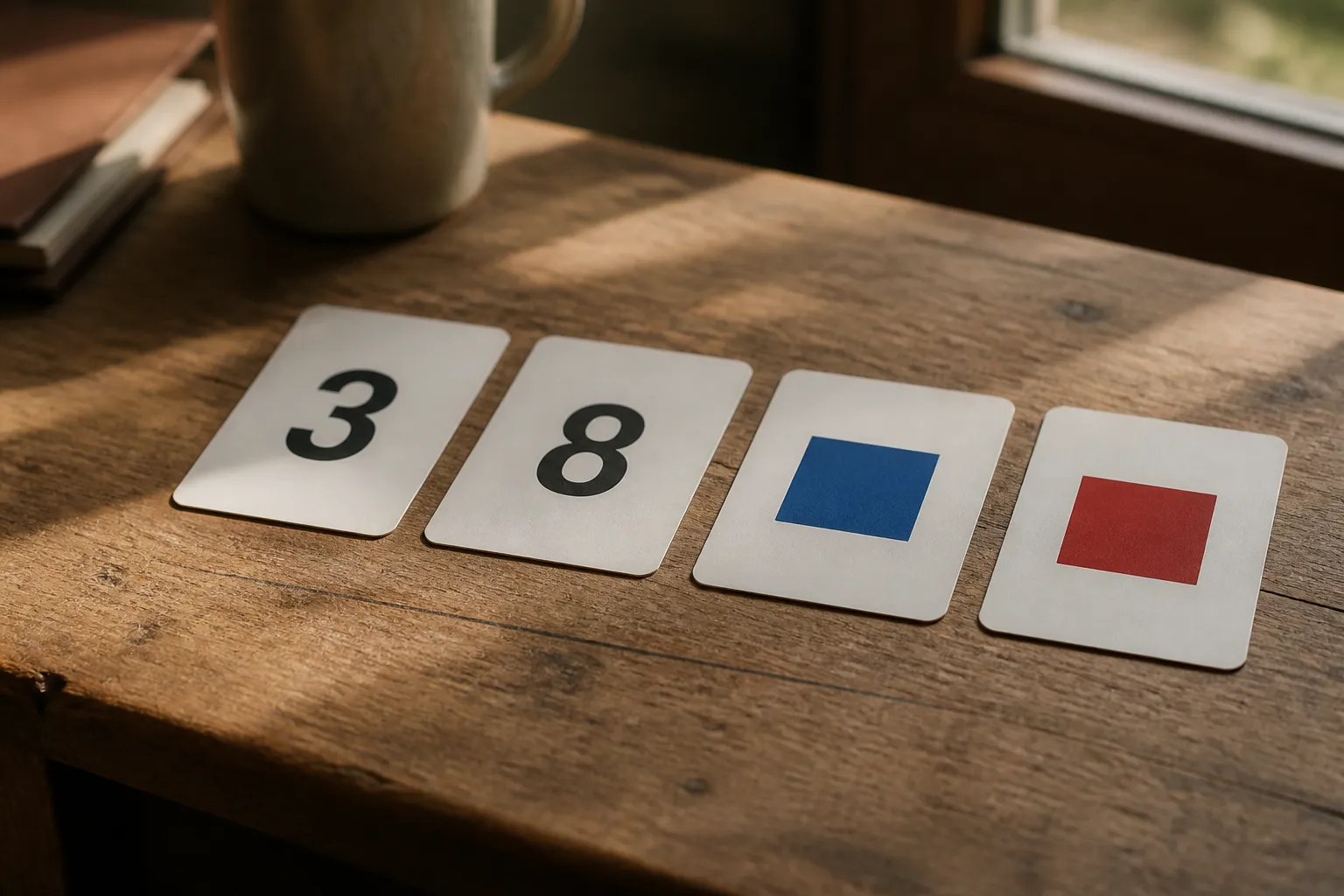
The challenge: Each card has a number on one side and a color on the other. You can see 3, 8, blue, and red. The rule is: if a card shows an even number on one face, then its opposite face is blue. Which cards must you turn over to test whether the rule is true? Turn over as few as you can, but do not skip any you need.
Think you have it?
Stop here and pick your cards before you read on. Write them down if you like. The point of the exercise is to catch your own first instinct, not to feel clever afterward.
Done? Good. Keep that answer handy. We will come back to it.
The task and its origin
Peter Cathcart Wason devised this puzzle in 1966. It is also called the four-card problem, and it is one of the most famous tasks in the study of deductive reasoning.
The classic version uses a rule like "If a card has a vowel on one side, then it has an even number on the other side." Four cards show only one face each, for example A, D, 4, and 7. You decide which cards to flip to test whether the rule holds. It takes thirty seconds to explain, which is a big reason researchers keep using it to study how people test conditional rules.
The correct reasoning
Go back to our cards. The right answer is the 8 and the red card.
Why the 8? An even number is exactly what the rule talks about. If its back is not blue, the rule is broken. So you have to look.
Why the red card? The rule says even numbers go with blue. A red card is not blue, so if it hides an even number, the rule fails. Look at it too.
Now the two you can leave alone. The 3 is odd, and the rule says nothing about odd numbers. Whatever is on its back, the rule survives. The blue card feels like it deserves a flip, but it does not. The rule never says that only even numbers can sit on blue cards. An odd number behind blue breaks nothing, per the worked example.
Underneath, the "if" is read as the material conditional from classical logic. That means you can solve it with two tools: modus ponens (even, so check for blue) and modus tollens (not blue, so check that it is not even). Nothing fancier is needed.
Why most people get it wrong
Many people grab the 8 and the blue card. The blue card feels right because it could confirm the rule. But only cards that could falsify the rule are worth flipping. This pull toward confirming evidence is the core demonstration of confirmation bias.
Other mistakes are easy to spot. Picking a card that need not be turned, or leaving out one that must be, counts as incorrect. Researchers usually measure the proportion of people who choose the exact right set, and that number tends to be low when the rule is abstract. I will not quote percentages, because the sources I used do not give them.
Explanations and variations
Here is the odd part. People struggle in most versions, but they can usually solve it when the imagined context is policing a social rule. Same logic, different dress, much better results.
Researchers have offered several accounts. Confirmation bias is one. Mental models theory (Johnson-Laird, 1983) is another. Pragmatic reasoning accounts (Cheng and Holyoak, 1985) argue that performance improves when rules line up with familiar social contracts. The social version is also linked to an evaluation of social relations hypothesis.
The practical lesson is small and useful. When you test a claim, ask which observation could prove it wrong, then go look there first. Which cards can falsify the rule? Start with those, and ignore the ones that merely feel supportive.