brain power
The Café Wall Illusion: How Straight Lines Learn to Lie
A Bristol café's black-and-white tiles reveal how the brain's edge-detecting neurons manufacture tilt out of perfectly parallel lines.
Tony5 min read

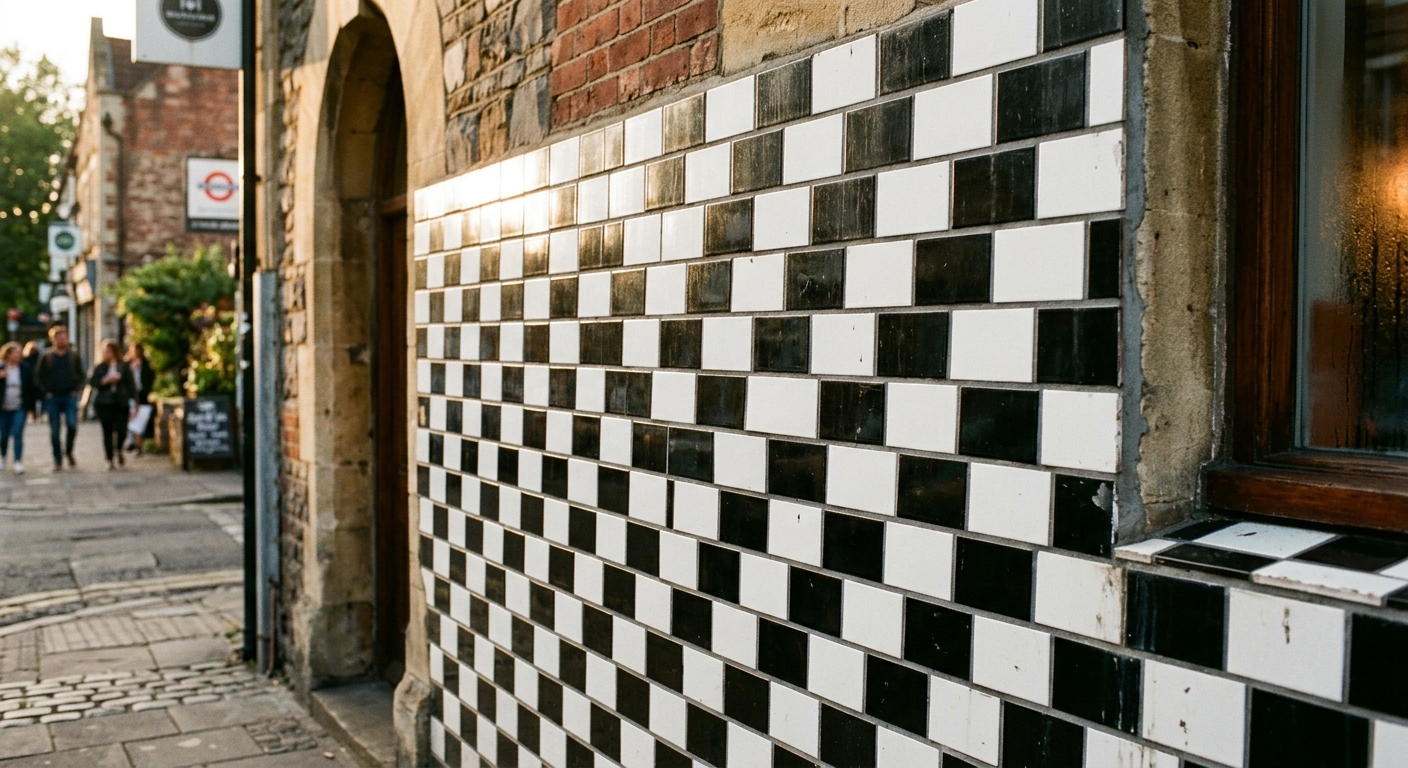
Somewhere in Bristol there is a café that never asked to become a psychology textbook, and yet here we are. Its exterior wall is tiled in tidy rows of black and white squares, laid brick-fashion, with a thin seam of gray mortar running between each row. The rows are dead level. A surveyor could confirm it with a laser and a smug grin. And yet every human who looks at that wall sees the rows sag and taper like a drunk trying to walk a straight line. That gap between what is physically true and what your brain insists is happening is the whole show.
A Wall in Bristol Started It All
Credit for noticing goes to a member of neuroscientist Richard Gregory's lab, who spotted the tilting effect on the tiled facade of a café on St Michael's Hill and dragged Gregory over to look. Gregory, working with Priscilla Heard, formalized the observation and gave it a name distinct from the older grid illusions it superficially resembles, according to the New World Encyclopedia's account of the discovery. The pattern itself is unglamorous: alternating rows of dark and light tiles, each row shifted sideways relative to the one above it, like bricks in a wall, with a strip of intermediate gray mortar separating the rows. Photograph it, sketch it, tile an actual building with it, the result is the same. Rows that are perfectly parallel in reality read as converging, diverging, wedge-shaped lines to every eye that lands on them.
The Optics of Offset Tiles
The illusion is fussier than it looks, which is exactly why it has survived as a research subject for decades instead of getting filed away as a cute curiosity. Three ingredients have to show up together. You need strong contrast between the light and dark tiles, you need the bricklike offset between adjacent rows, and you need that gray mortar line sitting between them at a brightness roughly halfway between the two tile shades. Pull any one of those out and the tilt collapses. Line the tiles up in neat, unoffset columns instead of a brick pattern, and the rows sit there being boringly straight. Widen the mortar line into pure black or pure white instead of gray, and the tilt vanishes just as fast, a detail documented in the overview of the effect on Wikipedia. Vision scientists treat that sensitivity as a gift, because it means you can dial the illusion up, down, or off entirely just by nudging one variable, which is about as clean as a laboratory setup gets.
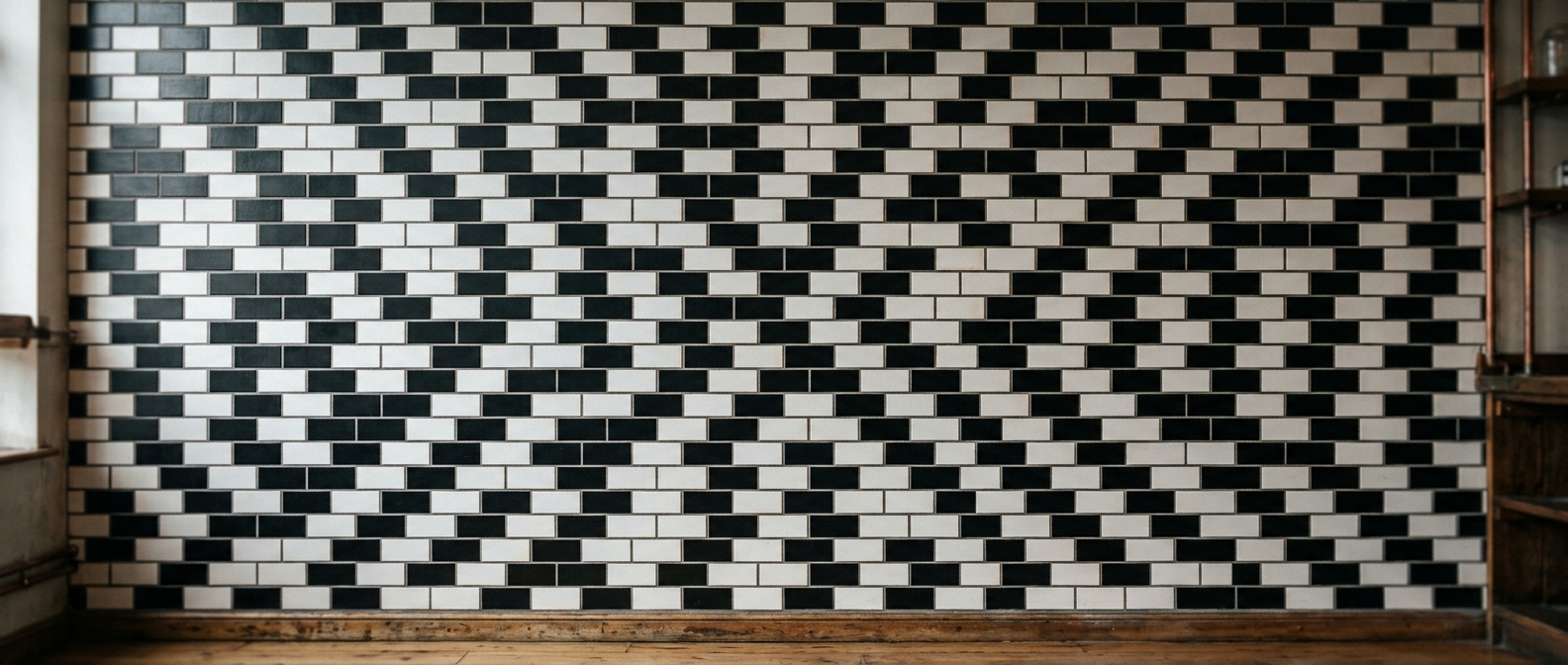
Adjust how far each row is offset and the illusion doesn't just get stronger or weaker in a straight line. At small offsets the tilt is faint. Push the offset toward roughly a quarter of a tile width and the tapering effect peaks. Push it further and the perceived slant can flatten out again or even bend into something closer to a gentle bow than a clean diagonal. That non-monotonic behavior is a headache for any theory trying to explain the illusion with a single tidy rule, and it's part of why the café wall has earned its own dedicated literature instead of being lumped in with simpler brightness illusions.
Why Your Visual Cortex Gets Fooled
The leading explanation lives at the level of individual neurons in the early visual cortex, the ones whose entire job is detecting edges and orientation. Along the boundary where a dark tile meets the gray mortar, and again where a light tile meets that same gray mortar, these edge detectors respond asymmetrically. The result is a set of tiny, localized brightness errors right at the tile-to-mortar seams, an effect sometimes described under the older term irradiation. None of those errors is large on its own. The trouble starts when the brain's low-level filters, which are built to stitch local edge information into continuous contours, connect those scattered brightness glitches into one smooth, sloping line. You end up perceiving a coherent tilt that was never present in the actual geometry, because your visual system is doing exactly what it evolved to do: finish the line, assume continuity, move on. The café wall belongs to a broader family of geometric tricks sometimes grouped under the label twisted cord illusions, where repeating contrast patterns generate false diagonals through the same basic mechanism.
Beyond the Café: Where Else It Shows Up
Once you know the recipe, you start seeing it everywhere, and not always on purpose. Building facades, tiled bathroom floors, and even some textile patterns have accidentally reproduced the exact offset-and-mortar combination, occasionally generating genuine complaints from people convinced their newly tiled wall was laid crooked. Architects and designers have caught on both ways. Some deliberately court the effect for a restless, dynamic facade. Others avoid the specific ratio of offset to mortar tone precisely because they want a calm, orderly surface that doesn't argue with the eye. Meanwhile the illusion keeps earning its keep in labs and classrooms, since it can be recreated with nothing more than a checkerboard grid and a gray marker, making it one of the cheapest, most reliable demonstrations of how contrast-processing neurons behave when you feed them a deliberately ambiguous pattern. It is, frankly, an embarrassingly simple trick for how thoroughly it humiliates your visual system, and that is precisely why it has outlasted fancier illusions for fifty years running.