brain power
The Buried Coin Logic Grid Puzzle and How to Solve It
A step-by-step look at why logic grid puzzles work and what makes the treasure-hunt format so effective at teaching deductive chaining.
Frank6 min read

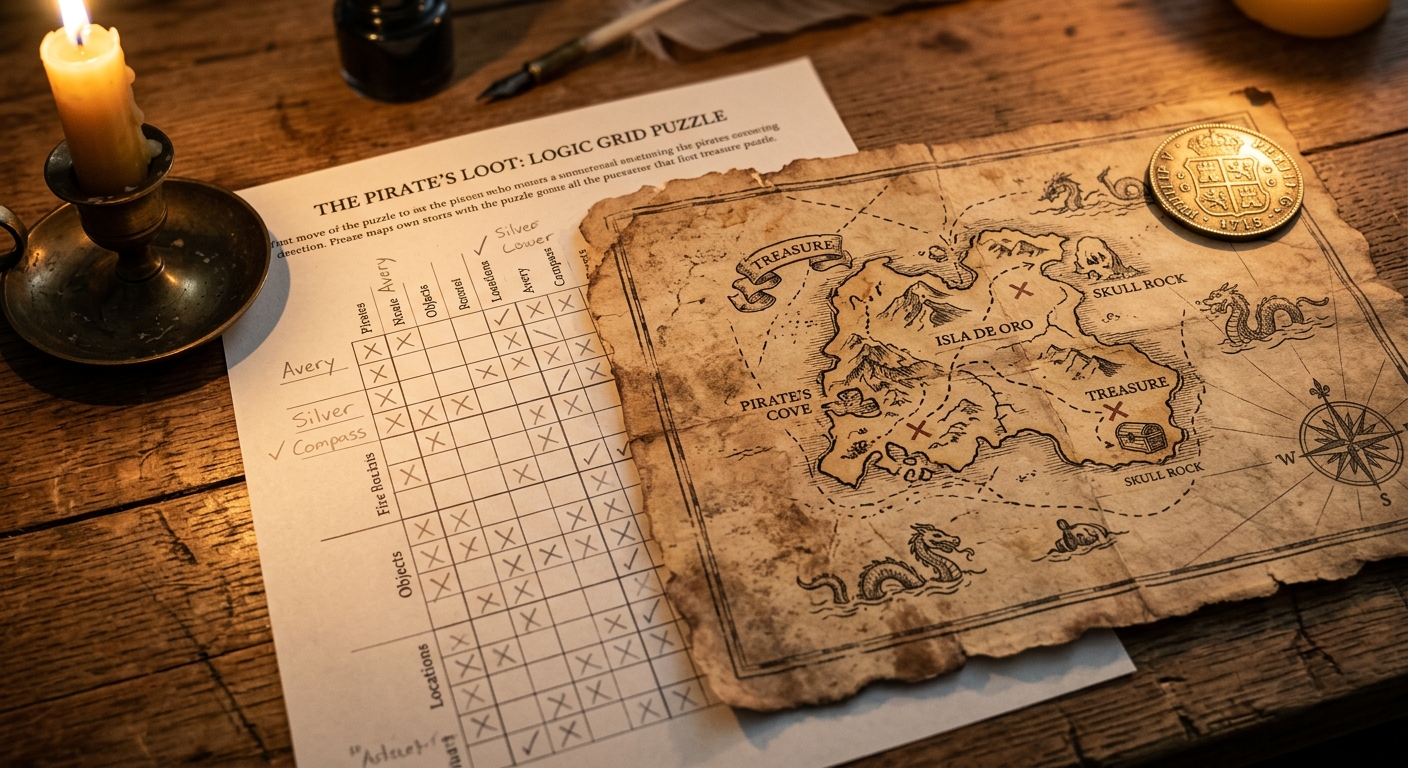
Most people look at a logic grid puzzle and think it is just a patience exercise, something to fill time on a slow afternoon. That undersells what is actually happening. A well-built logic grid is a small closed universe with exactly one exit, and finding that exit requires chaining deductions in a way that feels genuinely satisfying once the last cell locks in. The Buried Coin puzzle is a good example of the form at its best.
What Logic Grid Puzzles Actually Are
A logic grid puzzle hands you a closed world: a fixed set of characters, a fixed set of attributes, and a fixed set of constraints. Your only tool is process of elimination. Guessing is not just discouraged; it is structurally pointless, because a wrong assumption will either contradict a clue directly or leave the grid with no valid solution. According to Wikipedia's overview of the form, the genre traces back at least to the nineteenth century and was popularized throughout the twentieth in puzzle magazines, with the yes/no grid matrix becoming the standard visual aid.
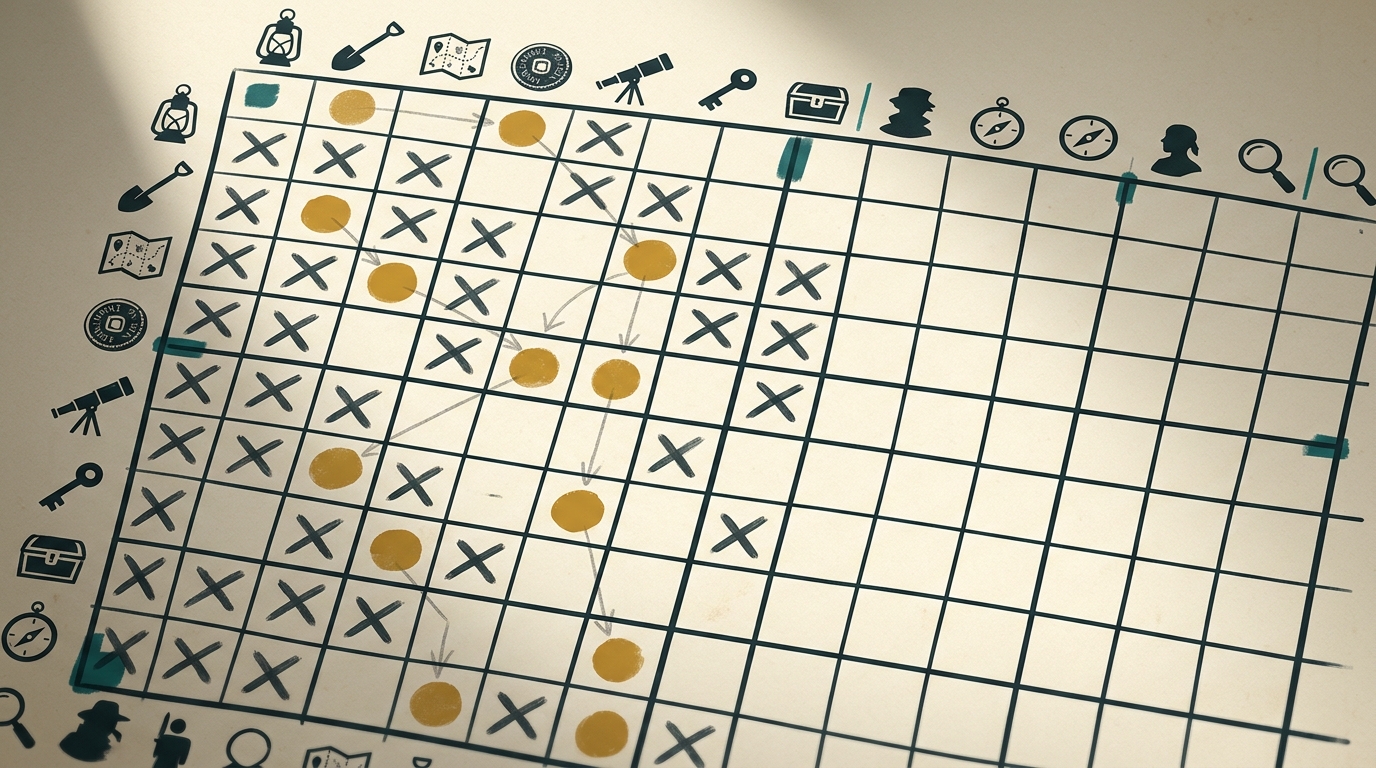
That grid matters. Each cell in the matrix represents one possible pairing between a character and an attribute. A confirmed pairing gets a checkmark; a ruled-out pairing gets an X. The solver works the matrix systematically, and the grid makes every intermediate result visible so nothing slips. Unlike riddles, which reward lateral thinking, or probability puzzles, which require estimating likelihood, logic grids are fully deterministic. Every clue is a hard constraint, and the correct answer is always the only answer that satisfies every constraint simultaneously. No intuition required.
The Buried Coin Scenario Explained
The Buried Coin puzzle follows the standard structure: four adventurers, four coin denominations, four distinct locations. Each adventurer buried exactly one coin in exactly one place. The solver's job is to reconstruct each complete triple from a handful of natural-language clues.
That natural-language step is where the real work begins. A clue reading "the person who buried the gold coin did not dig near the old oak" sounds simple enough, but it eliminates one cell in the coin-versus-location layer of the grid, and once other cells resolve, that elimination cascades into confirmed assignments elsewhere. Puzzle designers who use coin denominations as an attribute layer are doing something deliberate: copper, silver, and gold carry an implicit ordering by value, and that ordering allows asymmetric clues that feel intuitively fair but are surprisingly constraining. A clue like "the adventurer who buried the most valuable coin arrived before the one who buried the least valuable" uses the ordering to link two separate attribute categories without ever naming a specific character, which forces the solver to hold the ordering in mind across multiple passes.
The treasure-hunt framing also does real work. Buried loot, competing seekers, hidden locations, these narrative details give a purely abstract deductive exercise enough texture to carry a solver through the slower middle section of the grid, before the cascade of final answers begins and the puzzle starts resolving quickly on its own momentum.
- Who buried the copper coin?
- Which adventurer dug near the old oak?
- Was the gold coin buried at the riverbank or the cliffside?
- Which adventurer arrived last, and what did they bury?
- The copper coin was buried by the adventurer at the ruined chapel.
- The old oak was the site dug by the adventurer who buried silver.
- The gold coin was buried at the cliffside.
- The last adventurer to arrive buried the bronze coin at the riverbank.
The Solving Process Step by Step
Experienced solvers open with a scan for direct assignments: any clue that places one character with one attribute without needing prior deductions. Those cells get confirmed immediately, and confirmed cells almost always unlock something else. Finding one of these early is not luck; it is what the puzzle designer planted to give you a foothold.
The second pass works negative constraints. Clues that rule out a pairing fill in the elimination cells methodically. Once a row or column has only one remaining open cell, that cell becomes a confirmed assignment by exclusion, not by any clue that names it directly. This is where the grid format earns its keep: you can see the remaining possibilities at a glance rather than holding them in working memory.
The final phase involves chained reasoning across attribute categories, and this is where the puzzle either clicks or stalls. If adventurer A is confirmed at the riverbank, and a clue states the riverbank digger used a copper coin, and a separate clue states the copper coin was not buried by the person who arrived last, then adventurer A was not the last to arrive. That conclusion touches a third attribute category, one neither of the two original clues addressed directly. Chains like this are what separate a mechanical fill-in exercise from something that genuinely requires careful thinking. Mathematical logic of this kind, the formal manipulation of constraints rather than probabilities, underpins a surprising amount of serious analytical work beyond recreational puzzles.
Why Coin Puzzles Resonate with Puzzle and Arcade Fans
The incremental reveal structure of a logic grid mimics the feedback loop that makes score-chasing arcade games compelling. Each solved cell visibly changes the board state. Progress is legible. Attention and pattern recognition get rewarded in real time, not just at the end. That is not a coincidence; it is a design feature, and it explains why the format has survived across formats and decades.
Digital implementations have found a dedicated audience. Logic Grid Puzzle on Steam is one example of the form finding a home among players who enjoy deliberate, rule-bounded thinking. The audience overlaps heavily with strategy game fans and puzzle arcade players, which makes sense: the cognitive appeal is the same even when the visual aesthetics are completely different. One is about resource management under fog of war; the other is a blank matrix. Both reward the same habit of holding multiple constraints in mind and moving methodically rather than impulsively.
The coin framing adds one more layer. Treasure mythology, buried loot, competing seekers, hidden sites, it gives the abstract exercise a story to inhabit. That story is thin by design. It does not need to be thick. It just needs to be enough to keep a casual solver engaged through the slower middle section of the grid, where progress feels halting and the cascade of final answers has not yet started. Once it does start, the story falls away entirely and the pure logic takes over. That transition, from narrative puzzle to pure deduction, is the moment most solvers remember longest.