brain power
The Algae Protein That Gave Neuroscience an On/Off Switch
The 2026 Nobel Prize in Physiology or Medicine rewards Karl Deisseroth, Peter Hegemann, and Georg Nagel for optogenetics, a method born from a curious alga that lets researchers activate or silence individual nerve cells with light. Take the three-question challenge inside before you read on.
Tony7 min read

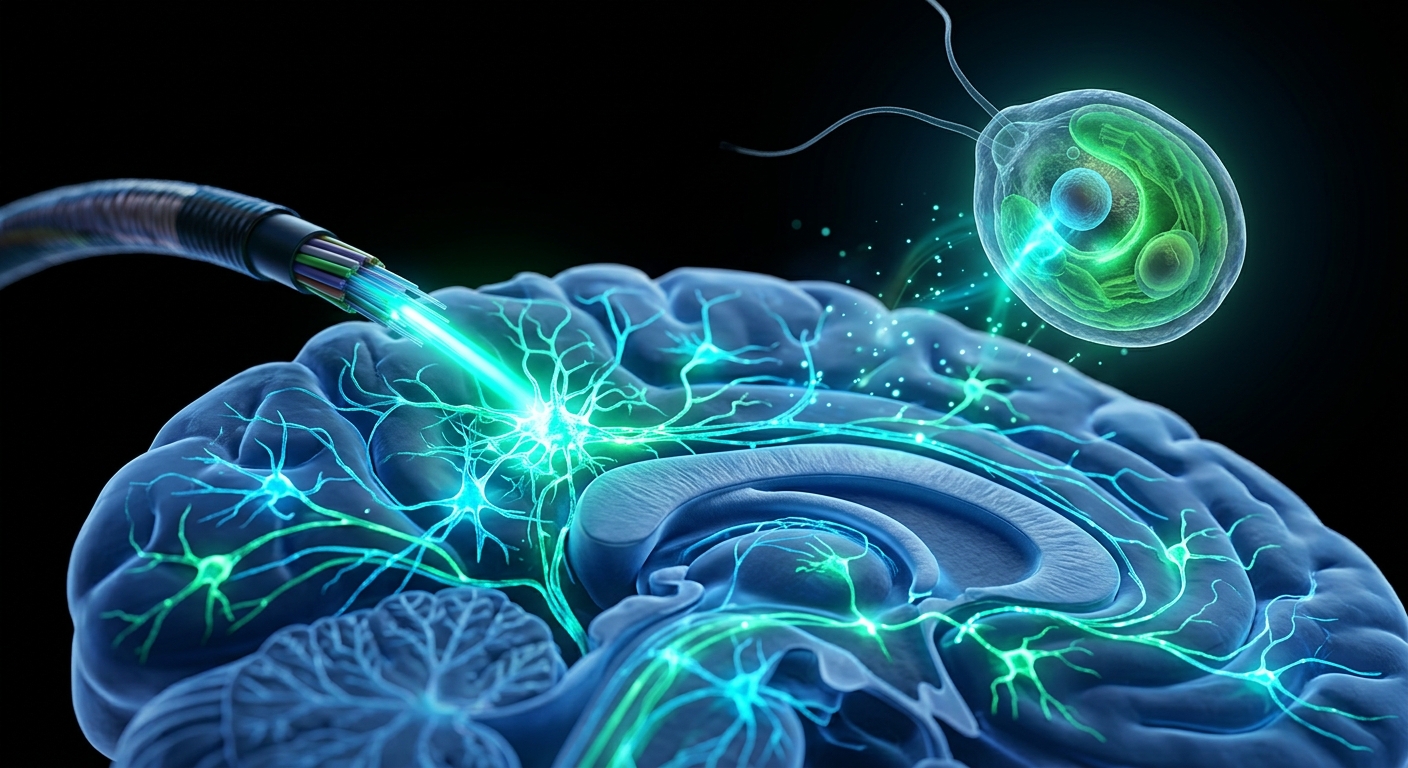
The 2026 Nobel Prize in Physiology or Medicine went to Karl Deisseroth, Peter Hegemann, and Georg Nagel for discoveries about light-gated ion channels and optogenetics. The prize is about a protein found in algae that gave neuroscientists a precise on/off switch for individual nerve cells in a living brain. That is the actual story, and it is strange enough that it needs no embellishment.
Quick Check: Could You Have Guessed This?
Before the science, a short challenge. Three questions. No timer, no trick answers, just a gut check on how much most people intuit about memory and brain research before reading further.
- What kind of organism does the protein at the center of this prize come from? (a) a sea snail, (b) a single-celled alga, (c) a fruit fly, (d) a cave-dwelling fish
- What does optogenetics use to trigger a nerve cell? (a) a mild electric current, (b) a chemical injection, (c) a pulse of light, (d) a magnetic field
- Before optogenetics, researchers could identify which brain regions were active during a behavior. What could they NOT reliably prove? (a) that the region contained neurons, (b) that a specific cell type directly caused the behavior, (c) that neurons use electrical signals, (d) that memory involves the hippocampus
Answers: b, c, b. If you got all three, you already think like someone who has spent time with this material. If you missed one or two, the next sections explain exactly why those answers are correct, and why each one surprised a fair number of working scientists when the underlying discoveries were first published.
How a Single-Celled Alga Changed Brain Science
Peter Hegemann spent years wondering how Chlamydomonas, a microscopic alga, manages to swim toward a light source. In the early 2000s, he and Georg Nagel identified channelrhodopsin, a protein sitting on the alga's cell surface. When blue light hits it, a channel opens through the protein, charged ions flow in, and an electrical impulse fires. The detail that made everything else possible: put the gene for channelrhodopsin into any cell, and that cell becomes light-sensitive. The protein does not care what kind of cell it is in. It just responds to light.
That is already a remarkable sentence, and Hegemann wrote it in a paper about pond algae. Nobody convened a committee to decide channelrhodopsin was relevant to neuroscience. It simply was, the moment someone looked at it long enough. As the Nobel Assembly's press release notes, Hegemann and Nagel found that regardless of which cell they put the protein in, those cells became light-sensitive, a property that turned a curiosity about phototaxis into a universal neural tool.
What Neuroscience Looked Like Before the Switch Existed
To understand why the Nobel Committee called this prize-worthy, you have to understand the problem it solved. Through most of the twentieth century, neuroscientists could identify which brain regions were involved in a behavior. They could not prove that any specific type of nerve cell directly caused a feeling or action. The methods available, including lesion studies, electrode arrays, and pharmacology, were blunt. They affected whole regions, mixed cell types, and produced correlations rather than causes.
As the popular-information document puts it, the picture of the brain that emerged was like a blurry photograph, missing many details. Francis Crick, decades after the double helix, imagined a tool that could activate individual nerve cells. He thought light was probably the right medium because neural signals are fast and light can be applied with spatial and temporal precision. He admitted the idea sounded far-fetched. The 2026 laureates built it anyway, using an algal protein nobody initially expected to be relevant to anything outside of phototaxis research.
Karl Deisseroth introduced the channelrhodopsin gene into rat nerve cells. Shine blue light on those cells and a nerve signal fires. Do it in the brain of a living mouse and you can trigger specific neural activity with millisecond precision, targeting only the cells that carry the gene. That method is optogenetics. The Nobel Assembly is not given to hyperbole, which makes its description of optogenetics as the foundation of a new era in neuroscience worth reading twice.
What the Method Actually Lets Researchers Do
The practical reach of optogenetics is wide. Researchers can now ask causal questions that were previously out of reach. Does activating this specific population of neurons in the hippocampus produce a memory? Does silencing these cells during a fear response prevent it from forming? Does restoring activity in a depleted circuit rescue a behavioral deficit in a mouse model of disease? Those experiments are now possible, and many have already been run. The switch changed what questions neuroscience is permitted to ask, and the field has been working through the backlog ever since.
The prize citation names memories, feelings, and behaviors as the three domains optogenetics is already illuminating. Studies have used the method to identify which neurons store a specific fear memory, to map the circuits underlying depression-like states in rodents, and to probe the sleep-wake cycle at the level of defined cell populations. None of that was achievable with the older toolkit. One algal gene, one blue laser, one mouse. The experiment runs. The cause is confirmed or it is not. That directness is the whole point.
A connecting detail worth holding onto: Deisseroth's first optogenetic experiments in neurons date to around 2005, consistent with the timeline described in the Nobel popular-information document. The prize followed roughly twenty years later. By historical standards, that is not a long wait. The committee tends to hold prizes until clinical or scientific impact is undeniable. Optogenetics reached that threshold quickly because the method spread fast, generated reproducible findings across many labs, and opened experimental doors that had been closed for the entire history of neuroscience.

The spatial memory angle is worth a brief note, since the story has been confused before. The 2014 Nobel in Physiology or Medicine went to John O'Keefe and May-Britt and Edvard Moser for discovering place cells and grid cells, the neurons that give the brain its internal spatial map. That work described a circuit. Optogenetics is a method for interrogating any circuit with a precision those earlier researchers did not have. Spatial memory research adopted optogenetics because the method lets you test exactly how place cells participate in encoding and retrieving episodes, rather than merely observing that they are active when an animal navigates.
Why This Prize Lands Where It Does in the Field's Timeline
Broad adoption, causal rigor, genuine novelty. That combination is what a Nobel citation about foundational work actually means. Optogenetics had all three within a decade of Deisseroth's first neuron experiments. Per Svenningsson, chair of the Nobel Committee, put it plainly in the official press release: optogenetics provides opportunities for mapping the brain in a way that researchers could once only dream of. Crick dreamed of it explicitly. The laureates delivered it through a protein that was, until Hegemann started asking questions about algae, entirely unknown to anyone outside of phototaxis research.
Foundational discoveries rarely announce themselves as foundational. Channelrhodopsin was a curiosity about how a pond organism finds sunlight. It became the key to a new era in brain science because two researchers characterized it carefully and a third asked what would happen if you put it somewhere it had never been. The answer turned out to be: a Nobel Prize, twenty years later, and a field that can finally ask the questions it always wanted to ask. Go back and check your quiz answers one more time. The one about causation, question two, is the one that most reshapes how you read neuroscience headlines from here forward.