Brain Teasers
Switch the Door: A Permanent Cure for Monty Hall Stupidity
The Monty Hall Problem has been making smart people look foolish for decades, and here's the math that finally ends the argument.
Tony5 min read

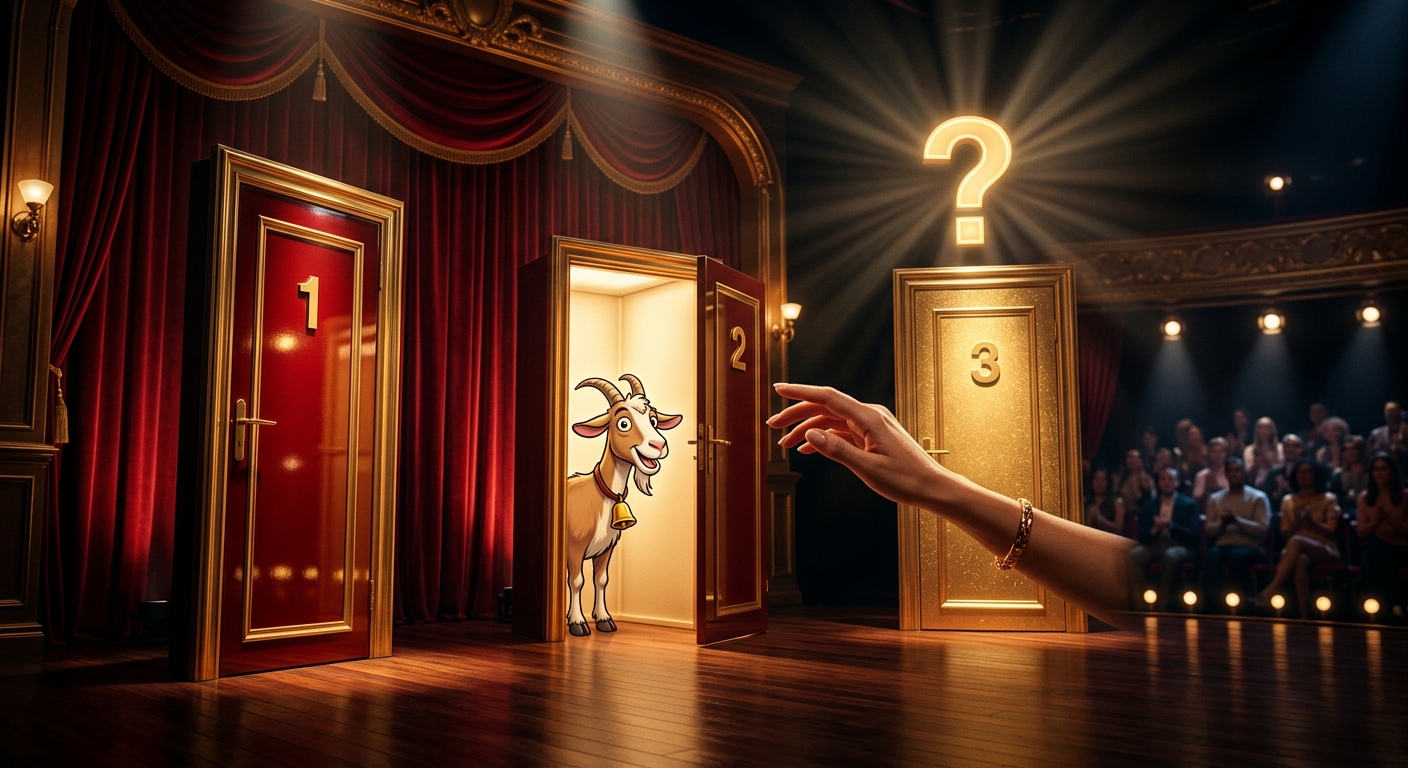
I've been right about a lot of things in my life, most of them profitable, several of them patented. But nothing has ever delighted me quite as much as watching a room full of certified geniuses lose their minds over three doors and a goat. The Monty Hall Problem has been humiliating smart people since 1975, and it hasn't slowed down since. Let's fix that, permanently.
The Setup: Three Doors, One Car, Two Goats
The premise is almost insultingly simple, which is exactly why it works. You're a contestant on a game show, standing in front of three doors. Behind one is a car. Behind the other two are goats, presumably unimpressed by the whole spectacle. You pick a door, say Door 1, and lock in your choice. Now the host, who knows exactly what's behind every door, opens one of the remaining two and reveals a goat. He never opens the car door, and he never opens yours. That rule is not decoration, it's the entire engine of the problem, as laid out in the classic framing of the puzzle from the Data Science Discovery guide at the University of Illinois.
Then comes the twist that made this thing famous: you're offered the chance to switch to the other unopened door instead of sticking with your original pick. Sounds like a throwaway decision. It is, in fact, the only decision that matters, and it's the one that has been dividing dinner parties and faculty lounges since the puzzle exploded into public consciousness through a 1990 magazine column that dared to give the correct answer.
Why Intuition Gets It Wrong
Here's the gut reaction, and I understand it because lesser minds have it constantly: two doors are left, so it must be fifty-fifty. Clean, symmetrical, comforting. Also wrong. This instinct is so persuasive that when the correct answer, switch, was first published, it triggered an avalanche of objections from readers who were absolutely certain they'd caught the columnist in an error, including people with serious mathematical credentials who should have known better.
The flaw in the intuition is subtle, which is the only reason I'll be gentle about it. People assume the host's reveal is neutral, just a random door falling away and leaving two equally likely survivors. But the host isn't random. He knows where the car is, and he is constitutionally incapable of opening that door. That constraint injects information into the system, and information changes probabilities. Treating the two remaining doors as identical twins ignores the fact that one of them is quietly carrying the accumulated weight of an entire group of doors that no longer exists.
The Math: Switching Wins Two-Thirds of the Time
Let's do the arithmetic properly, because that's the only language that settles arguments at my level. When you first pick a door, you have a 1 in 3 chance of being right and a 2 in 3 chance of being wrong. That never changes just because a goat gets revealed later. The host's forced move, opening a door he knows has a goat behind it, doesn't spread that 2/3 chance evenly across the universe. It funnels the entire 2/3 probability into the one remaining unopened door you didn't pick.
So sticking with your original door wins exactly 1 out of 3 times, on average, forever. Switching wins the other 2 out of 3 times. It's not a coin flip dressed up as a puzzle, it's a lopsided bet hiding behind a symmetrical-looking stage set. If you don't trust my arithmetic, and you shouldn't just take my word for anything, you can run the numbers yourself. Interactive simulators built by university data science programs let you play hundreds of rounds and watch the results settle into that same 33 percent versus 67 percent split, exactly as the Illinois data science guide demonstrates with its own hands-on version of the game.
Three Ways to See the Solution Clearly
Nobody has to take this on faith, which is refreshing in a world full of people who want you to just believe them. There are at least three solid ways to make the 2/3 advantage undeniable, and I recommend using all of them if you're arguing with someone who's dug in.
- Build a full decision tree or table that enumerates every possible car placement against every possible initial pick. Once you lay out all nine combinations, the switching advantage stops being a theory and becomes a spreadsheet.
- Run a simulation, either by hand with cups and a coin or with actual code, and repeat the game hundreds of times. The theoretical 33/67 split emerges empirically, which is exactly the approach behind the interactive tool from the Data Science Discovery project.
- Scale the problem absurdly. Imagine 100 doors instead of 3. You pick one, and the host opens 98 other doors, all goats, leaving your original pick and exactly one other door standing. Suddenly switching feels less like a coin flip and more like common sense, because it obviously is.
Each method attacks the same flawed assumption from a different angle. The table proves it structurally, the simulation proves it empirically, and the hundred-door version proves it intuitively, by making the asymmetry too large to ignore. Stack all three together and even the most stubborn skeptic runs out of road.
The Recap, Plate by Plate

Side by side, that's the whole con, and it's a beautiful one. Nothing about the car moves. Nothing about your original guess gets smarter. All that happens is the host's forced, informed reveal collapses two doors' worth of uncertainty into one, and the door left standing inherits it all. Switch every time, do the math if anyone doubts you, and enjoy being the only person at the table who actually understood the game before it ended.