memory
What Deep Sleep Does to Your Memories Overnight
Slow waves, ripples and a newly found reset signal may help the brain store the day. Here is what the studies show, and what they cannot yet say.
Tony4 min read

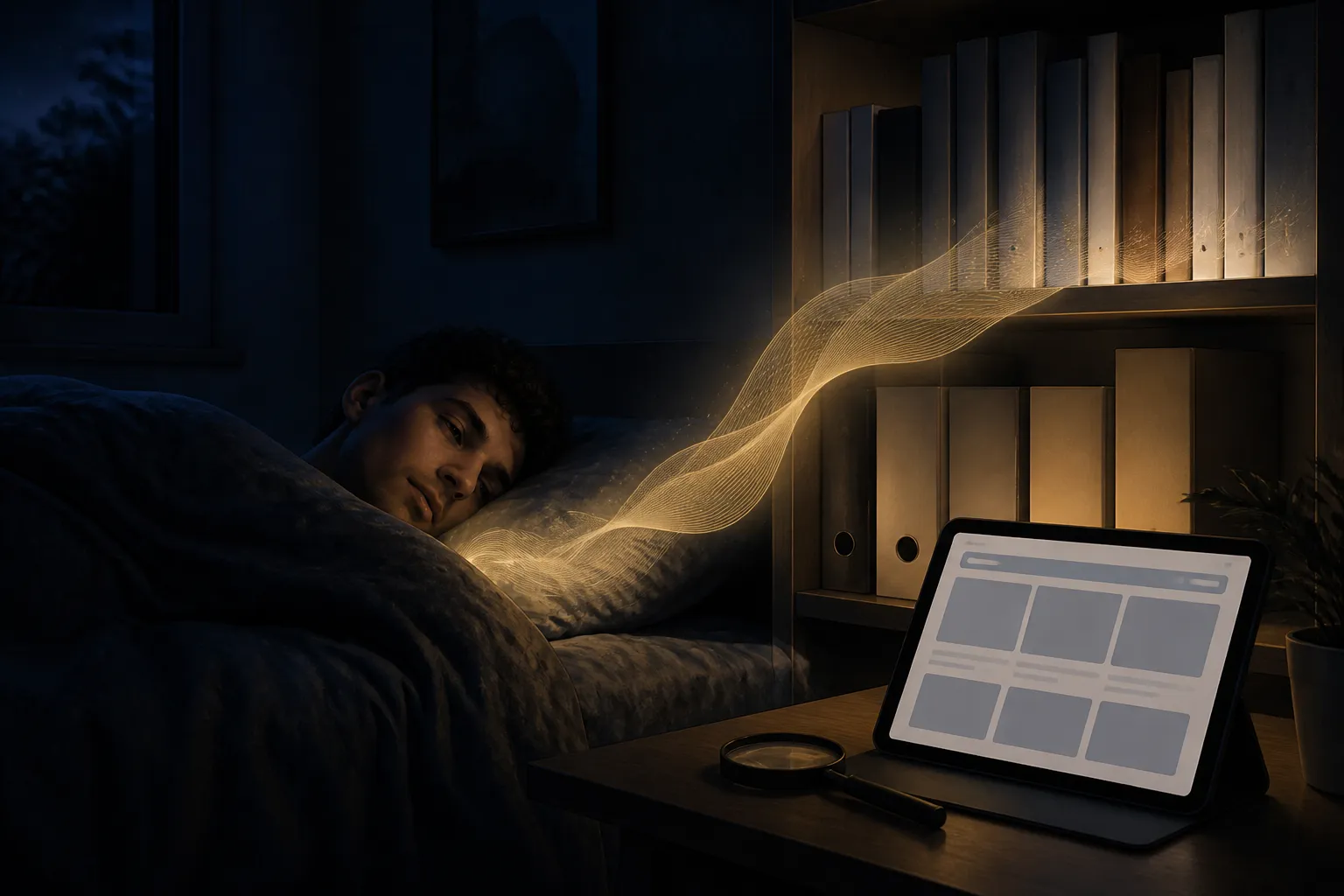
Every night, while you sleep, your brain does some quiet housekeeping. Researchers think the deepest stage of non-REM sleep, called slow-wave sleep, helps turn the day's experiences into lasting memories. The evidence is growing. It also comes mostly from rodents and from human brain tissue studied in a lab. This piece walks through what those studies found and where the limits are.
What Slow-Wave Sleep Looks Like in the Brain
Slow-wave sleep is a deep phase of non-REM sleep. Its signature is a slow rhythm. Voltage in many neurons rises and falls together about once per second, and an EEG can pick it up [4][5]. Scientists have linked these slow oscillations in the cortex to memory formation for nearly 20 years. How they did it stayed unclear [4].
A Nature Communications study from December 2024 went after the mechanism. The team used intact neocortical tissue from 45 patients who were undergoing neurosurgery for epilepsy or a brain tumor. They simulated slow-wave voltage swings in the tissue and measured how nerve cells responded [4][5]. Synapses worked most efficiently right after a voltage rise in the slow oscillation [5]. Slow waves appear to make neocortical neurons especially receptive to new information by changing the strength of synaptic connections [4][5].
The Overnight Handoff From Hippocampus to Neocortex
The leading idea is a handoff. Experts believe the brain replays the day's events during sleep. That replay moves information from the hippocampus, which handles newer memories, to the neocortex, which holds long-term ones [4][5]. Replay repeats daytime firing patterns and strengthens the connections that make a memory stick [3].
One detail helps here. During non-REM sleep, hippocampal neurons fire short bursts called sharp-wave ripples. These bursts are considered essential for memory consolidation [2]. Think of them as the moments when the filing actually happens.

BARRs: The Reset After the Filing
A Science paper published on 16 August 2024 described a newly identified kind of hippocampal activity. The team called it BARRs. These are long barrages of action potentials from a subset of CA2 pyramidal cells during non-REM sleep [2][3].
BARRs seem to rebalance the hippocampal network after consolidation. In the study, CA1 neurons that had ramped up during learning were inhibited by BARRs. When researchers disrupted BARRs after learning, memory performance dropped in mice and rats [2]. The team used electrodes and optogenetics, which means switching groups of genetically modified neurons on or off with light [3].
The lesson is about balance. Too little reactivation of memory cells can cause problems. So can too much [2]. The reset appears to clear the hippocampus so it can take in new learning [2][3]. Researcher Oliva has noted that people spend about a third of their lives asleep [3]. That is a lot of time for this work.
What We Still Do Not Know
Be careful with the leap from lab to bedroom. The BARRs work used mice and rats [2][3]. The slow-wave work used human tissue outside the body [4]. None of this shows that a given habit will improve your memory at home. Whether the benefits hold in healthy people sleeping normally remains an open question [2][3][4].
Researchers also report that boosting slow-wave sleep from outside improved memory. The findings might help refine electrical or acoustic stimulation for conditions like mild cognitive impairment [4][5]. The clinical status and safety of those techniques were not covered in the sources I reviewed. The same goes for practical advice on increasing slow-wave sleep through habits. The Sleep Foundation's NREM page was the one source meant to cover the stages, but the captured text held only navigation and product ads [1].
Questions Worth Asking Next
Two questions follow from the research. Do these animal and tissue findings apply to healthy people sleeping at home? And which brain-stimulation approaches are being tested to enhance slow-wave sleep, and at what stage [2][3][4][5]? The effects of disrupted or short sleep on consolidation also deserve a closer look [2][3].
For now, the story is promising and incomplete. Slow waves and ripples appear to prepare the brain to store memories. BARRs appear to tidy up afterward. Treat any claim that goes further, especially one that sells you something, with some caution.
- Slow oscillations make neurons more receptive to new information [4][5].
- Sharp-wave ripples support consolidation [2].
- BARRs help reset the hippocampus [2][3].