mind training
Six Tiles, Zero Mercy: What the Anagram Vault Taught Me About Letters
A quick tour of how word finders build their lists, why their counts disagree, and how to use VAULTS as a daily puzzle without embarrassing yourself.
Tony4 min read


I have built companies out of scrambled ideas, so a scrambled word hardly rattles me. Still, the Anagram Vault is a tidy little toy. Feed it a handful of letters, usually VAULT or VAULTS, and it coughs up every word those letters can build. I find that delightful. You may find it humbling. Both reactions are reasonable.
The challenge: take the letters V, A, U, L, T, S. Find the six-letter word that uses all of them. Then find as many shorter words as you can before you peek at any list. A five-letter word counts. So does a four-letter one. Pride counts double.
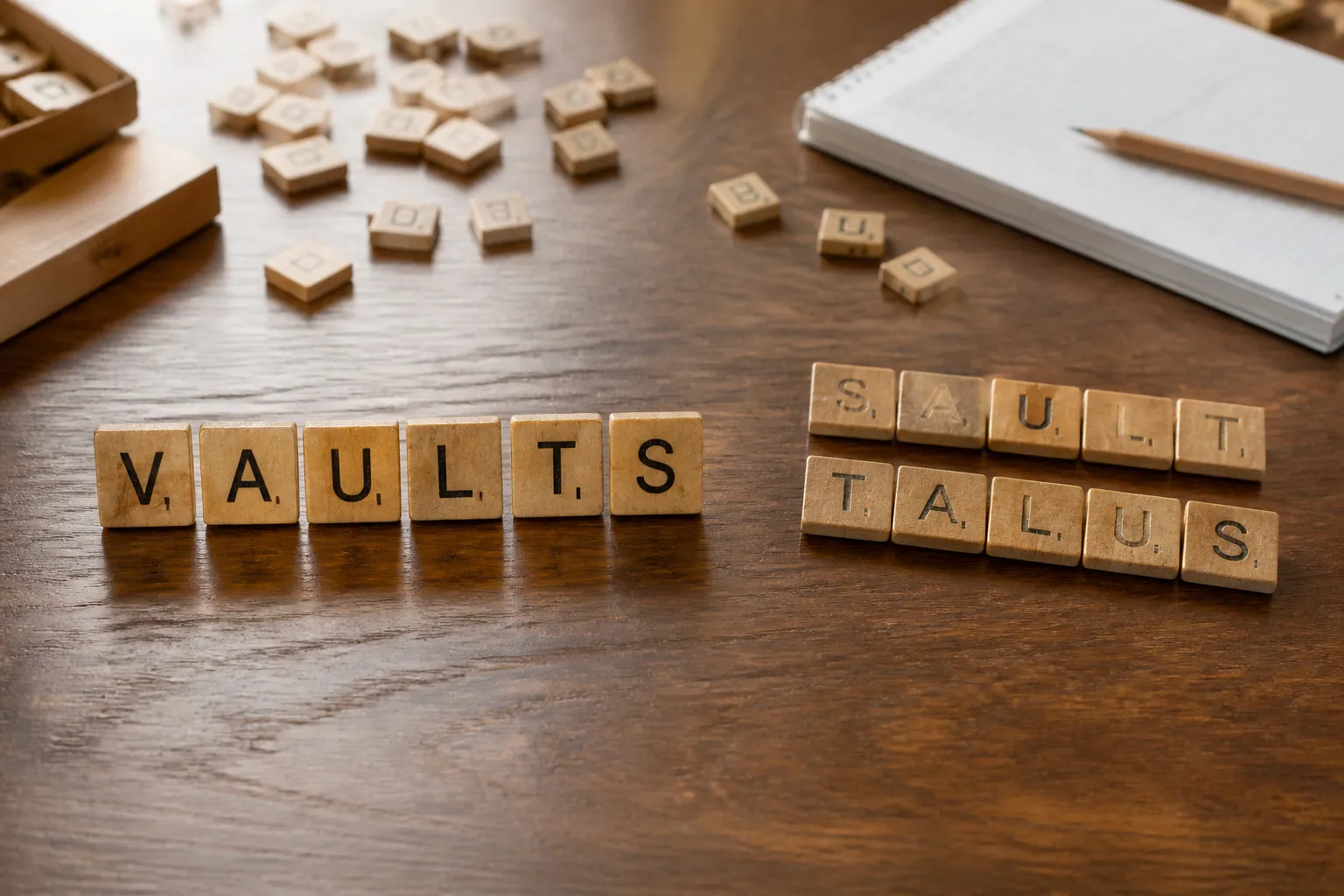
What an anagram vault actually holds
Here, a vault is a word-finder page built around one set of letters. You enter them, and it returns every valid word it can make from some or all of them. The pages I looked at, such as Unscramblex and UnscrambleWords.net, agree on the idea even when they disagree on the numbers.
The word itself is simple. An anagram rearranges the letters of a word or phrase into a new one. The Internet Anagram Server offers the classics: Dormitory becomes Dirty Room, and Listen becomes Silent. Same letters, two meanings, and the solver has to spot the hidden twin. That is exactly why it works as brain training.
How a word finder builds its list
The mechanics are not exotic. The tool takes your letters, checks combinations against a word list, and sorts the hits by length. A five-letter result like SAULT or TALUS sits apart from a six-letter result like VAULTS. It does not need every letter, which is why a VAULTS list includes shorter words too, as the Unscramblex page shows.
Some finders go further and show words made by adding one letter or swapping one tile. For a puzzle designer, that is a gift. Finish one word, and you are pointed at the next rack without starting from zero.
Why the counts disagree
Here is where amateurs get bamboozled. One finder lists 51 valid words for VAULTS. Another lists 49. A third gives 18 for VAULT, a different input, so that one is not even a fair fight. The gaps come from different word lists and different rules on plurals and odd forms.
The practical lesson: check which dictionary a tool uses before you crown its count as truth. Some pages say they follow Scrabble or Words With Friends lists, and those differ in scope. They also call themselves unofficial and for entertainment only. Believe them.
The tile game behind the word
Anagrams is also a tile game. Players rearrange letter tiles into words, often building on words already on the table. According to Wikipedia, it first appeared in 1877 as Word Making and Taking by Charles Hammett. Rules vary from table to table, because it was never standardized.
Tiles are shuffled face-down and flipped one at a time. You either build from your own tiles or steal a word already played. Spotting that a longer word hides inside what is on the table is the same trick the vault trains. I enjoy stealing things. Legally.
Using the vault for short daily puzzles
Decide first whether your puzzle wants one target word or any valid word. The sources show both styles. Pick one and say so, or you will annoy the clever player who finds a legitimate word you did not expect.
Scoring is the second choice. In Scrabble, VAULTS is worth 9 points, the top scorer from those letters per the same finder, and VAULT is worth 8. Use tile values if you want to reward rules nerds. Count words found if you want simplicity. State the rule plainly either way.
Think you have it?
Pause. Cover the answer below. Try the six-letter word, then hunt for SAULT, TALUS and friends. Go on. I will wait, though my time is more expensive than yours.
The answer, and the cautions
The six-letter answer is VAULTS, which uses every tile. Five-letter finds include VAULT, SAULT, TALUS, ULVAS and VATUS, all listed on the Unscramblex page. If you found three or more unaided, acceptable. If you found them all, you may borrow a sliver of my confidence.
A few cautions. Many of these pages bury their lists under navigation links and ads for other tools. Ignore the clutter. The sources also say nothing on scheduling daily puzzles, grading difficulty, or solving anagrams efficiently, and there is no standard rule set for the tile game. Those are open questions. Test them yourself, preferably while losing to me.