brain power
Say It Enough and a Word Goes Strange: What Researchers Found
Repeat a word for about a minute and it can sound like noise. From a 1907 report to a 2023 Ig Nobel study, here is what the research shows, plus a one-minute spoon test to try.
Frank4 min read

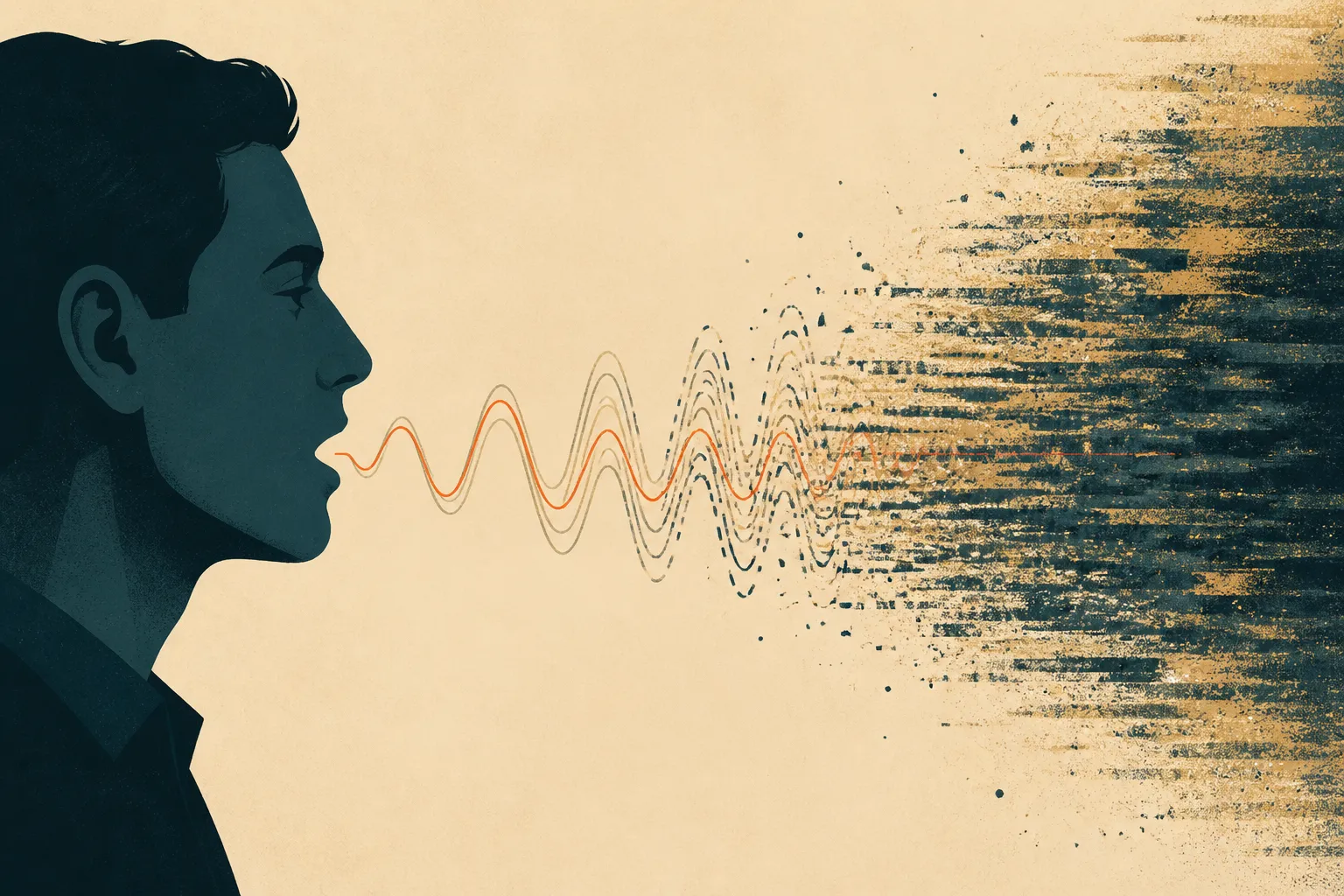
Say a word out loud. "Spoon." Spoon. Spoon. Keep going. Somewhere along the way it stops sounding like a word and starts sounding like a strange little noise your mouth is making. Psychologists call this semantic satiation, the loss of meaning of a word or phrase after it has been repeated many times. Most people have felt it. The question is what the research says about it, and how far that stretches.

An old observation with a French name
The feeling has a cousin called jamais vu, French for "never seen." It is the odd sense that something you know well looks unfamiliar or peculiar. It is the opposite of déjà vu. One overview of jamais vu traces an early version to 1907. Margaret Floy Washburn and Elizabeth Severance reported that staring at a word for several minutes could make it look strange and fragmented. They called the result a "loss of associative power."
That is a useful detail. The effect is not a recent internet curiosity. Researchers noticed it more than a century ago, and they noticed it with something as plain as a written word. The reading is also instructive. The word did not vanish. The person still knew it was a word. What changed was how it felt to meet it.
The lab version: thirty repetitions
A more recent team made the effect measurable. Chris Moulin, Nicole Bell and Akira O'Connor, with colleagues, won the 2023 Ig Nobel Prize for Literature for a paper in the journal Memory titled "The the the the induction of jamais vu in the laboratory: word alienation and semantic satiation." The University of St Andrews announcement describes the setup. Participants copied words again and again until they felt peculiar, finished the task, or had another reason to stop.
The words included common ones such as "door." They also included "the," which is a nice test because it is about as familiar as a word gets. Participants reported feeling peculiar after about 30 repetitions, or roughly one minute. Across two experiments, around two thirds of them felt it. The Substack overview adds that in the first experiment around 70 percent reported the sensation at least once.
The St Andrews account describes the feeling as a dissociative experience. You still know the word is a proper word. The subjective experience of meeting it goes "off." That fits what most of us notice at home.
What a 2024 model adds, and what it cannot
In 2024, Zhang and colleagues published a paper in Communications Biology on the mechanisms of semantic satiation, listed in the University of Birmingham research portal. They did not test people in the usual way. They built a deep learning model using continuous coupled neural networks. In the model, satiation depends on continuous learning and on switching between objects. The strength of the underlying neural coupling can make it stronger or weaker.
The authors suggest that, viewed at a mesoscopic scale, satiation may be a bottom-up process. Many psychological studies at the macroscopic level describe it as top-down. That is a hypothesis from a computer model. It is interesting, and it should be read that way.
The sources leave real gaps. They do not give full methods, sample sizes or statistical results, so the percentages above cannot be checked in detail. They do not say how long the effect lasts after the task ends. No source explains the neural basis of jamais vu in human participants beyond the model's account. One source I checked, a Frontiers paper on N400 brain responses and satiation, returned only navigation text, so nothing from it is used here.
Try it yourself: the spoon test
This is a small experiment, not a brain-training program. No source says repeated word exercises help or harm your mind, and none addresses whether the effect is safe or useful in training. Treat it as a way to notice the effect firsthand.
- Pick a common word. "Spoon" or "door" works. Try "the" on a second round.
- Start a one-minute timer.
- Say the word aloud at a steady pace, or write it again and again as the lab participants did.
- Note when it first feels odd. The lab reports put it near 30 repetitions.
- Stop and say the word once in a normal sentence. Notice how quickly it feels ordinary again.
Things to watch for. Did the word lose its meaning, or did you simply stop paying attention to it? Did "the" go strange faster or slower than "spoon"? Did you want to stop early, and why? Those last questions match gaps the research itself leaves open: whether participants had reasons to stop and how that was recorded, and whether every word behaves the same way.
You will probably feel the effect within a minute. What you can safely conclude is small. Repeating a word can make it feel strange, and that is a real, reproducible experience. Anything beyond that, such as advice on how to train memory or focus, needs its own evidence. The gap between a strange feeling and a firm conclusion is the trap. It is easy to spot once you look for it.