IQ Challenges
The Mirror Maze: Predict the Reflection, Then Fold to Check
A 2025 review of teachers' origami lessons, NRICH reflection problems and a hands-on mirror activity offer ways to practise spatial thinking. None of the sources measure how much it helps.
Tony5 min read

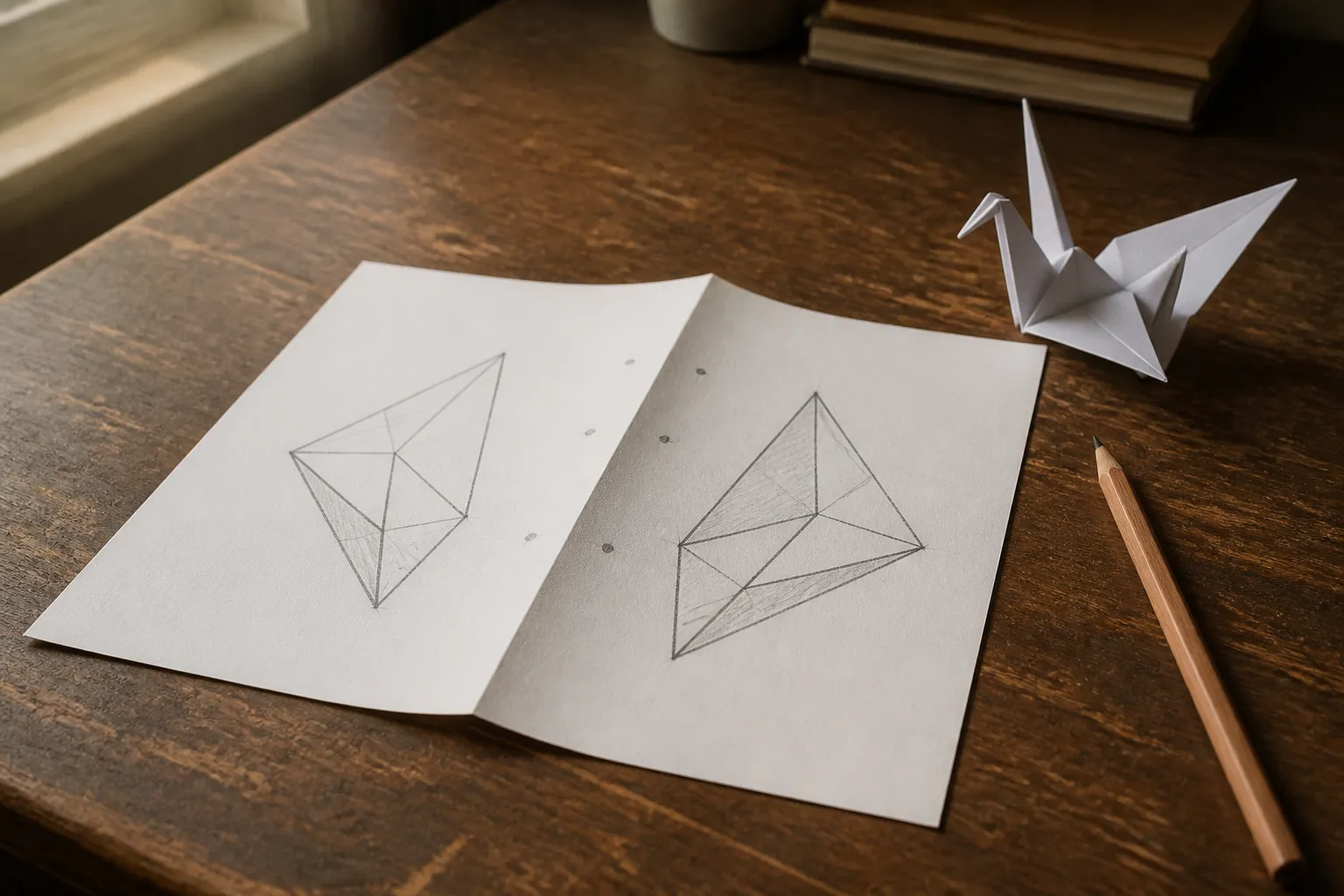
Reflection puzzles ask for one small act of nerve. You picture a shape flipped across a line, commit to an answer, and only then check it. Sometimes you are right. Sometimes the shape lands somewhere you did not expect, and that is the useful part. This piece collects a few ways in, from folded paper to online tools, plus one puzzle you can try right now.
Why predict first, then fold
The habit is simple. Predict first, verify second. Flip the shape in your head, say where the corners will land, and only then reach for the pencil or the paper. Most of us skip to checking because it feels faster. Predicting first gives the check something to prove or correct.
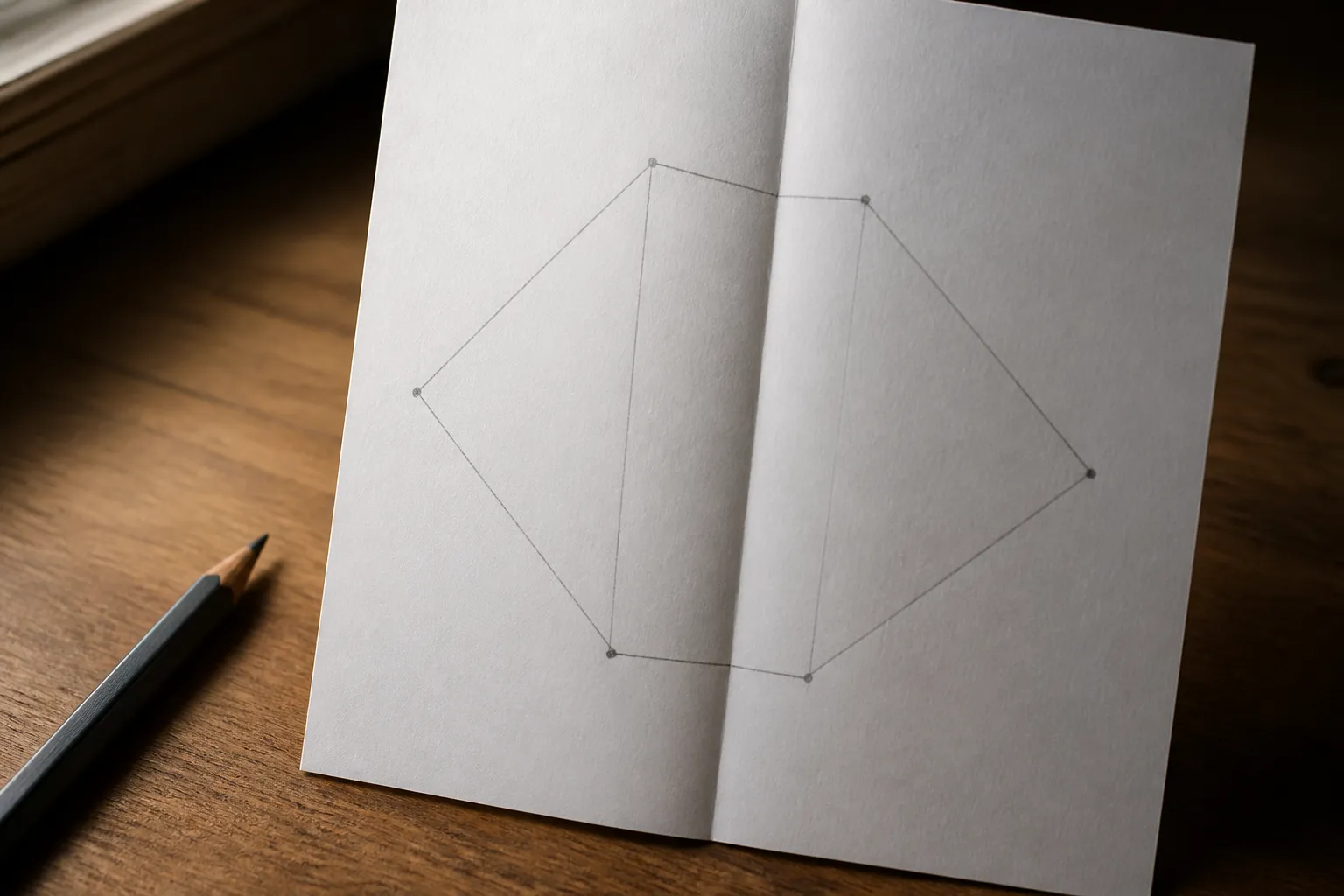
Folding gives you a physical way to check. Fold a paper shape along a line and every point on one side lands on a matching point on the other. You can see which edges meet. Fran Watson's NRICH article on paper folding describes it as a route into geometry, with benefits for both content and learning dispositions. None of the sources measure how much this sharpens spatial thinking, so treat it as a good habit to try, not a proven training method.
A puzzle to try before you read on
Grab squared paper. Draw the shape below, then draw its mirror image before you read the answer.
Puzzle: On a grid, a triangle has corners at (1, 1), (3, 1) and (1, 4). A vertical mirror line runs through x = 4. Where are the corners of the reflected triangle? Bonus: which corner of the original is closest to the mirror, and which corner of the reflection is closest to it?
Answer
Each point lands the same distance from the mirror line, on the opposite side. The line is at x = 4, so a point at x = 3 sits one unit away and its image sits one unit past the line, at x = 5. A point at x = 1 is three units away, so its image is at x = 7. Heights do not change, because the mirror is vertical.
- (1, 1) goes to (7, 1)
- (3, 1) goes to (5, 1)
- (1, 4) goes to (7, 4)
For the bonus, the corner at (3, 1) is closest to the mirror, and its image at (5, 1) is the closest corner on the other side. A quick rule falls out of this: the new x-value is 8 minus the old one. If you got the shape right but facing the wrong way, check which side your longest edge ended up on.
What classroom research says about folding
A 2025 review in the Eurasia Journal of Mathematics, Science and Technology Education looked at how secondary-school teachers use mathematical origami. The authors analyzed 45 articles written by teachers from four countries, using grounded research theory. Folding turned up across a broad range of topics, for varied reasons and learning objectives, and teachers encouraged colleagues to use it in class.
The review sorted its findings into four categories: the topics taught with folding, teachers' reasons for folding, aspects of the teaching process, and advice for teachers. Experts validated those categories. That makes it a map of what teachers do and say, not a test of what works. As summarized here, the review reports no test scores or effect sizes.
Where to find more mirror problems
NRICH keeps a page of reflection problems across several age bands. Most of the ones listed are rated challenge level 1 out of 3. "Let Us Reflect" is for ages 7 to 11 and asks where a mirror can go across a square so the whole square is still seen, and how many positions work. "Reflecting Squarely" and "Shady Symmetry" are for ages 11 to 14. "ReflectoR! RotcelfeR" is for ages 7 to 11 and sits at level 3.
"Mirror, Mirror..." is for ages 11 to 14. You reflect a flag in two parallel mirror lines, then describe the single transformation that takes the first image to the last. The questions it raises are worth chewing on. Does the order of the reflections matter? Does it matter whether the shape sits between the lines or to one side? What does the gap between the lines do to the result? Try it with the triangle above and a second mirror line, then compare the first and last triangles.
If you prefer a screen, NCTM's Mirror Tool is listed for high school. Click a shape, drag the two dots to move the green line, then press reflect. Press reflect again to undo it. It also asks whether a figure can be placed so its reflection looks exactly like the original, and for which figures that is impossible.
A mirror you can hold: the Disorientation Maze
Science World's Disorientation Maze takes 10 to 15 minutes. Partners trace a path first without a mirror, then while looking only at the reflection, and compare times. The page suggests tracing a simple shape such as a star or heart the same way.
It also corrects a common slip. A flat mirror returns an image the same size, with light bouncing back at the angle it arrived. It mainly changes which way the object faces, front to back, instead of simply swapping left and right. That is worth remembering when your predicted triangle comes out facing the wrong way. The activity page asks whether you could improve with practice. The sources do not say, so time yourself twice and see.
How to choose and what to watch for
Match the task to age and start at challenge level 1. Level 3 can wait until reflections stop surprising you. For a short session, the maze fits in 15 minutes or less. For direct work on symmetry, the Mirror Tool is the interactive option.
A few limits apply. The NRICH pages give no full solutions in the material available, so work each problem on paper first and do not assume a complete answer key exists. No source here describes a daily puzzle format or shows step-by-step folding for line symmetry, so the fold-and-check routine above is a suggestion, not a documented method. Costs and access terms for the tools were not covered either. Fold, reflect, guess boldly, and let the crease tell you how close you came.