brain power
Palindrome Pursuit: The Art of Crafting Words That Read the Same Backwards
From ancient Roman carvings to competitive online communities, the palindrome has endured for millennia as proof that strict constraints can produce genuine creative joy.
Charlie5 min read

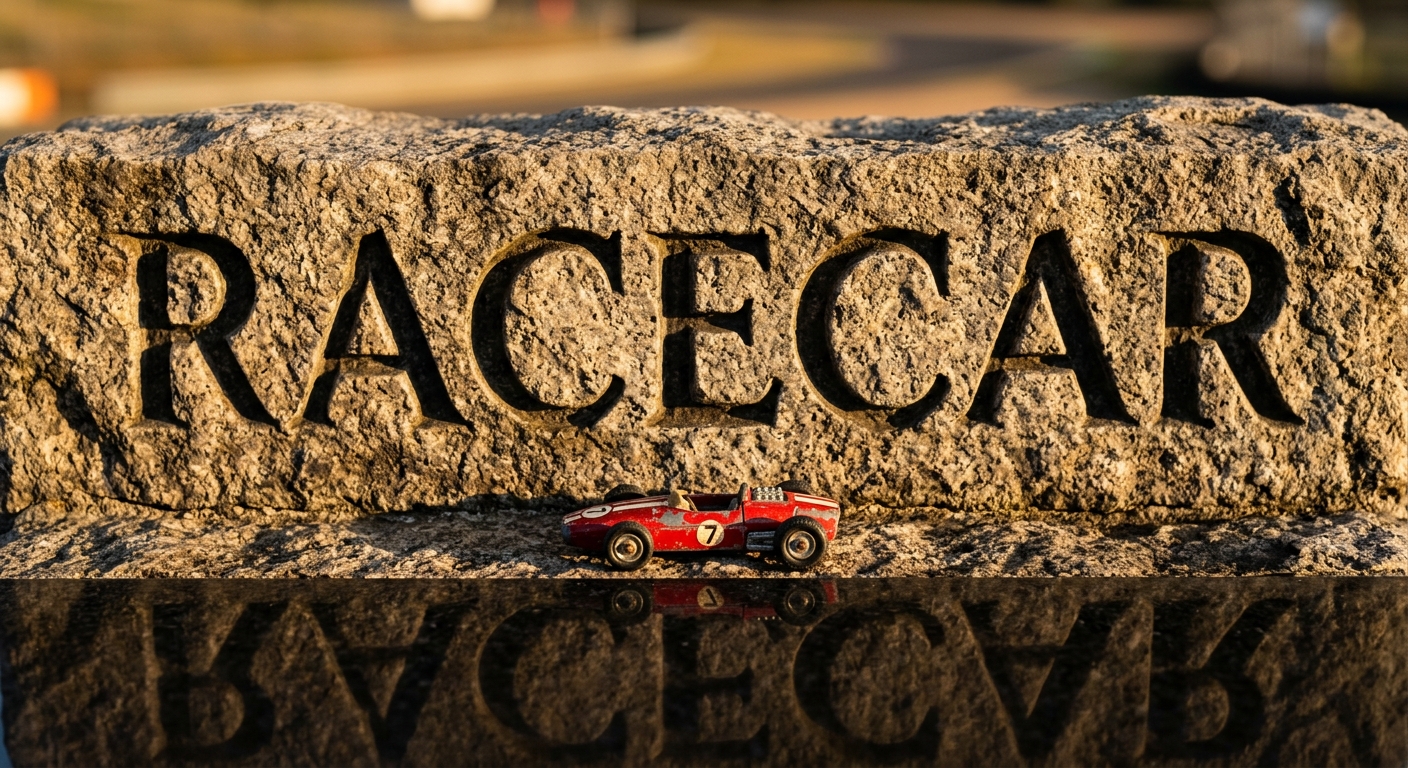
From the quick satisfaction of "level" to the complex artistry of full sentences, palindromes captivate. A palindrome is a perfectly balanced structure, a verbal mirror image that reveals something fundamental about pattern recognition in the human mind. The form derives from the Greek palindromos, meaning "running back again," and speaks to an inherent delight in symmetry. Puzzle culture writers note that the palindrome holds a unique position among wordplay forms: it generates a distinct "aha" sensation not just upon discovery, but on every re-reading, because its mirrored structure feels slightly miraculous no matter how well one understands the construction.
Try it yourself: What seven-letter palindrome names a common vehicle? It contains the letters R, A, C, E, C, A, R in some order. Read your answer the same way forwards and backwards to confirm it works.
Answer: RACECAR. Scanned left to right or right to left, every letter lands in the same position.
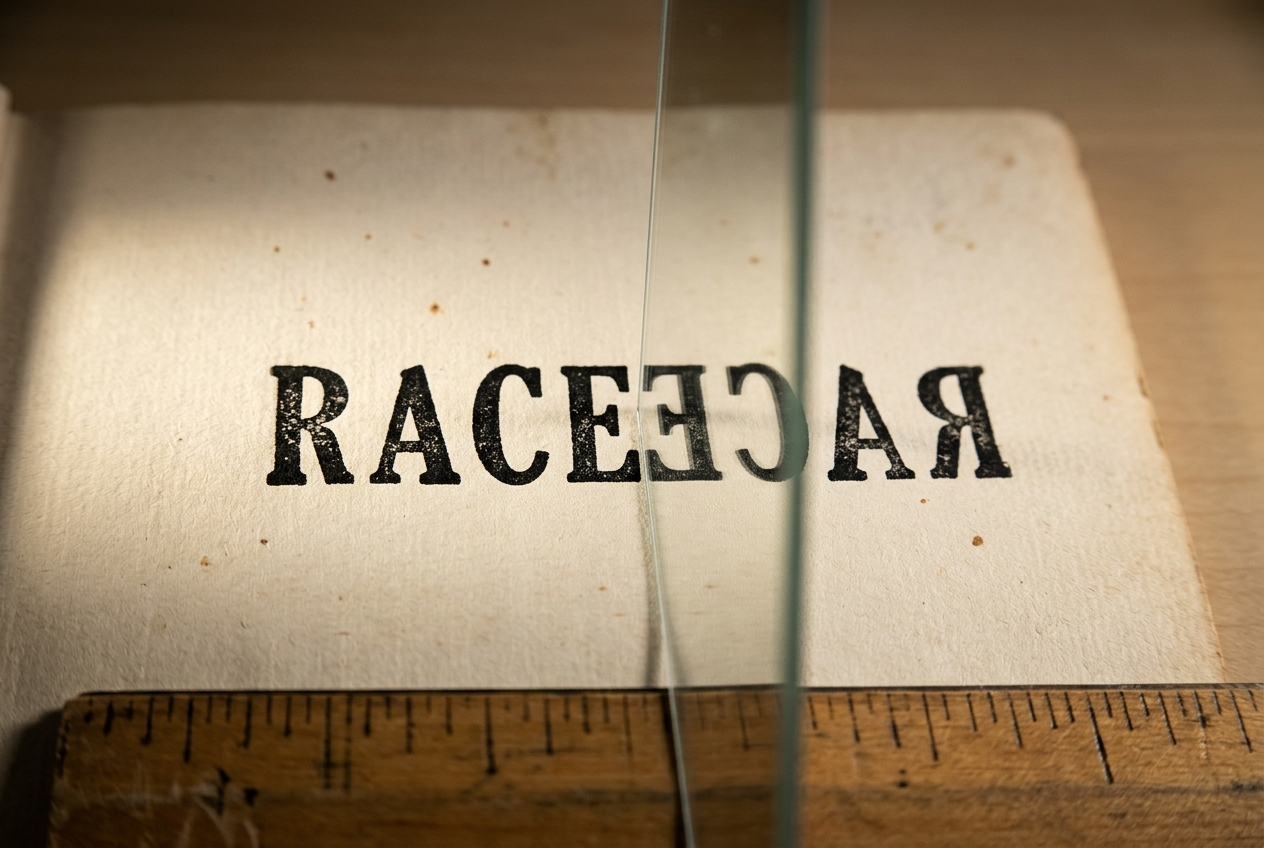
What Makes a Palindrome Tick
At its core, a palindrome is any word, phrase, or sentence that reads identically whether you scan it left to right or right to left. For longer constructions, common practice ignores spaces, punctuation, and capitalization to focus on the essential character symmetry. Simple examples like "racecar" or "kayak" are immediate. The real intellectual exercise comes in crafting multi-word phrases that remain grammatically sound while adhering to strict bilateral symmetry. As puzzle constructor and writer Wendy E notes at Cafetalk, palindromes sit alongside anagrams and semordnilaps in a broader ecosystem of language games, all of which reward patient construction and a keen eye for linguistic structure. A semordnilap, worth knowing here, is literally "palindromes" spelled backwards, and describes a word that becomes a different valid word when reversed, such as STRESSED becoming DESSERTS.
The History and Heritage of the Form
The human fascination with palindromes dates back millennia. One of the earliest and most famous examples is the Sator Square, a five-word Latin palindrome arranged in a grid, discovered carved into walls at sites across the Roman Empire. This ancient artifact functioned as a linguistic puzzle and may have held religious or talismanic significance. Throughout medieval and Renaissance Europe, crafting palindromes marked scholarly cleverness, appearing in theological texts, court poetry, and manuscript margins.
The 19th and early 20th centuries saw a surge of interest in English palindromes, fueled by newspaper puzzle columns that offered prizes and transformed the pursuit into a competitive sport for wordsmiths. Today, palindrome culture thrives online. Communities on forums and social platforms share new constructions, debate rules, and push the boundaries of length. As writer and palindrome enthusiast Tivadar Danka has noted, the form continues to attract serious practitioners who treat it as a discipline rather than a parlor trick.
Lyriahnam.com writer and poet Lyria Hnam documents a related tradition: the reversible poem, a form where the entire line order, or even letter order, can be read forwards and backwards for different effects. The most celebrated historical example is "Star Gauge," embroidered by Su Hui in fourth-century China, a 29x29 block of Chinese ideograms whose meanings can be deciphered in any direction.
Techniques and Strategies Constructors Use
Crafting effective palindromes requires a precise methodology. Experienced builders often begin by working outward from a central letter or a central pair of letters, then add symmetrical character pairs on either side. During this process, they constantly check that the emerging string can still be parsed into real words and coherent syntax. This discipline becomes exponentially more demanding as length increases.
Constructors frequently use naturally palindromic or near-palindromic words as foundational elements. By anchoring a construction around words that are already internally symmetrical, they reduce the balancing act required for surrounding material. For very long palindromes, digital tools and custom scripts are now standard. Serious constructors write programs to search for valid word sequences meeting the symmetry constraint, though many purists still insist the final product must sound natural when spoken, not merely satisfy a mathematical condition.
PuzzCulture contributor and crossword constructor G.M. Direct has written about the additional challenge palindromes present in grid puzzles, noting that placing inherently symmetrical words in a crossword often creates letter-crossing problems because the same common letters appear at predictable intervals. The constructor must ensure only one valid solution path exists, which common palindromic letter patterns work against.
- Start from the center and build outward one character pair at a time.
- Keep a running mirror ledger tracking committed letters on each side.
- Use inherently palindromic words, such as "level" or "civic," as structural anchors.
- Test every intermediate stage aloud, not only on the page.
Palindromes Across Languages and Cultures
While English palindrome culture is well-documented, the form flourishes in Finnish, Japanese, Hebrew, and Arabic, among other languages. Each presents unique structural challenges based on morphology, script direction, and grammatical conventions. Logographic writing systems such as Chinese offer a distinct take on the constraint. Here, palindromic symmetry can operate at the character level, independent of phonology, creating works that are visually symmetric without necessarily sounding mirrored when read aloud. Su Hui's fourth-century "Star Gauge" remains the most ambitious example of this approach.
In oral and poetic traditions, some cultures developed palindromic verse forms where meaning shifted or inverted on the return reading, a device sometimes called cancrine or crab verse. This transformed a mechanical constraint into a vehicle for deliberate semantic irony. Educators are increasingly recognizing palindromes as a teaching tool, using them to sharpen students' awareness of letter patterns, spelling conventions, and the internal architecture of words.
Why Palindromes Endure as Cultural Objects
The persistence of palindromes across millennia suggests they tap into something more fundamental than cleverness. The same cognitive appetite for symmetry that makes faces, snowflakes, and architectural facades visually satisfying seems to operate in verbal symmetry as well. The palindrome maintains a sense of mild wonder at its mirrored structure, and that wonder does not diminish with familiarity.
Beyond recreation, the concept has influenced branding, graphic design, and musical composition. In molecular biology, the term "palindromic sequence" describes nucleotide sequences on DNA strands that read the same on complementary strands, illustrating how the underlying concept of mirrored pattern recognition migrates wherever structural clarity matters. Artist Hannah of Palindrome Art has built an entire illustration and stationery practice around the wordplay principle, noting that "words and illustrations play together, mixing whimsy and wordplay with a heart for repair." That sensibility, serious craft worn lightly, is exactly what the best palindrome constructors have always understood.