IQ Challenges
How to Solve a 3x3 Matrix Puzzle Without Guessing
A repeatable checklist, from listing attributes to eliminating distractors, turns a confusing grid into a short sequence of checks.
Frank4 min read

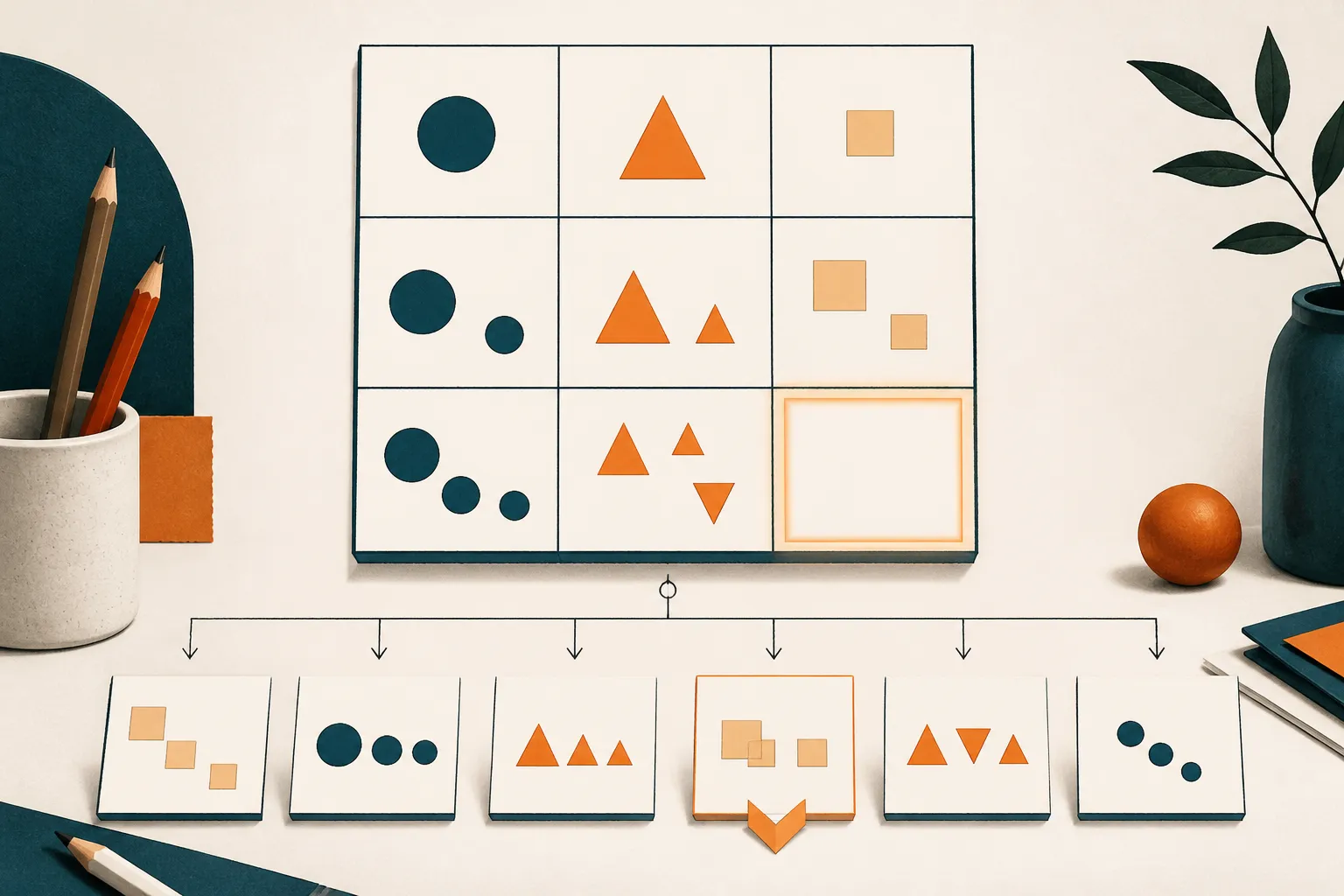
Eight boxes hold shapes. A ninth sits empty. Six answer choices wait underneath, and half of them look right. Most people pick the one that feels right. A 3x3 matrix rewards a checklist more than a hunch, and the checklist is short. This guide gives you the checklist, then a worked grid you can try yourself.
What the Puzzle Asks You to Do
A Raven's-style grid shows eight cells filled with abstract figures. The bottom-right cell is blank. You pick the option that completes the pattern. Your job is to find the rule the grid follows. Choosing a figure you happen to like is a different job, and it usually fails.
Start with one working assumption. Rows and columns usually obey the same rules. If the first row grows in size from left to right, the second and third rows probably do too. Every filled cell then becomes a check on your guess. This is general solving practice for the format, not a research finding, so treat it as a method to try.
Scan the Grid for Attributes
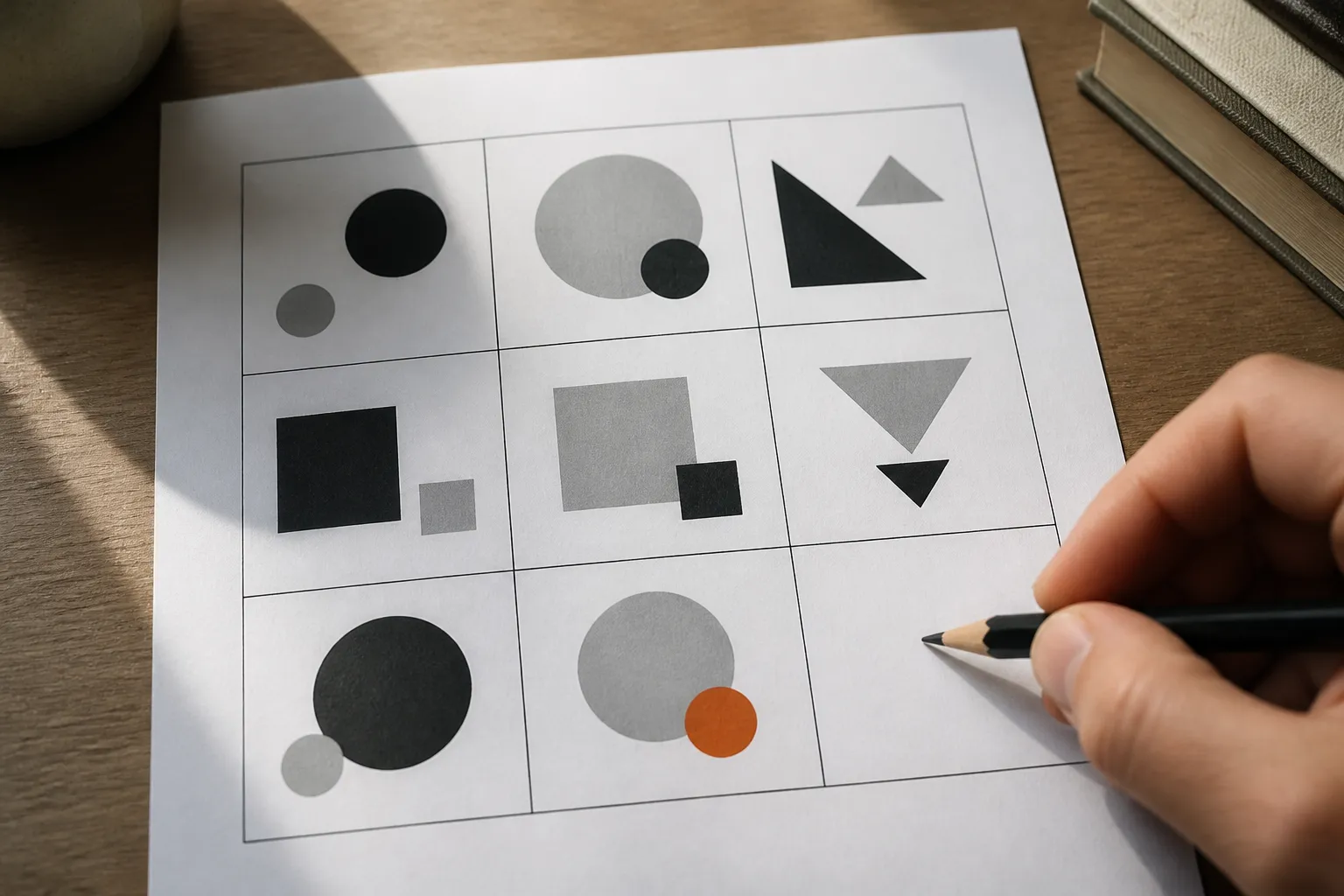
Before you test any rule, list what can change. Number of shapes. Shape type. Size. Fill or shading. Orientation. Position inside the cell. Color, if the puzzle has any. Naming these keeps you from locking onto one loud feature while a quieter one does the real work.
Read across the top row, left to right. Then compare the same attribute down the columns. For each attribute, ask whether it stays constant, goes up, goes down, rotates or cycles. Jot a shorthand such as "count +1," "fill alternates," or "shape constant." A visual puzzle turns into a list you can check line by line.
It also helps to know the common rule families. Three show up again and again:
- Progression: an attribute steps up or down by a fixed amount, like one more shape per cell.
- Constant in a row: every cell in a row shares an attribute, while the value changes from row to row.
- Distribution of three: three different values appear once each in every row, in shifting order.
Test Rules Against Every Row and Column
Now take each candidate rule and run it through all three rows and all three columns. A rule that works in row one and breaks in row two is wrong or incomplete. Let it go. Bending the grid to save a favorite idea costs more time than starting over.
Expect combined rules. Count might follow a progression while shape type stays constant in each row and shading follows a distribution of three. Test each attribute alone. Then put the verdicts together and see what they say about the blank cell.
Here is a short challenge to practice on. Read it as words, and draw it on paper if that helps.
Row 1: one small black triangle, two small black triangles, three small black triangles.
Row 2: one small black circle, two small black circles, three small black circles.
Row 3: one small black square, two small black squares, then a blank.
Which cell completes the grid? A) two black squares, B) three black squares, C) three white squares, D) three black circles, E) three large black squares.
Answer: B. Count is a progression of plus one across every row, so the blank holds three shapes. Shape type is constant within a row, and row three uses squares. Size and fill never change. Option A breaks the count. Option C changes fill. Option D changes the shape. Option E changes size. Each distractor differs from the answer by exactly one attribute.
Use Elimination Before Committing
Predict the missing figure before you study the options. Say it aloud if you can: "Three squares, small, black." That prediction protects you from a distractor that looks good for shallow reasons.
Then go option by option and cut anything that breaks a confirmed rule. Distractors are often built by changing a single attribute, as the challenge above shows. So check every attribute on each survivor, not only the one you found first. Usually one choice is left standing. If two remain, you have probably missed a rule, and the attribute list is where to look.

Make It a Habit
The routine is the same every time. List attributes. Name the rule for each. Check it against every row and column. Predict. Eliminate. It feels slow on your first few grids. It speeds up, because you stop re-reading the whole picture and start checking one feature at a time.
When you get stuck, go back to the attribute list and find the one you never wrote down. Many hard grids hide their rule in position or orientation, the two attributes people forget to check.