Brain Teasers
Four Cards, One Rule, and a Brain That Blinks
A 1966 puzzle that most people fail in seconds shows how easily logic gives way to familiarity.
Tony4 min read

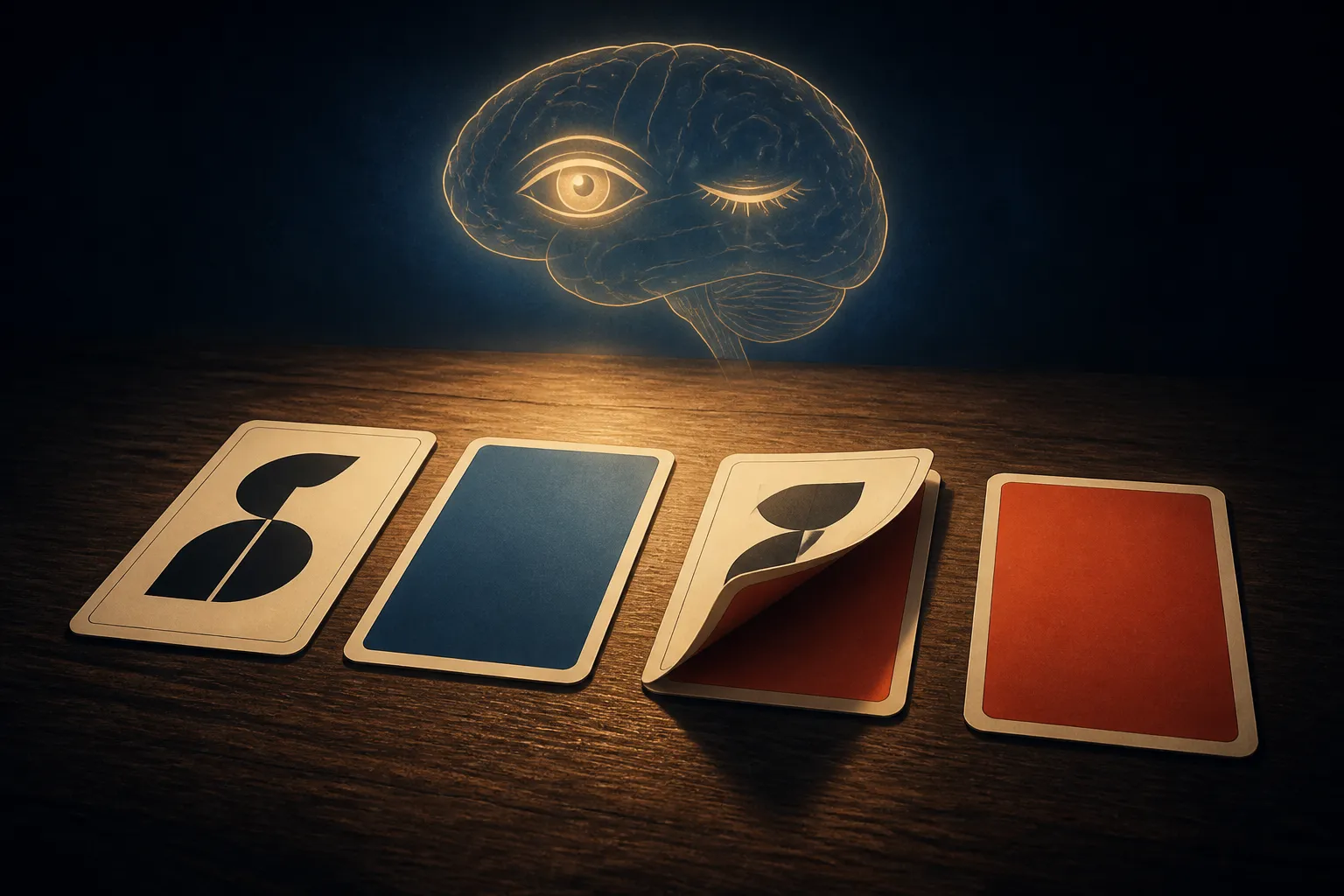
I solved this puzzle in about four seconds the first time I saw it. Most people don't. That gap is the entire reason a 1966 card trick is still famous, and it is a lovely way to watch a human brain trip over its own shoelaces.
Where the puzzle comes from
The Wason selection task, also called the four-card problem, was devised by Peter Cathcart Wason in 1966. According to Wikipedia's entry on the task, it is one of the most famous experiments in the study of deductive reasoning. That is the kind of thinking where the conclusion has to follow from the premises, with no wiggle room and no vibes.
The original version used numbers (even and odd) and letters (vowels and consonants). The rules are short enough to hold in your head, which is the charm. There is no hidden complexity to blame. You can see the gap between the right answer and the popular answer in plain daylight.
The setup and the correct answer
Here is the challenge, in the version with numbers and colours.
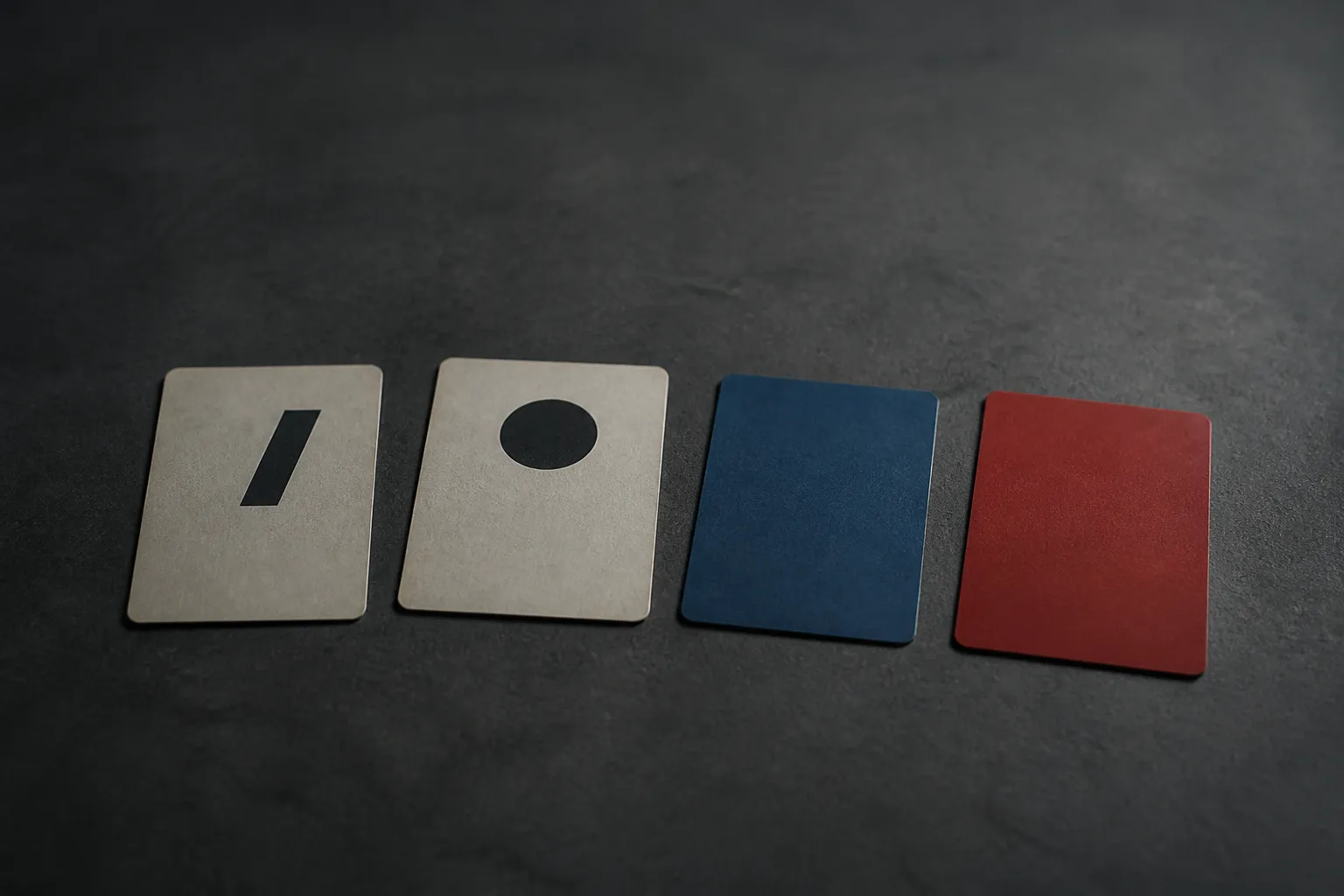
Four cards lie on a table. Each has a number on one side and a colour on the other. You can see one face of each: 3, 8, blue and red. The rule is: if a card shows an even number on one face, then its opposite face is blue. Which cards must you turn over to test whether the rule holds?
Think you have it?
Pause here. Commit to your cards. Write them down if you want to be honest with yourself, which is a habit I recommend and rarely see practised.
The answer, and why each card earns its place
Turn over the 8 and the red card. Per the same source, only a card with an even number on one face and a non-blue colour on the other can break the rule. So you hunt for exactly that combination, and only two cards could be hiding it.
The 8 must be turned. If its back is not blue, the rule is dead. That is modus ponens: even implies blue, so check the even card for blue.
The red card must be turned too. If an even number sits behind it, the rule fails. That is modus tollens, the move almost everyone forgets. Not blue means it had better not be even.
The 3 is a waste of your wrist. The rule says nothing about odd numbers, so any colour behind it is fine. The blue card is the popular trap. Whatever number is behind it, the rule survives, because the rule never claimed blue was reserved for even numbers. Picking it is the error called affirming the consequent. Name a card you didn't need, or skip one you did, and the answer is wrong. Rigid, yes. Also correct.
Why people struggle, and when they do better
People have a hard time with this task in most scenarios. Yet the same source notes they can usually solve it in certain contexts. The famous one is policing a social rule, such as checking that people follow a drinking-age law. Nobody blinks at checking the teenager's glass and the beer drinker's ID.
Why the difference? I'd love to give you the full explanation. The material I have only names the topics, including the social relations hypothesis, without giving the findings. It also offers no success rates. So I won't invent any. Same logic, friendlier costume, better scores. Draw your own conclusions about how much of your reasoning is logic and how much is familiarity.
The task in modern research
The puzzle has outlived its inventor's era. A 2026 arXiv paper, "Evaluation of Deontic Conditional Reasoning in Large Language Models: The Case of Wason's Selection Task", uses it to test large language models. Humans failed it for decades, and now machines get graded on it too.
I can only report the title. The source I have gives no methods or results, so I'll resist the urge to pretend otherwise. The task's use in classrooms, games or brain training is also outside what I can verify. What I can say is that four cards, one rule and a few seconds of honest thought still separate the careful from the confident. I'm both, naturally.