mind training
Five Suspects, One Grid: How the Elimination Method Works
A method explainer for grid-based logic puzzles, using the five-man, five-room, five-weapon Five Murders setup to show how one matching rule drives every deduction.
Tony5 min read

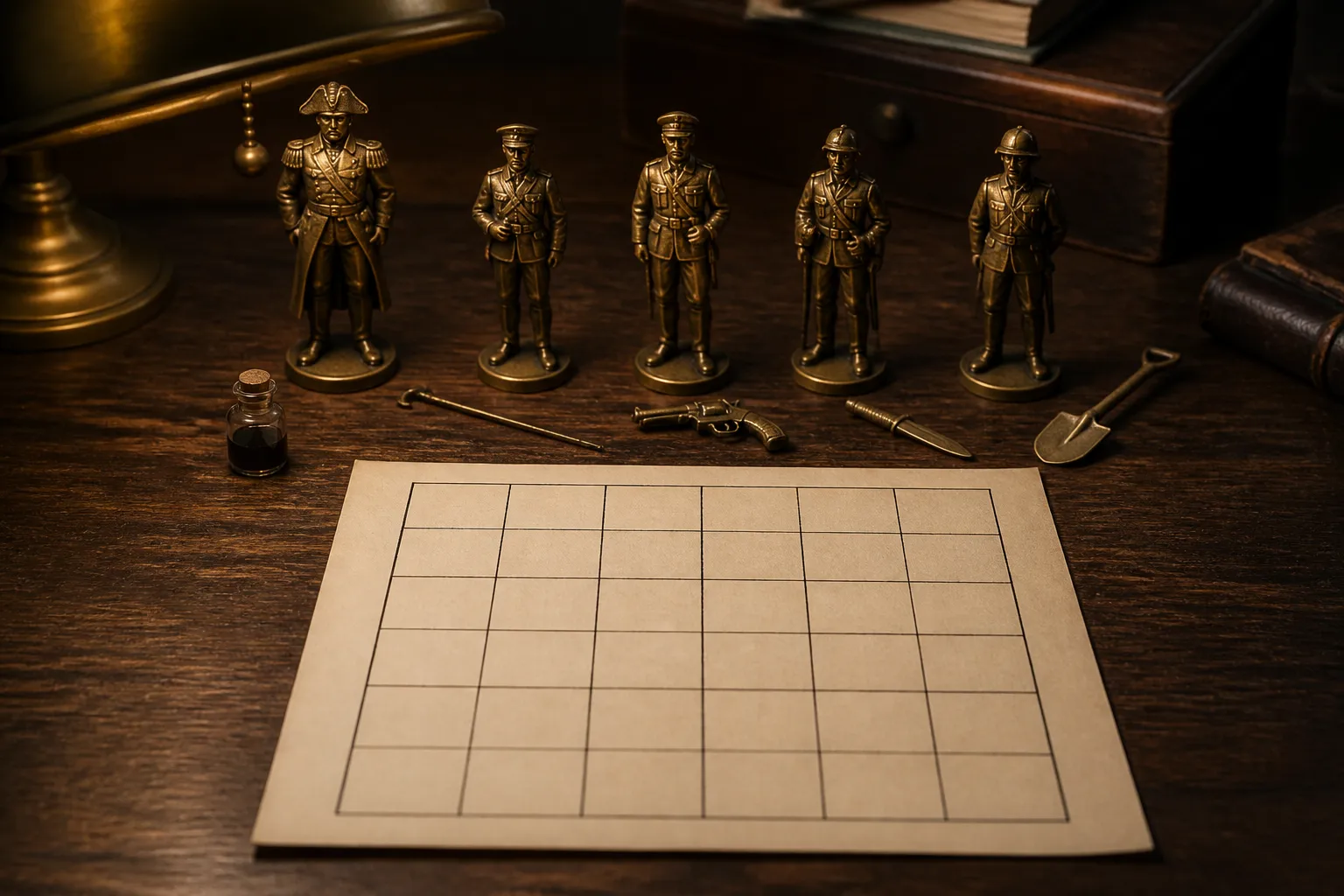
Five military men. Five rooms. Five weapons. One grid. This piece explains how to work a puzzle like that, step by step. It does not hand you the clues or the answer, and I will say why below.
What the Five Suspects puzzle sets up
The raw material is a 2020 Math Doctors post on a puzzle called "Five Murders," which the post says originally dates to 2001. The cast is a general, a captain, a lieutenant, a sergeant and a corporal. Each man is matched to a room (bedroom, basement, pantry, den or attic) and a weapon (poison, poker, gun, knife or shovel). No two men share a room or a weapon.
That gives you three attributes: man, room and weapon. The same post describes this as easier than problems with five attributes. So it is a friendly place to start. You only track two links per man.
How a grid-based logic puzzle works
The genre is simple to state. You get a story and some clues. You match items across categories by marking true and false in a grid. Brilliant's elimination grid page and the Double Helix guide both lay it out.
One rule sits underneath. Each item in one category matches one and only one item in every other category. Every deduction you make is that rule in a different form.
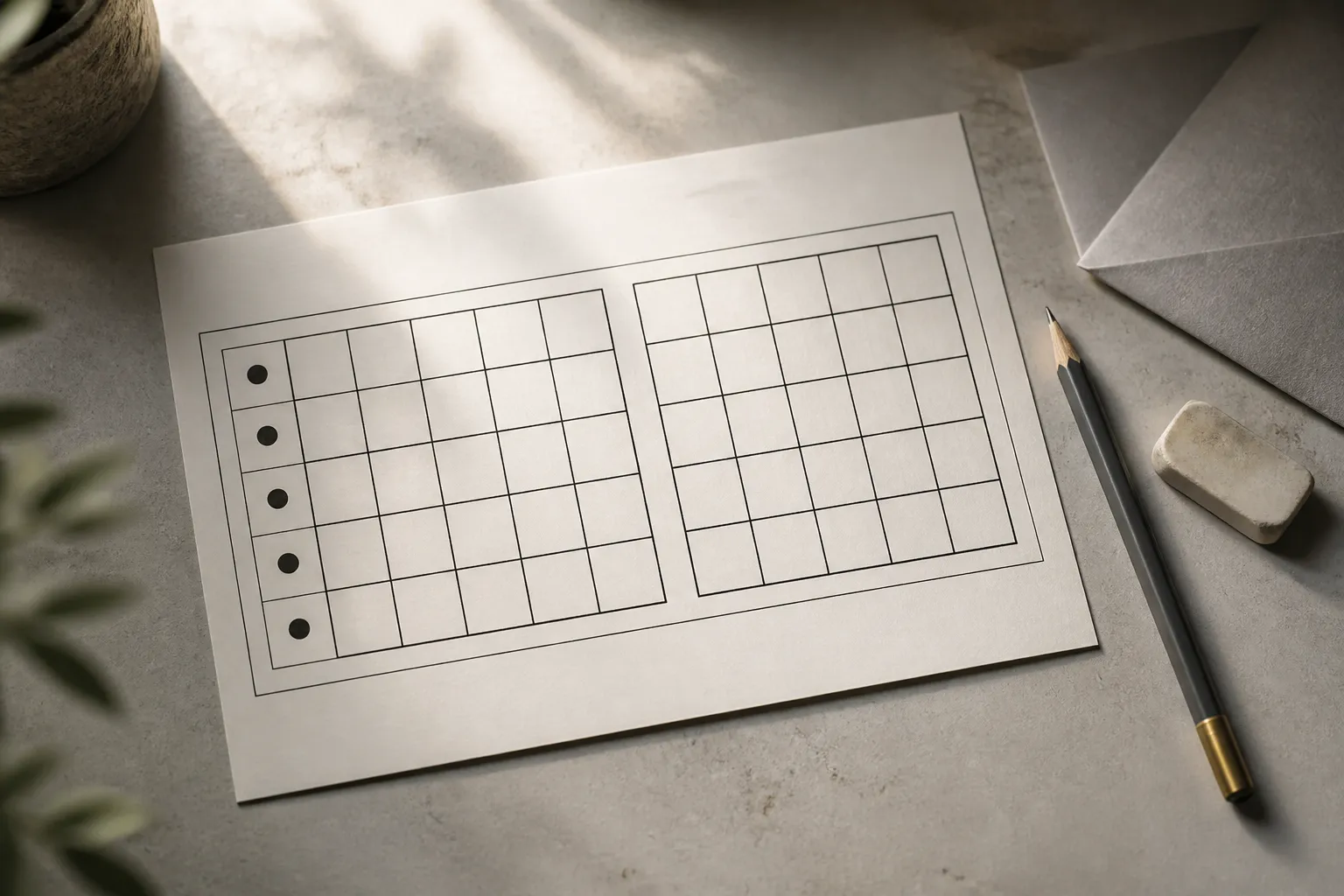
Setup is quick. Make a grid with each category as rows and columns, label the room and weapon columns, and mark an O for false statements. Then read a clue and write true or false in the matching box.
Double Helix adds two moves that carry most of the work:
- A true match makes every other box in its row and column false.
- If all but one box in a row or column of a sub-table is false, the remaining box is true.
The Double Helix example uses three friends, three vehicles and three colours. Each category has three items, so each sub-table is 3×3. The murder puzzle is the same idea scaled up to five items per category, so each sub-table is 5×5.
Choosing a clue and working through the grid
Begin with the simplest clue, the one that links two pieces of information directly. A direct link gives you a sure true box. That one box then knocks out a whole row and column of possibilities. Clever clues can wait until the grid has fewer open squares.
Negative clues do quiet work. Brilliant's examples run along the lines of "X is not a doctor" or "Y can be a doctor or a teacher." You cross out squares until only one match is left.
Here is a clue I made up to show the motion. It is not from the Five Murders puzzle:
The corporal was not in the attic, and the person in the attic did not hold the knife.
Put an O in the corporal and attic box. Now you know the attic belongs to one of the other four men. The second half ties the attic to a weapon by exclusion, so put an O in the attic and knife box. Neither mark solves anything alone. Together with later clues, they shrink the grid until a lone box is left in some row. When that happens, mark it true and clear its row and column.
As you go, ask two questions:
- Which clue gives a direct true match I can enter right now?
- Which items can a "not" clue rule out?
Those questions follow the Double Helix and Brilliant approach. Enter the sure thing. Propagate the falses. Repeat.
Choosing a puzzle for your level
Match the attribute count to your comfort. The Math Doctors post treats three attributes as easier and five as harder. If you are new to grids, start with three. Move up when the elimination moves feel automatic.
Also prefer puzzles that hand you a grid. Brilliant recommends setting one up even though nothing forces you to. A grid keeps your deductions on paper, so you are not holding a dozen maybes in your head. It also makes mistakes easy to spot, because a contradiction shows up as two true marks in one row.
If you do go grid-free on an easy puzzle, keep the rule in mind anyway. One match per item, per category. That is the check that catches slips.
What the sources leave open
A few honest limits. The sources do not give the full clue list or the full solution to Five Murders in a form I can reproduce here. So I cannot offer an answer key, and you cannot check a final answer against this article. For the actual clues, go to the Math Doctors post itself.
The sources also say nothing about how long these puzzles take or how difficulty is scored. They do not explain how to build a puzzle, or how to adapt the method for scoring in a daily brain-training game. And the Brilliant page is archived and no longer maintained, so its material may be out of date.
What you do get is a method you can use on any puzzle of this type. Build the grid. Enter the obvious. Cross out the impossible. Let the last open box tell you the answer.