brain power
Five Doors, Four Goats, and Your Stubborn Intuition
Adding two more doors to the Monty Hall puzzle makes the case for switching hard to ignore. Try the five-door challenge, then check your answer.
Tony4 min read

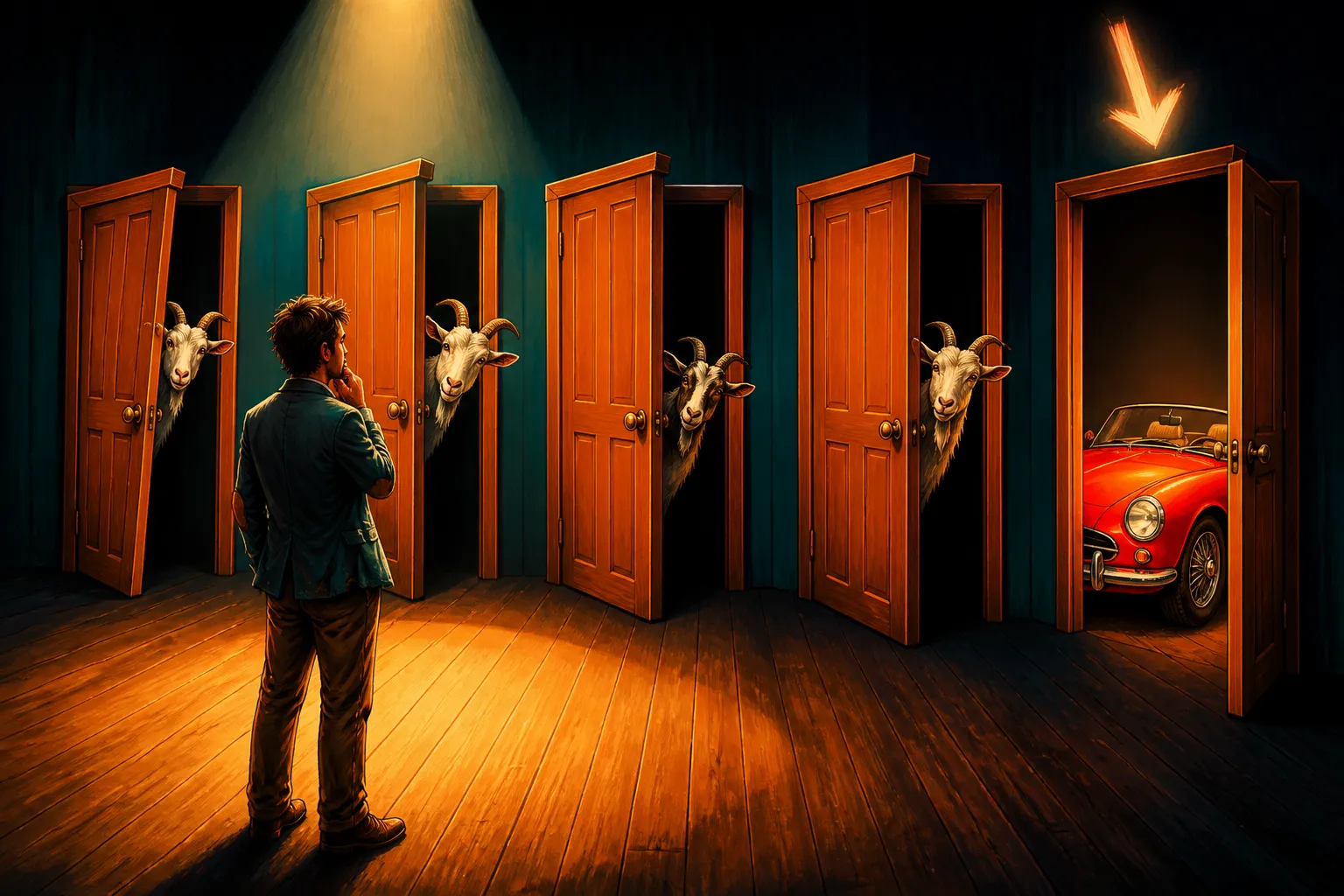
Three doors. One car. Two goats. Somehow this tiny setup has made grown adults with graduate degrees write angry letters. Today we make it worse by adding two more doors, purely to watch your intuition squirm.
The original puzzle and why it surprises
The classic version goes like this. A car sits behind one of three doors, goats behind the other two. You pick a door. The host, who knows where everything is, opens a different door to reveal a goat. Then he offers you the last unopened door. Switch or stay? Switching wins two-thirds of the time, and sticking wins one-third, per Wolfram MathWorld.
Most people say it's fifty-fifty. Two doors, one car, simple. That answer is wrong, but it feels deeply correct, which is why the puzzle has lasted so long.
The name comes from Let's Make a Deal, which Monty Hall hosted for nearly thirty years after its 1963 debut, according to Data Science Discovery. The puzzle was posed in a 1975 letter to The American Statistician and again in a 1990 Parade column. Many respondents rejected the answer, often vehemently. Paul Erdős was reportedly unconvinced until he saw an empirical demonstration, as this arXiv paper notes. If Erdős needed a demo, you may forgive yourself. Briefly.
Checking the answer
Skip the formulas and list every outcome. Under the nine-outcome sample space described by Data Science Discovery, staying wins in three of nine cases and switching wins in six. That is one-third against two-thirds.
Simulation is the second check. Play the game a few hundred times with playing cards, one ace and two other cards, and tally the results. Switching pulls ahead and stays there. Nothing cures disbelief like your own tally sheet.
Why the host's choice carries information
The whole trick is dependence. The host never opens the car door and always shows a goat, so the door he reveals depends on where the car is. That reveal is evidence. Treat the doors as independent and you throw the evidence away, which is what intuition does, as the arXiv analysis explains.
This is why the puzzle is a common way to introduce Bayesian thinking: you update your beliefs when new evidence arrives. The host is not flipping a coin. His choice leaks information, and you are allowed to use it.
Your turn: five doors
Now the fun part. Try this one before you scroll on.
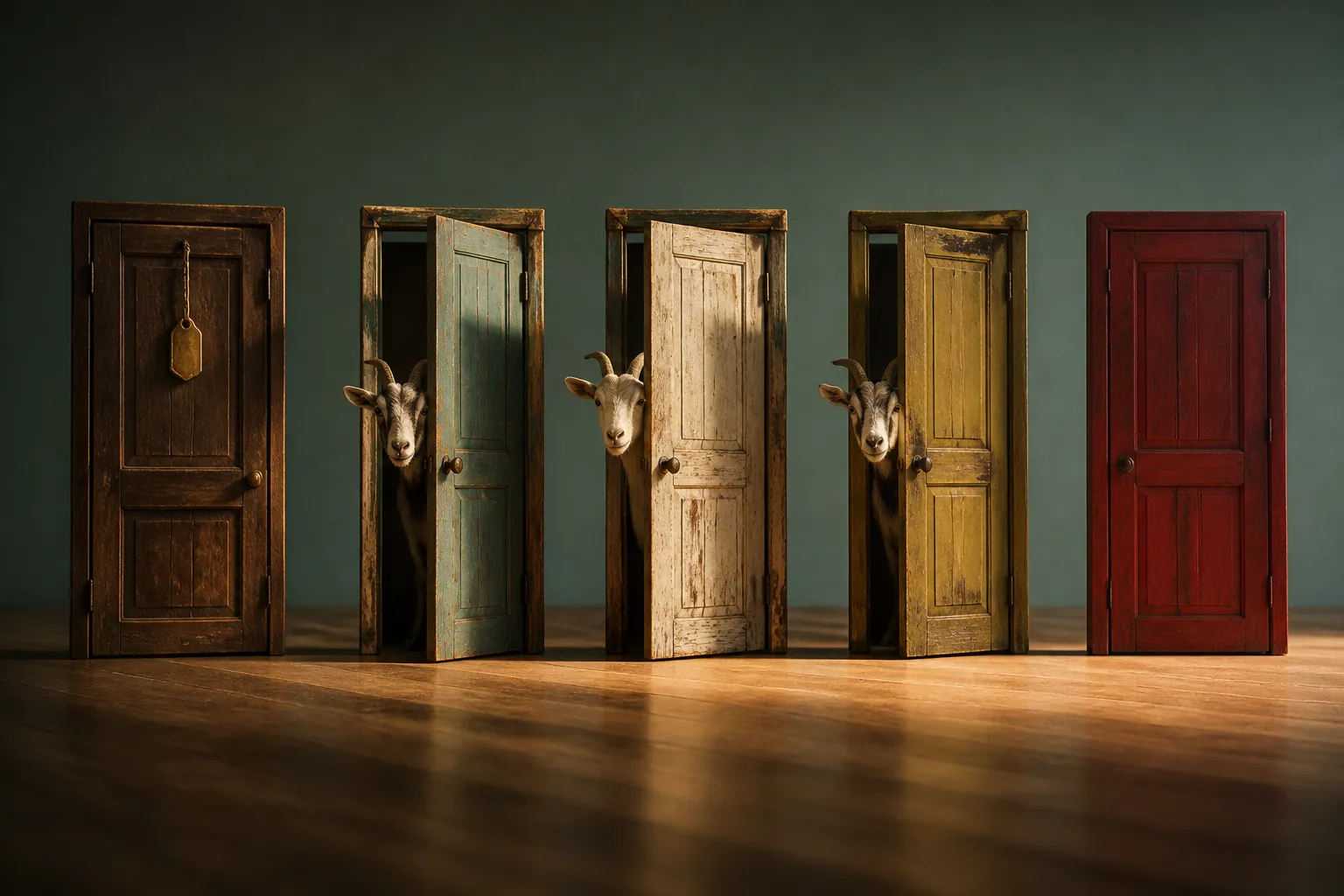
The five-door challenge. One car and four goats sit behind five doors. You pick one door. The host knows where the car is. He then opens three of the four doors you did not pick, and every one of them shows a goat. One other door stays closed. Do you stay with your first pick or switch? What are your chances either way?
Grab a pencil. Think about how likely your first pick was to be right. Then think about where the car must be if it was not.
Answer
Switch. Switching wins four times in five. Staying wins one time in five.
Here is why. Your first pick has a one-in-five chance of hiding the car, and nothing the host does changes that. He always opens three goat doors from the four you did not pick. So if your first pick was wrong, the car is behind one of the other four doors. Three of those get opened to goats, which leaves the car behind the one remaining closed door. Switching therefore wins whenever your first pick was wrong, and that happens four times in five.
This is the same logic as the three-door game with the dial turned up. I worked out the five-door numbers myself from that logic, and the sources I used do not cover this exact version. You can check it with the card tally from earlier, using one ace and four other cards.
Notice how the five-door version kills the fifty-fifty instinct. Two closed doors remain, yet hardly anyone believes your door is as good as the other one. That gap is the lesson.
What happens with more reveals
Researchers have studied other versions. In a four-door game with one car, the host opens one goat door and later a second. MathWorld lists the winning chances for four strategies. Pick, stick, then switch wins 6 in 8, the best of the four. Pick, switch, then switch wins 5 in 8. The plain advice for that version is to stick until the last choice, then switch, per MathWorld.
Gnedin's paper, The Doors, looks at the classical and multi-door versions and stresses dominance. It shows that always switching is optimal for a nonuniform prize allocation and an arbitrary door-revealing mechanism, when the first pick matches the prize. That is a narrower claim than "switching always wins," and the details are technical.
The takeaway for your own games is simple. Ask how the host chooses what to reveal. If his choice depends on the car, it is evidence, and the answer can move a lot.