IQ Challenges
How to Spot the Rule-Breaker in a Figural Progression
Work through an original five-panel puzzle, then follow the steps that find the rule and the one panel that breaks it.
Charlie4 min read

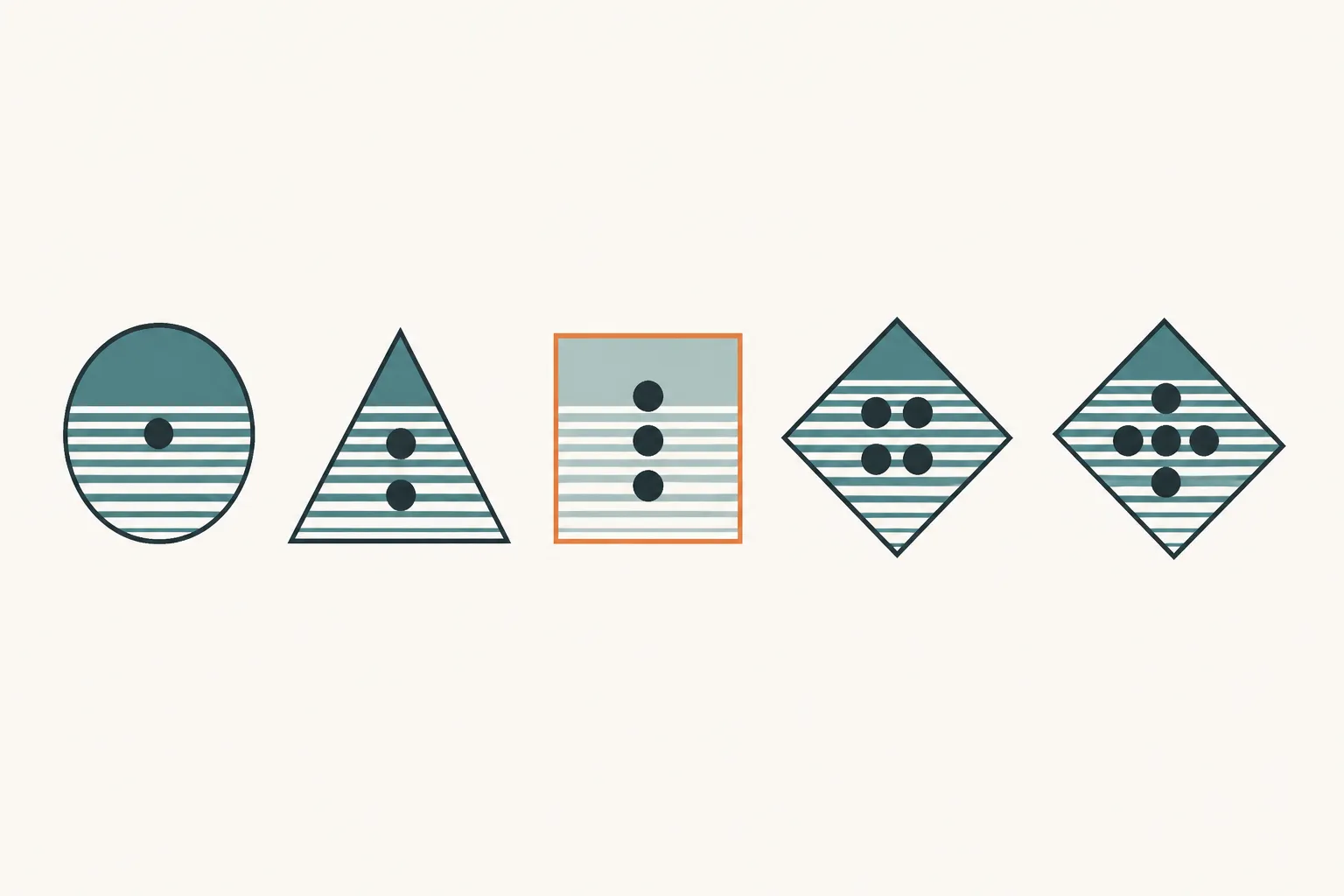
A figural progression gives you a row of shapes and one job. Find the rule that links them, then find the panel that ignores it. Start with the rule. A panel is only an oddball once you know what the others are doing.
Abstract reasoning items like this use shapes and patterns with no reading required, which is why they are often described as a low-language way to test reasoning about new problems [3]. The puzzle below is our own original example. It is not taken from any of the sources cited here.
Start With the Rule, Not the Oddball
Common pattern types include rotation, colour or fill alternation, size progression, count changes, position shifts, and added or removed features [2]. Real items often stack two or more of these at once. One EPSO practice guide says you need to identify all of them to pick the right answer [2].
So do not hunt for the strangest shape. The strangest shape is often a legitimate step in the sequence. Read the whole row first. Pick the most obvious change and write it down in plain words. Then look for a second change running underneath it.
The same guide suggests scanning all the panels before you fix on one element [2]. That habit stops you from building a rule out of two panels and then defending it too long.
The Challenge
Try this one before you read on. Every panel contains a single triangle with some dots inside it.
Panel 1: triangle pointing up, 1 dot.
Panel 2: triangle pointing right, 2 dots.
Panel 3: triangle pointing down, 3 dots.
Panel 4: triangle pointing left, 5 dots.
Panel 5: triangle pointing up, 5 dots.Question: Which panel breaks the rule?
Give yourself about a minute. That is the pace of a timed test, where one EPSO format allows 10 questions in 10 minutes [2]. You do not need that pressure here, but it shows why a fixed routine helps.
Answer and Worked Steps
Answer: Panel 4. It has 5 dots where the count rule calls for 4. Here is the path to that answer.
- Scan all five panels without judging any of them.
- Take the loudest change first. The dots go 1, 2, 3, then 5, 5. The first three suggest plus one per panel.
- Check that rule across every panel, not just the first pair. Panel 4 should have 4 dots and has 5. Panel 5 should have 5 and does.
- Look for a second rule. The triangle points up, right, down, left, up. That is a 90 degree clockwise turn each step, and all five panels obey it.
- Compare the two rules. Rotation never fails. Count fails once, at Panel 4.
Notice the trap. Panel 5 repeats the number 5, so it looks suspicious at a glance. Under the rule it is correct. Panel 4 is the one that departs from it. Confirming a rule holds across all panels, and then testing a second element for another rule, is the order the EPSOready guide recommends [2].
Habits That Save Time
Say the rule out loud, or in your head, in one sentence. For the puzzle above it is: one more dot each panel, and a quarter turn clockwise. Then test that sentence against each panel in turn. If it fails twice, your sentence is wrong, not the puzzle.
Count carefully. Shapes can partly overlap, so a count rule is easy to misread when the pieces crowd together [2]. Touch each item once, in the same order every time.
If your puzzle comes with answer options, use them. The EPSO guide notes that comparing how the five choices differ can eliminate two or three quickly [2]. The differences between the options often point straight at the attribute the puzzle is testing.
- Name one rule before you look for a second.
- Check each rule against every panel.
- Do not trust a panel just because it looks odd.
The same guide also warns that a fixed time per item can push people into guessing, and it advises making a best guess over leaving an item blank [2].
Practice Without Overclaiming
Puzzles like this are close in spirit to formal matrix tests. Raven's 2, for example, is described by its publisher as suitable for non-verbal adults and children [4]. A daily puzzle on this site is not one of those instruments. We have no scores, norms or validity data for puzzles of this kind, so treat your result as a record of practice, not a measure of ability.
When you miss one, go back and name the attribute you overlooked. Was it fill, count, position, or turn? Keeping a short note of your usual miss is a modest habit, and it costs nothing. Then try the next puzzle with that attribute checked first.