IQ Challenges
Can You Climb All Four Rungs of This Analogy Puzzle?
Each level demands a genuinely different cognitive operation, not just a harder version of the same one.
Frank6 min read

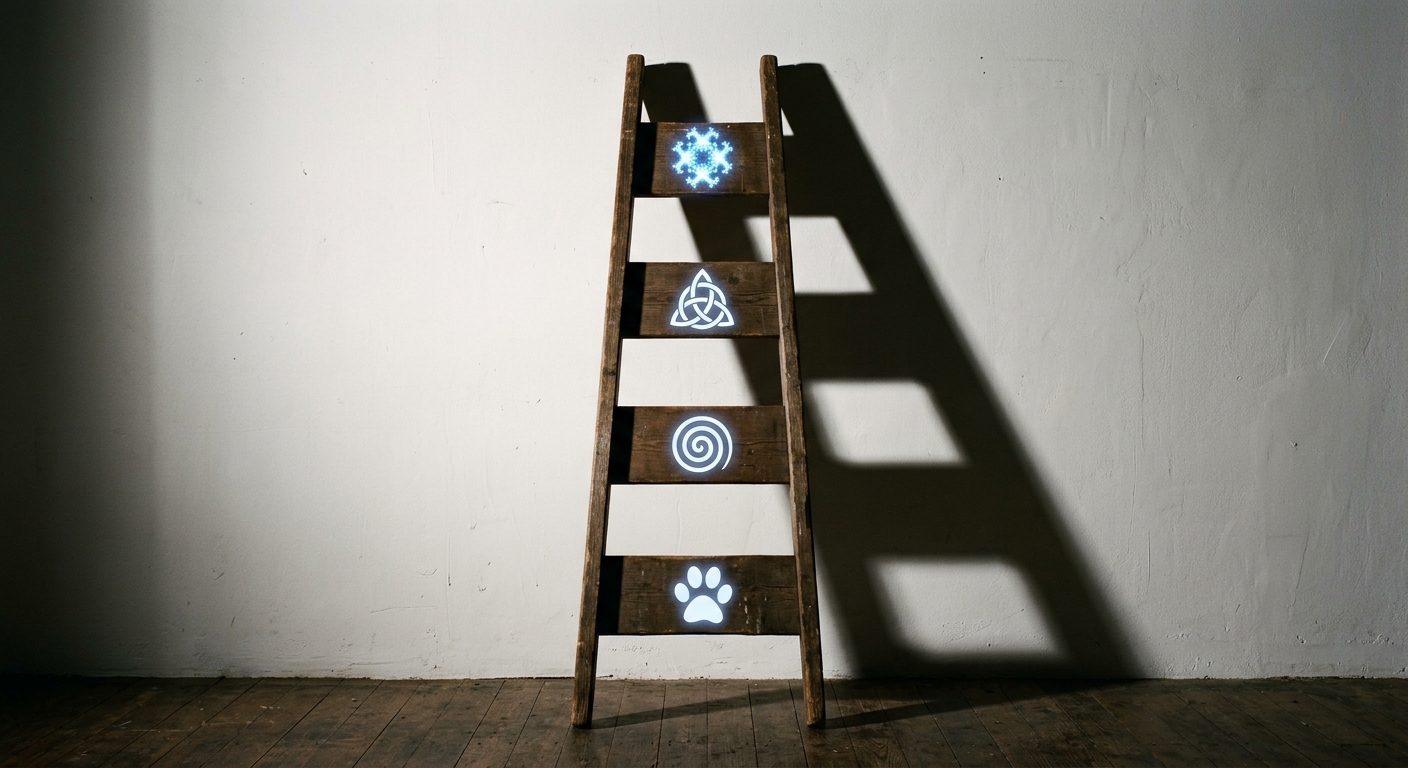
Most verbal analogy puzzles flatten out at a single level of difficulty and call it a day. This one does not. What follows is a four-rung ladder where each step demands a genuinely different cognitive operation, and the gap between rungs is not cosmetic. By the time you reach the top, you are doing something that even large language models find surprisingly hard to pull off cleanly.
Rung One: The Obvious Pair
The first rung is deliberately easy, and that is the point. Consider:
Puppy is to dog as kitten is to ___.
You solved that before you finished reading the sentence. Cognitive scientists call this the surface similarity stage, where the shared features between pairs are perceptually obvious and require almost no abstraction. It is the standard entry point in standardized verbal reasoning assessments precisely because the conceptual relationship is tight enough that only one answer is plausible.
Research into first and second language processing confirms that even learners with limited vocabulary in their non-native tongue can usually crack rung-one analogies. The form constrains the answer so completely that world knowledge barely enters the picture. The pedagogical value here is calibration, not challenge. Rung one tells the solver what the format is asking before the difficulty accelerates. Think of it as tuning the instrument before the performance.
Rung Two: The Functional Relationship
The second rung shifts from categorical membership to function:
Scalpel is to surgeon as gavel is to ___.
The answer is judge, but getting there requires a different move. You cannot match surface features and win. Scalpels and gavels are both tools, yes, but so are wrenches and staplers, and that path leads nowhere useful. The solver has to map a relational schema, specifically tool-of-agent, onto both pairs at the same time and hold it steady while testing candidates against it.
Psycholinguistic studies show that functional analogies produce measurably longer response times than categorical ones, even when participants report feeling confident. The relational mapping is computationally heavier than it feels from the inside. For puzzle designers, rung two is the workhorse of the set. It rewards solvers who press on without making anyone feel lost. Hard enough to feel satisfying, transparent enough to remain fair.
Rung Three: The Relational Reversal
Rung three is where confident solvers start making mistakes they cannot immediately explain:
Abundance is to scarcity as accelerate is to ___.
The answer is decelerate (or brake, depending on how strict you want to be about morphology). But the difficulty is not naming an opposite. Most people can do that in a second. The difficulty is verifying that the opposition maps symmetrically across both pairs, and doing that while holding two representations in working memory at the same time: the structure of the first pair and its mirror image applied to the second.
Human subjects in analogy studies frequently produce what researchers call associative intrusions at this stage. A solver blurts out a word strongly linked to one of the prompt words but breaks the relational symmetry in the process. The error is not random. It reveals the moment when associative retrieval outpaces structural checking, which is precisely what rung three is designed to surface.
There is also an interesting individual-differences story here. Some solvers approach the reversal algebraically, treating the pairs like an equation to balance. Others work imaginistically, picturing a dial being turned the other way. Rung three can be tuned to stress either strategy, which makes it a surprisingly flexible diagnostic tool for anyone building a reasoning assessment.
Rung Four: The Meta-Relational Leap
The fourth rung abandons concrete nouns almost entirely:
Hypothesis is to theory as sketch is to ___.
The answer is blueprint. Both pairs trace a trajectory from a provisional, exploratory form to a formalized, evidence-backed structure. The solver who tries to answer by surface association finds nothing to grab onto. Science and architecture share no obvious vocabulary, no overlapping domain, no perceptual similarity between a hypothesis and a sketch. The only thing that connects them is the shape of the relationship itself, a movement from tentative to confirmed.
This is what researchers call a second-order analogy, where the solver must recognize that the way the first pair relates to each other is analogous to the way the second pair relates to each other. It is a structural echo rather than a content match. Computational linguistics research has shown that even large language models trained on enormous corpora stumble disproportionately on second-order analogies. The problem is not missing world knowledge. The models know what hypotheses and blueprints are. The problem is that the relational abstraction required goes beyond pattern completion and demands something closer to structural alignment, finding congruence between two separate relational schemas rather than retrieving a memorized association.
For the human solver who does crack rung four, the experience tends to be described not as retrieval but as a sudden snap of recognition. Two separate lattices locking into place at once. That gestalt quality is part of why verbal analogy puzzles have endured for so long as a benchmark of fluid intelligence. Vocabulary size matters much less here than the ability to see structure hiding inside content, which is a skill worth practicing.
Think You Have It?
Before reading further, try working through all four rungs in sequence without stopping. Set a timer if you want to track how your response time changes between rung one and rung four. The gap is usually larger than people expect, and that gap is the whole point of building the ladder rather than handing you a single puzzle at a fixed difficulty.
The Answers and What They Reveal
Rung one: cat. Rung two: judge. Rung three: decelerate (or brake). Rung four: blueprint.
The progression matters more than any single answer. Analogy research consistently finds that performance drops sharply as relational complexity increases, even in solvers who scored well on the easier rungs. That drop is not a sign of low intelligence. It is a sign that the brain is being asked to do something genuinely different at each step, not just a harder version of the same thing. The ladder works because each rung changes the operation, not just the vocabulary.
If rung four stopped you cold, spend a minute reconstructing what the first pair is actually doing before looking at the second pair. Name the relationship in a full sentence: a hypothesis becomes a theory once evidence accumulates and the structure is formalized. Then ask whether that sentence describes what a sketch does when it becomes something else. That sentence-level translation is the move that makes second-order analogies solvable, and it is a habit worth building.